
First came the Terra collapse. Then the bankruptcies of the centralized lenders. And now the insolvency of FTX, once the second largest cryptocurrency exchange in the world. A market analysis of the exchange's own token FTT and its role during the spectacular blow-up.
FTX’s collapse has shaken the industry to its core, in part because it is a fundamentally different type of business than a crypto lender like Celsius. FTX is a cryptocurrency exchange. The service it provides is that of a facilitator of trades: they earn a transaction fee for every trade executed by one of their clients. FTX is neither a trading firm nor a lender, so theoretically, they should at all times have access to the equivalent of 100% of their client’s funds. But we now know that that was not the case due to a dangerously intertwined relationship with FTX’s sister company, the trading firm Alameda Research, and the improper use of FTX’s native cryptocurrency FTT.
Recent events around FTX
Following a mass exodus of funds, FTX halted withdrawals shortly before Sam Bankman-Fried (SBF) announced a “strategic transaction” from its competitor Binance to ensure “customers are protected.” Binance has since said that it would not go through with the deal, stating that “the issues are beyond our ability to control or help.” SBF informed investors last week that FTX would need to file for bankruptcy, with a hole of up to $10bn.
Press Release pic.twitter.com/rgxq3QSBqm
— FTX (@FTX_Official) November 11, 2022
Ironically, FTX has issued more than $750 million in credit lines to distressed crypto companies that ended up insolvent largely because they misappropriated their client funds. While we still don’t know the exact extent of the balance sheet hole, or whether an acquisition will materialize, the crypto industry has just undergone an era-defining realignment.
FTT: A cursed concoction
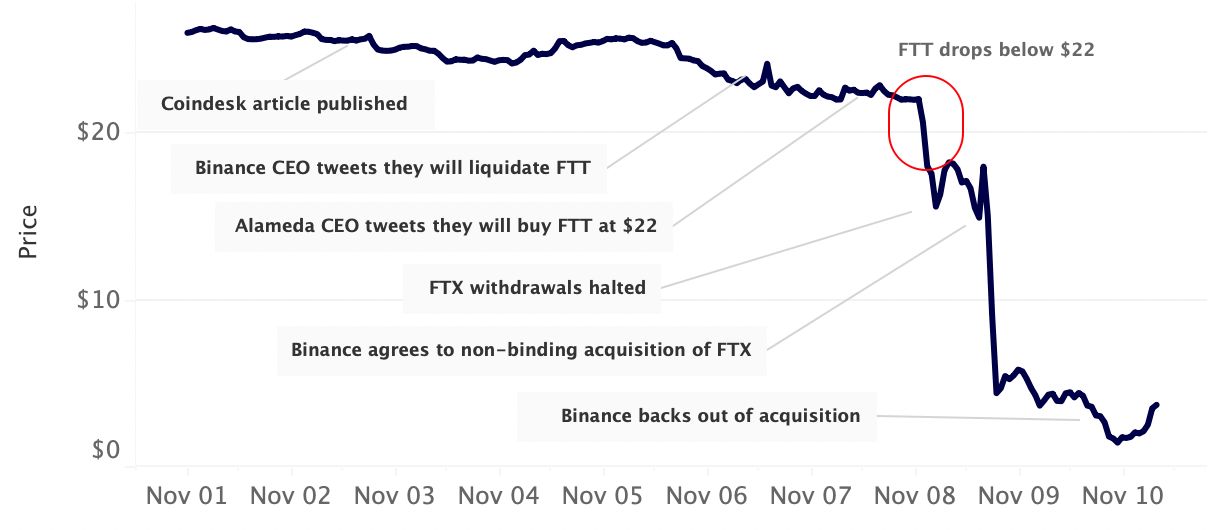
The rapid unwinding of one of the world’s largest exchanges all started with an investigative story from CoinDesk, reporting that Alameda held a significant portion of its balance sheet in FTT, a cryptocurrency created by FTX. This instantly raised questions about FTT, namely: what is its actual purpose? Cryptocurrency exchanges have long issued their own tokens, which generally have few benefits beyond giving holders discounts on trading fees, but have rarely received scrutiny. As described in FTX’s FAQ section, here is FTT’s utility:
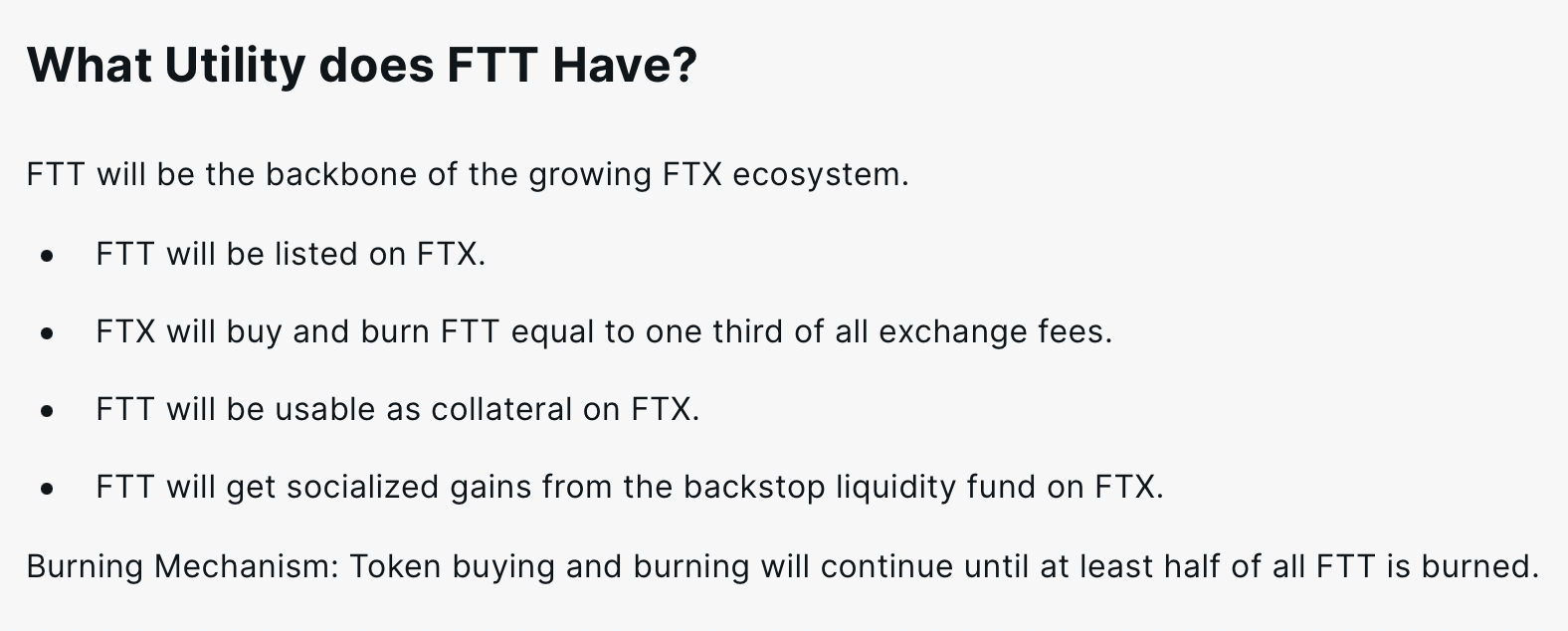
The more we learn about FTT, the more it seems that this concocted cryptocurrency underpinned a significant portion of the FTX/Alameda empire. The token has/had extremely limited utility, but it is was used extensively as collateral: in DeFi, inside FTX, and on the books of Alameda.
Alameda suffered massive losses during the May market crash along with most other cryptocurrency hedge funds, which FTX tried to repair using its own funds in exchange for FTT as collateral. A portion of these very funds belonged to their clients. The information on Alamada’s balance sheet was enough to cause Binance CEO Changpeng Zhao (CZ) to declare that Binance would liquidate all of its FTT holdings (received as part of its exit from FTX equity), which at the time was worth about $500mn. That’s when things started to unravel.




An illiquid token
FTT is a relatively illiquid token, trading actively on just 10 exchanges for a total of 23 spot markets. For comparison, BTC has ~370 spot markets, SOL ~80, and DOGE - a memecoin - more than 130. Following CZ’s tweet, Alameda CEO Caroline Ellison tweeted that her firm would buy all of Binance’s FTT at $22. If the solvency of the Alameda / FTX empire hinged on FTT, then maintaining its price was likely the number one priority.
It is unclear whether these OTC discussions progressed, but at 9:15pm UTC on November 7, FTT liquidity was quickly pulled from order books: Bitfinex's 1% bid depth dropped from nearly $2mn to under $250, while Huobi's fell from $1.5mn to just under $3k in a matter of minutes. Depth on Binance and FTX was maintained over the same time interval, which suggests that it could have been a non-Alameda market maker that decided to exit the Bitfinex and Huobi markets, perhaps after getting wind that OTC deal talks between Binance and FTX had broken down.
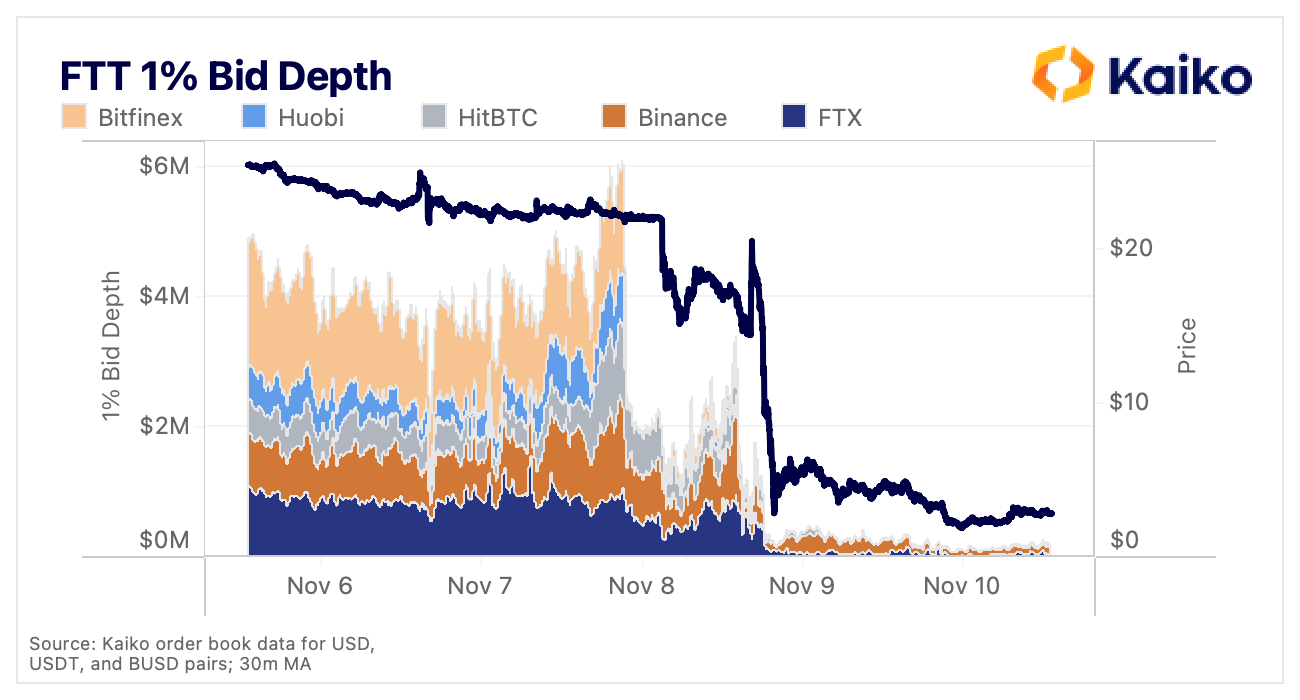
It is likely that Alameda accounted for the vast majority of market making activity for FTT, which explains why it took a few days for FTT’s price to collapse even though selling pressure had already started. On this note, there was a sharp increase in depth preceding the crash, suggesting a bid wall. But the sudden collapse in liquidity does pose questions as to why Alameda didn’t or couldn't do more to maintain bids for FTT if the future of the firm depended on maintaining its price.
The collapse of the FTT token
Five hours after liquidity collapsed, FTT’s price crashed below $22. Liquidity appeared to be improving as FTT bounced around in the $15-17 range, but again vanished ahead of the announcement that FTX would be acquired by Binance. FTT’s price increased on the news but quickly crashed below $3. Since then, FTT's 1% bid depth across all markets is hovering around $200k, and it is unclear who is still making markets at this point.
We can see just how quickly FTT liquidity collapsed by looking at price slippage. Using a simulated $50k market sell order, slippage on the two most liquid FTT pairs listed on Binance and FTX surged. By Wednesday, a $50k sell order on FTX would result in a whopping 8% price slippage as FTT’s price continued to plunge.
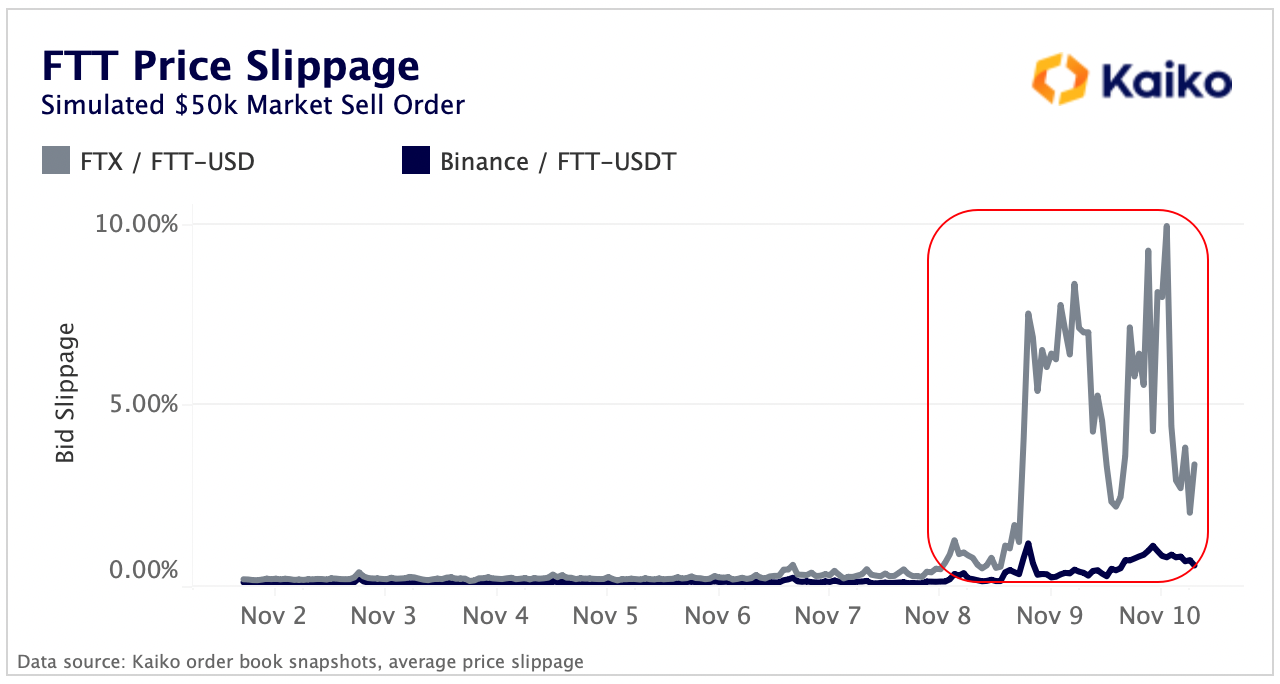
Huge market sell orders were rolling through as price was declining. Further revelations of Multicoin Capital’s exposure to FTT suggest industry participants were rapidly liquidating FTT as it slipped below $22. Typically traders will break up their orders into smaller chunks to avoid slippage, but in times of desperation, firms were taking whatever price they could get, with numerous orders larger than $100k.
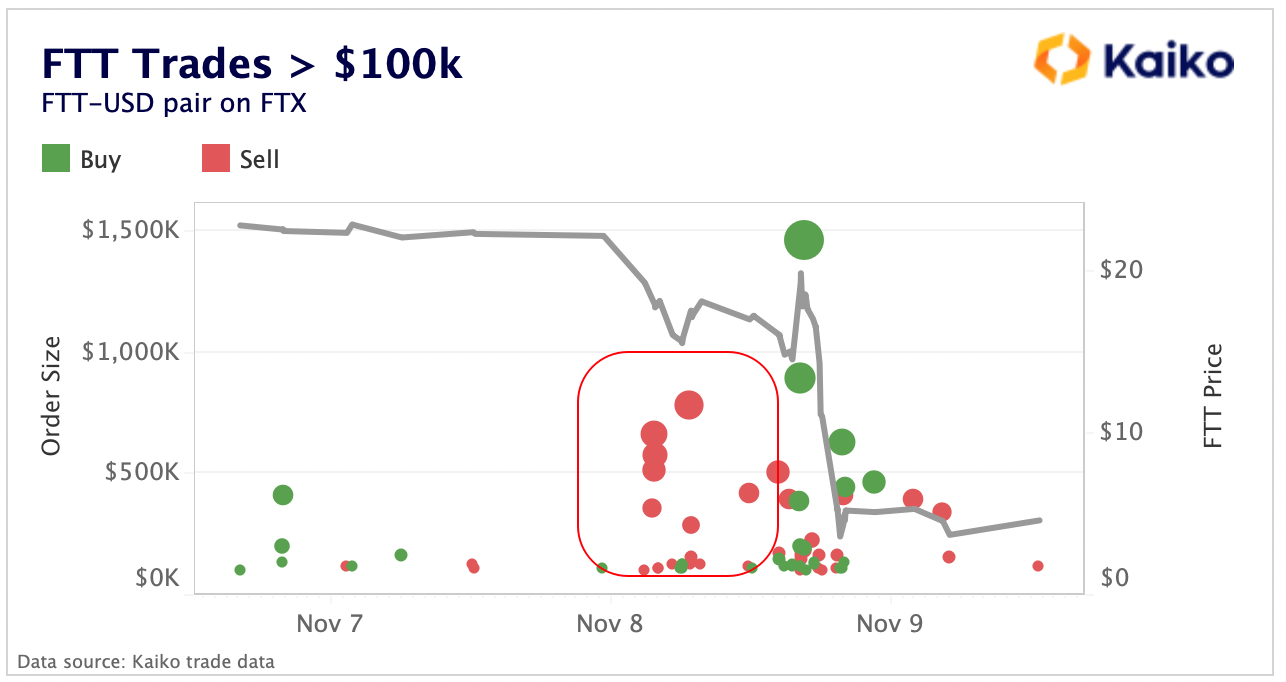
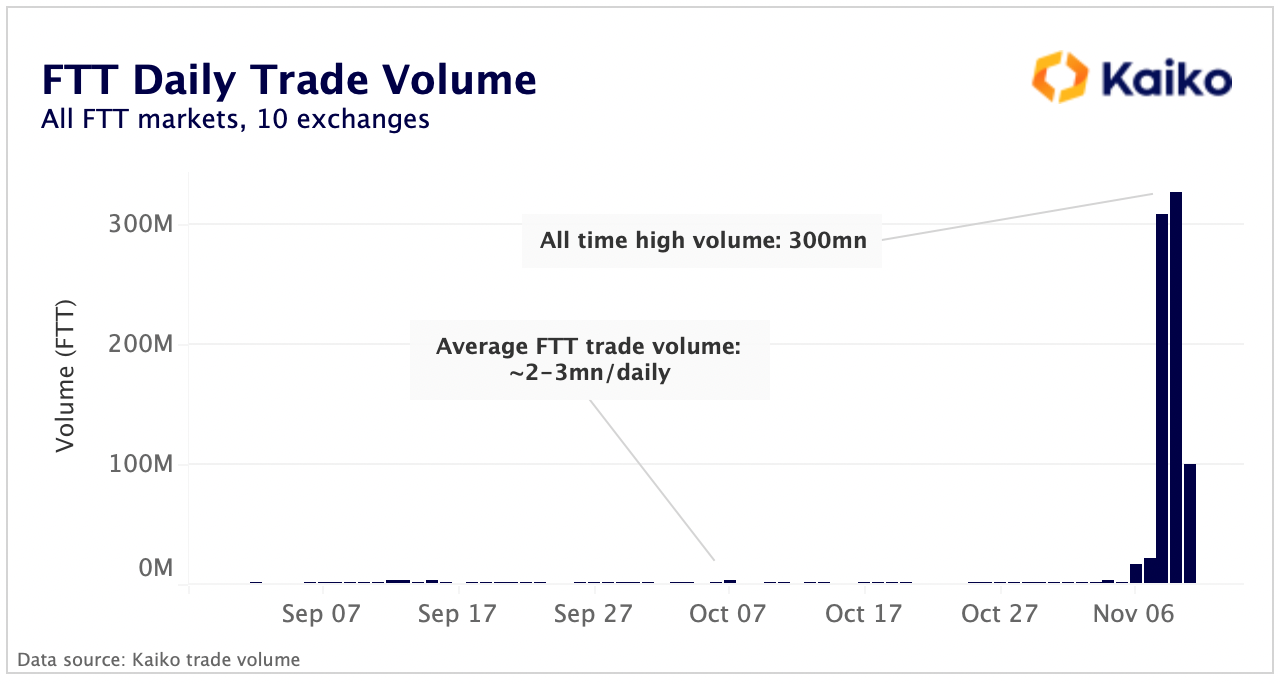
As news of Binance’s potential acquisition spread, there was a brief spike in FTT, with a few very large market buy orders placed, possibly by Alameda in an attempt to push up the price. But markets quickly re-priced the seriousness of the move. By the end of Tuesday, FTT trade volumes had soared to all time highs, with a whopping 300mn FTT swapped in a single day. On Wednesday, Binance issued a warning to all traders to halt all purchases and sales of FTT due to extreme risk, and volumes have since settled down.
FTT is now virtually worthless, the exchange token for an exchange with a multi-billion dollar hole in its book. The token is down over 90% in the past week, now trading at under $2, with a fully diluted valuation of just roughly $600mn. Unfortunately, the damage from this market collapse spread far and wide due to the importance of FTX and the tangled web of investments that Alameda Research supported using the FTT token.
Users in trouble
FTX is now purgatory, with all funds on the exchange effectively turned into Monopoly money or legal claims, depending on your time horizon. Market makers and retail users alike are trapped on the exchange, cut off from the rest of markets and left to develop its own biosphere. This is most simply illustrated by the price of ETH perpetual futures, which began to diverge on November 9.

Liquidity on the exchange has understandably evaporated. 4% market depth for BTC is down from $25mn to under $2mn; ETH from $17mn to under $750k. It’s reasonable to expect that FTX markets will continue to become stranger and less tied to reality the longer that users are trapped.

Subsidiary of FTX becomes a downfall
Moving on to Alameda, the company held a significant amount of SOL and Solana ecosystem tokens. FTX had also been an early backer of the project and SBF had frequently spoken highly of the network. SOL’s price has plummeted amidst the collapse, and open interest on FTX is trending towards 0. Open interest has surged on other exchanges, coupled with a funding rate that moved violently downward, suggesting heavy shorting.

Alameda had long been involved in the Solana ecosystem, and had developed a reputation for investing in projects with massive fully diluted valuations and small market caps, which allowed them to profit while early retail investors were crushed. Many of these tokens were already down over 90% from all-time highs (for OXY, the all-time high was reached immediately after launch). However, Alameda still held these tokens, though they have since become too illiquid for the company to unload a significant amount without sending the tokens to 0.
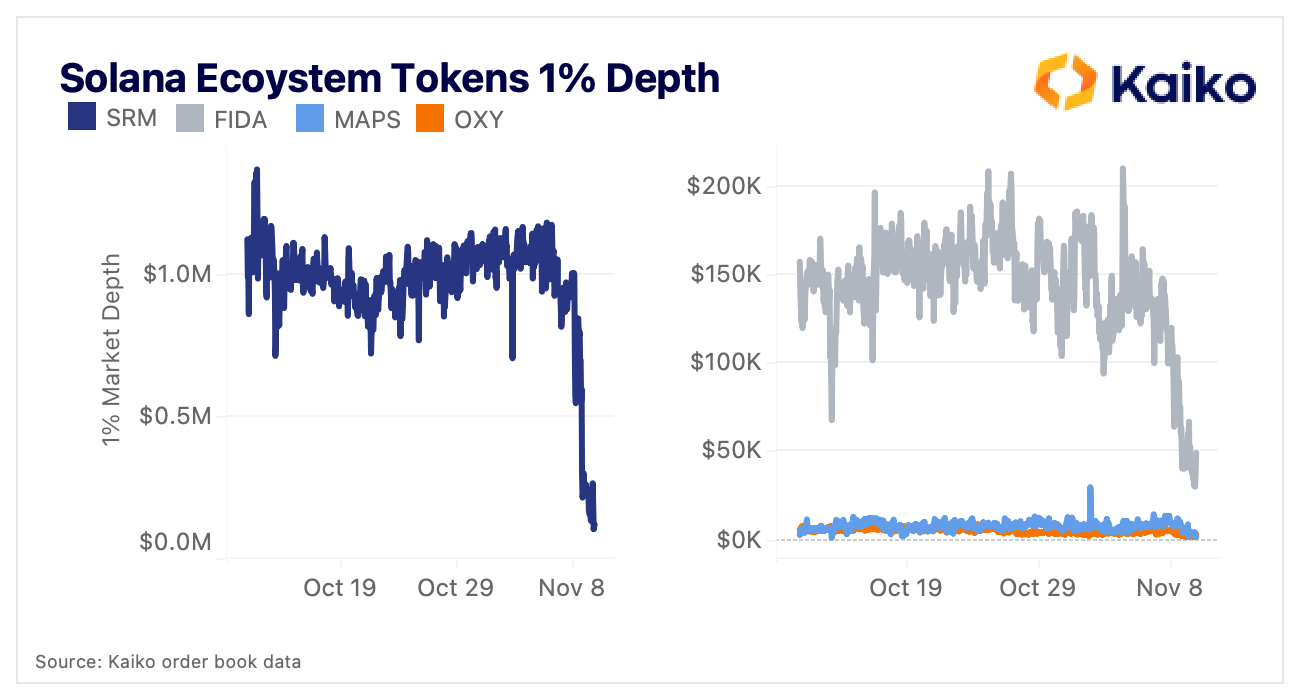
While this is a bleak moment for Solana and its ecosystem, the network will be put to the test now that one of its most significant (and predatory) backers is no more. Ethereum and Bitcoin have undergone similar – and likely tougher – tests, and both were made stronger afterwards. Should Solana survive this test, it could be better for it.
A marking event for the entire industry
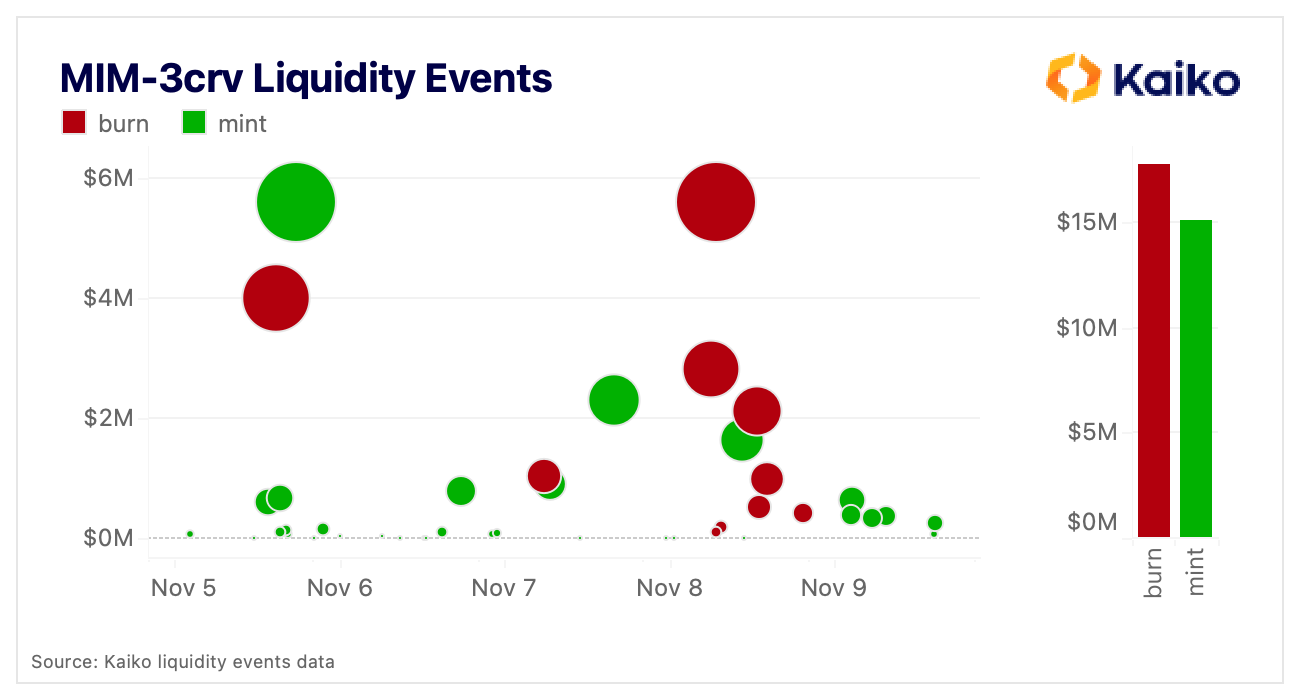
The fallout has spread to Ethereum, too. People quickly realized that FTT was a major backing of MIM, a collateralized stablecoin. On-chain investigation revealed that much of this was Alameda’s position, and it would be liquidated when FTT reached $6. On this news, MIM’s peg started to shake, though the team quickly announced that it was working with Alameda to reduce the size of their loan. MIM then returned to its peg and has not seen strong outflows from its Curve pool. Total burns were only a bit more than mints over the past few days.
On the other hand, the Lido Staked Ether (stETH) Curve pool has seen massive outflows in the past three days, with over $600mn net removed from the pool. The stETH discount has also reappeared, and is currently at around 2%. The exact cause for this removal of liquidity and reemergence of the discount is not entirely clear, though some have speculated that Alameda has had a sizable stack of stETH.