
Close Menu
Crypto Valley Journal
    Facebook X (Twitter) Instagram
    Crypto Valley Journal
    • Hot Topics
      • News
      • Minds
    • Focus
      • Background
      • Blockchain
      • Legal & Compliance
      • Non-Fungible Token (NFTs)
    • Investing
      • Markets
      • Financial Products
      • Decentralized Finance (DeFi)
      • Exchange overview
    • Education
      • Basics
      • Glossary
      • Politicians on crypto
    • Statistics
      • Bitcoin-ETF-Flows
      • Ethereum-ETF-Flows
      • Crypto market data
      • On-chain data
    • Academy
      • Overview
      • Part 1: Blockchain
      • Part 2: Money
      • Part 3: Bitcoin
      • Part 4: Cryptocurrencies
      • Part 5: Decentralized Finance
      • Part 6: Investing
    • English
      • Deutsch
    Crypto Valley Journal
    You are at:Home » Education » Academy » Investing, speculating and trading with cryptocurrencies
    Kryptowährungen bieten dank ihrer speziellen Begebenheiten spezifische Investitions- und Handelsmöglichkeiten.

    Investing, speculating and trading with cryptocurrencies

    By Editorial Office CVJ.CH on 10. October 2025 Academy

    What is DeFi? How is it relevant to the crypto industry? The field of decentralized financial applications seemingly emerged out of nowhere. Now, a broad ecosystem of decentralized, transparent, and open source protocols has formed.

    The following topics are covered in this knowledge article:

    Table of Contents:

    The decentralization of finance is ushering in a new era of democratization of finance and commerce. Although the DeFi sector is still in its infancy, its potential is immense. DeFi users have access to all kinds of opportunities that are difficult to access or only available to large financial institutions in the traditional financial system. Buying and selling cryptocurrencies, lending and borrowing, and even participating in market-making activities are all possible in this new world. In addition, the direct interaction of market participants creates a true, unadulterated yield curve for cryptocurrencies.

    The free decentralized financial world is far from perfect; risks lurk in many places, and regulation is lagging behind this rapidly growing sector. Nevertheless, the best aspects of traditional finance (TradFi) and decentralized finance (DeFi) could create a modern and more fair financial infrastructure.

    Automated protocols on the blockchain

    DeFi applications are primarily found on smart contract-enabled blockchains. The most common DeFi projects are on the second largest public blockchain, Ethereum, and its alternatives. Currently, over $100 billion is invested in various DeFi applications across different blockchains and protocols.

    Smart contracts make it easy to run applications on the platform. Smart contracts are computer programs that automatically perform the necessary actions to fulfill an agreement between multiple parties over the Internet. This is possible through the use of blockchain technology without a central authority, legal system, or external enforcement mechanism.

    Because these decentralized applications (dApps) are peer-to-peer, financial services are available to the unbanked. No central authority can exclude others from the ecosystem, and the applications are as permanent as the blockchain itself. It also makes it easier to build on top of different financial applications. Protocols can use the services of other applications and integrate them into their own projects.

    The broad DeFi ecosystem

    The various use cases range from a simple swapping of assets on a decentralized exchange (e.g. swapping BTC for ETH) to complex investment strategies that mirror traditional financial instruments. The most common sectors can be summarized as follows:

    In the DeFi space, there are no minimums or complex contracts that require pre-approval. Because of the decentralized nature of DeFi applications, no one can be excluded from interacting with them. However, the end user takes on full responsibility.

    Decentralized Exchanges (DEX) / Automated Market Makers (AMM)

    In terms of volume, decentralized exchanges (DEXes) are the most widely used DeFi applications. Unlike centralized exchanges (CEXs), DEXs do not have an order book that determines the price of a token. Instead, liquidity pools can be created for each token, allowing anyone to contribute liquidity. When a user wants to buy a particular token or exchange one token for another, they access the appropriate liquidity pool.
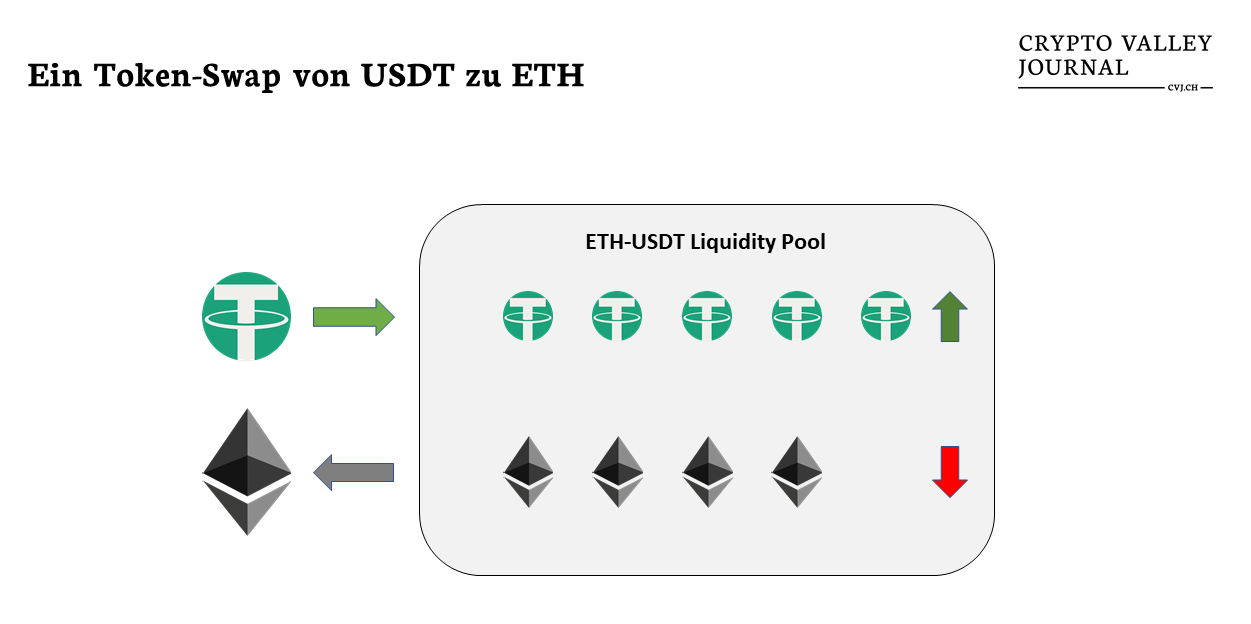
    In the example, a DeFi user buys ETH with USDT. This action automatically adds Tether (USDT) to the liquidity pool while removing Ether (ETH) from it.

    The transaction price is automatically adjusted by the protocol, without a third party, based on the token reserves in the liquidity pools. In addition, external oracles can verify token prices to ensure they reflect current market conditions. Liquidity Providers (LPs) are rewarded with a share of transaction fees. To decentralize decision making, most DEXes have governance tokens that allow users to vote on important aspects of the protocol, such as distributing additional incentives to specific liquidity pools or creating a reserve that accumulates a portion of all protocol fees.

    INFO: DEX liquidity pools allow anyone to participate in trading volume by providing liquidity and earning fees, unlike traditional market making typically reserved for large institutions. Automated Market Maker (AMM) algorithms democratize market making. For example, any user can contribute USD and ETH to a liquidity pool and earn trading volume and fees, similar to traditionally contributing USD and Nvidia stock to Nasdaq pools and earning trading volume fees.

    Credit Markets on the Blockchain

    In addition to decentralized exchanges, lending and borrowing protocols are a significant part of the DeFi market. Depositors can deposit digital assets in a lending protocol and earn interest on those assets. Interest rates fluctuate based on market conditions and loan demand.

    For example, if a protocol is low in USDC (a US dollar stablecoin) liquidity and many people want to borrow USDC, the interest rate for depositors will increase to incentivize deposits. Conversely, if the demand for credit is low and there is ample liquidity, the interest rate for depositors will be lower. For depositors, it’s a way to earn passive income, often with higher returns than traditional banks, reflecting the unadulterated supply and demand of the market – without the influence of a central bank dictating interest rates.

    • Dezentralized finance applications (DeFi) enable a new era of finance and trade through its democratization, where users have unrestricted access to financial services, previously reserved for established institutions.
    • DeFi projects utilize smart contracts running on blockchains such as Ethereum and Solana to provide peer-to-peer financial services without central authority, thereby reaching people without access to traditional banking.
    • Decentralized exchanges (DEXes) utilize liquidity pools instead of order books to automatically determine token prices. Liquidity providers are incentivized with fees, while governance tokens enable decentralized decision-making.
    • In addition to decentralized exchanges, lending protocols dominate the DeFi market by offering interest to depositors and enabling borrowers to take loans using digital collateral without central authorities.
    • Der Markt ist zwar riesig, aber etwa 90% der gesamten Marktkapitalisierung konzentriert sich auf die 20 wichtigsten Kryptowährungen, wobei Bitcoin und Ether allein 70% ausmachen. Damit kann mit einer kleinen Auswahl diversifiziert werden.
    • Liquid staking democratizes access to staking returns through protocols like Lido that create pools that are converted into liquid staking tokens, eliminating high barriers to entry and making participation more accessible to a broader audience.
    • Last bietet DeFi aims to be a transparent, efficient and decentralized financial system without intermediaries. But we are still in the early stages. Errors in smart contracts and dependence on price oracles pose new risks.
    DeFi
    Übersicht
    Share. Facebook Twitter LinkedIn Email Telegram WhatsApp

    About the author

    Editorial Office CVJ.CH
    • Website
    • Twitter
    • LinkedIn

    Since 2018, the editorial team at Crypto Valley Journal has been reporting from Zug - the heart of Switzerland’s Crypto Valley - on Bitcoin, cryptocurrency, blockchain, and regulatory developments in digital assets. Behind the publication’s collective editorial voice is a team of writers with backgrounds in financial markets, law, and technology.

    Related Articles

    Dezentrale Finanzwelt (DeFi)

    DeFi: a blockchain based world of decentralized finance

    CVJ.CH Academy - What are cryptocurrencies?

    What are cryptocurrencies?

    Bitcoin

    What is Bitcoin?

    cvj weekly review
    23. May 2026

    Weekly review CW 21: SpaceX reveals $1.5 billion Bitcoin investment

    Polymarket exploit on Polygon: the UMA CTF Adapter loses more than 520,000 USD to labelled exploiter addresses.
    22. May 2026

    Polymarket exploit: prediction market loses $520k to attackers

    Trump Media bitcoin holdings shrink: 2,650 BTC moved to Crypto.com, remaining 6.8k BTC sit 34% below the cost basis.
    22. May 2026

    Trump Media sells more bitcoin at a 34% loss

    twitter image button instagram image button linkedin image button youtube image button

    About Crypto Valley Journal
    About Crypto Valley Journal

    On the pulse of the movement

    • Academy
    • Contact
    • Advertising
    • About us
    • Partner
    • Imprint
    • Privacy
    • Disclaimer
    Search

    Type above and press Enter to search. Press Esc to cancel.