
Microsoft's Office and the Windows operating system have always led the top downloads of software piracy platforms. The company has already tried to get a grip on them with various (often customer-unfriendly) measures.
A research document has published a completely transparent incentive system for anti-piracy campaigns. The document contains an examination of a transparent blockchain-based system by Redmond software giant, with the participation of experts from Alibaba and Carnegie Mellon University. Argus is based on the Ethereum blockchain, and aims to create a trustworthy incentive mechanism while protecting the data of anonymous reporters.
Given that piracy is essentially about distributing copyrighted content outside of legal distribution channels, the key question in combating piracy is how to incentivize people to report pirated content. Industry associations and companies have offered large rewards for reporting pirated content. For example, the Business Software Alliance (BSA), whose members include Apple, IBM, Microsoft, Symantec and many others, has offered a $1 million reward for reports.
Cryptographic watermark
Argus, with the help of a digital watermark, is designed to make it possible to trace pirated content back to its source. The four pillars of the Argus concept are total transparency, incentives, information hiding and optimization. These are the main focus areas that are discussed in more detail in this paper. It is worth noting that these are not four problems to be solved individually, but integral aspects in a coherent design.
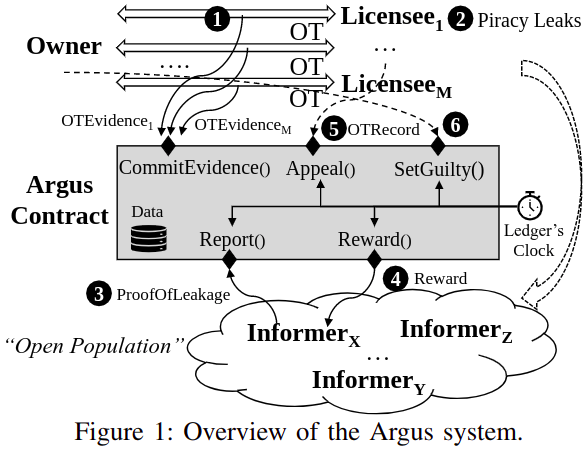
Argus allows pirated content to be traced back to the source with an appropriate watermarking algorithm, which is described in detail in the paper. With the "Proof of Leakage", a procedure to hide information is performed every time leaked content is reported. In this way, no one but the whistle-blower can report the same watermarked copy without actually possessing it.
The researchers have optimized several cryptographic operations to reduce the cost of a piracy report to sending about 14 ETH transfer transactions. This would otherwise be equivalent to thousands of transactions on the public Ethereum network. With the security and practicality of Argus, Microsoft hopes that by moving to a fully transparent incentive mechanism, anti-piracy campaigns will be truly effective in the real world.
Anti-piracy Challenges
A fundamental challenge is the interest of whistle-blowers (customers) to remain anonymous to the public. The interest of the owner (Microsoft) is to collect bona fide reports so that the severity of the infringement can be accurately assessed. However, the interest of each whistle-blower is to maximize his or her own reward. In Argus, the incentive model ensures that the total reward of the informant and all of his sybils is less than the reward he would receive without falsifying the sybils. In other words, the model discourages Sybil attacks so that the informant's interests are aligned with those of the owner. In addition, the model is superior to previous models for better incentives due to several other features.
Because Argus runs on a public ledger, its execution is completely transparent to everyone. It is critical that a whistle-blower not be able to resubmit a report that was previously submitted by someone else. For this reason, the Argus protocol for submitting reports is based on the Multi-period Commitment Scheme, which provides a "zero-knowledge" guarantee, meaning that a submission only proves that the whistle-blower has a copy of the content without revealing any other information. Compared to traditional commitment schemes, this scheme does not reveal useful information even in the disclosure phase, while avoiding the high cost of zero-knowledge proof.
Anonymous registration
Microsoft's anti-piracy efforts are fundamentally a process based on collecting data from the open, anonymous population, so the question of how to incentivize credible reporting is at the heart of the problem. Academic researchers and real-world companies have developed various incentive mechanisms. However, because the interests of the various roles and the goals of an anti-piracy system are not explicitly defined, developing such a mechanism is more of a "creative art" than a systematic and disciplined investigation.
The researchers see the most important value of this work not in the Argus system itself, but in the approach that led to its design and implementation. First, the interests of the various roles and the goal of full transparency are established without trusting any one role. Once these were established, all the design requirements emerged on their own, such as Sybil security, information transfer, resistance to infringement denial, etc. Once these design requirements were clear, they were able to derive the general form of valid solutions rather than inventing them; the derived general form then boils down to a series of unavoidable technical obstacles, which can be overcome by adapting cryptographic techniques, writing contract code, and optimizing performance.
Conclusions
Argus is an example of the result of a disciplined approach. It is superior to existing solutions in terms of trust acceptance and assured properties. It is a compelling use case for public blockchains because:
- It is feasible to develop a fully transparent solution without introducing a trusted role. This could enable a paradigm shift in anti-piracy incentive solutions.
- Such a solution actually consolidates the interests of all roles in a fair way, i.e., as long as one role is not guilty, its interests are not affected by other malicious or guilty roles;
- In addition to being logically sound, the solution is also economically feasible due to the effective optimizations.