For several years, the U.S. Securities and Exchange Commission (SEC), led by Chairman Gary Gensler, has been waging a crusade against the crypto industry. As part of a new offensive against staking services, lawsuits have been filed against Consensys, Lido Finance and Rocket Pool.
The SEC has filed a lawsuit against software provider Consensys over the staking services of its Ethereum wallet MetaMask. The tool is considered an unregistered broker engaged in the offer and sale of securities. In addition, the SEC sued the decentralized Ethereum staking services Lido Finance and Rocket Pool, which MetaMask uses as staking service providers.
Does staking constitute a securities offering?
Staking is the process of actively participating in the validation of transactions on a proof-of-stake (PoS) blockchain such as Ethereum. Users stake a certain amount of the native cryptocurrency in exchange for rewards in the form of cryptocurrency. This incentivizes network security, and locked cryptocurrencies stabilize their price. Decentralized staking services such as Lido and Rocket Pool simplify the process by using a protocol to validate transactions and pay users via a liquid token. Over 10% of the total supply of Ether (ETH) is locked in such protocols.
According to the SEC, such an offering meets the criteria of the Howey test, which was introduced in 1946. This test determines whether a transaction qualifies as an investment contract. Under the Howey test, an investment contract exists when money is invested in a common enterprise with the expectation that profits will be made through the efforts of others. This definition could indeed apply to staking, as investors expect a passive return on their Ether (ETH) earned through the transaction validation of decentralized protocols.
Consensys ready for legal battle
The SEC previously accused Consensys in May this year of operating an unregistered brokerage through the MetaMask wallet. MetaMask provides a "swap" service to trade various cryptocurrencies over a decentralized protocol, charging a fee of 0.875%. This fee has generated hundreds of millions of USD for the company over the past four years.
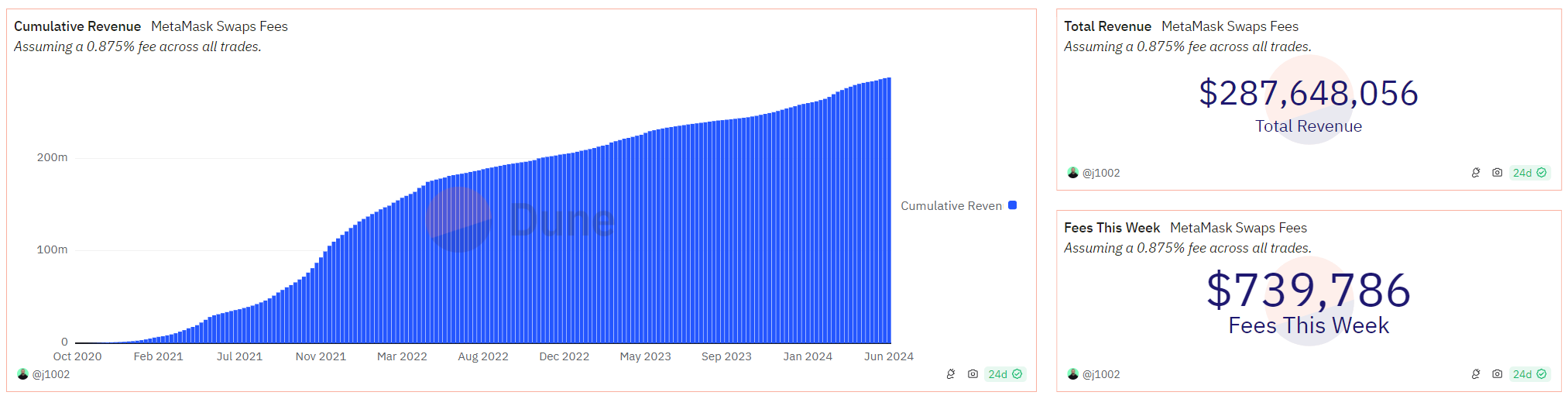
Consensys revenue from MetaMask swap fee / Source: Dune
A significant portion of these transactions involved "cryptoasset securities," according to the SEC. The government agency specifically named cryptocurrencies such as Polygon (MATIC), Mana (MANA), Chiliz (CHZ), The Sandbox (SAND), and Luna (LUNA). The SEC alleges that other digital assets also meet the criteria of a securities offering. Consensys anticipated these allegations and filed a lawsuit against the SEC in April. The company remains committed to defending the crypto industry against this regulatory overreach.
"Consensys fully expected the SEC to follow through on its threat to claim our MetaMask software interface must register as a securities broker. The SEC has been pursuing an anti-crypto agenda led by ad hoc enforcement action. This is just the latest example of its regulatory overreach - a transparent attempt to redefine well-established legal standards and expand the SEC’s jurisdiction via lawsuit. We are confident in our position that the SEC has not been granted authority to regulate software interfaces like MetaMask. We will continue to vigorously pursue our case in Texas for ruling on these issues because it matters not only to our company but the future success of web3." - Consensys statement following the SEC action.