
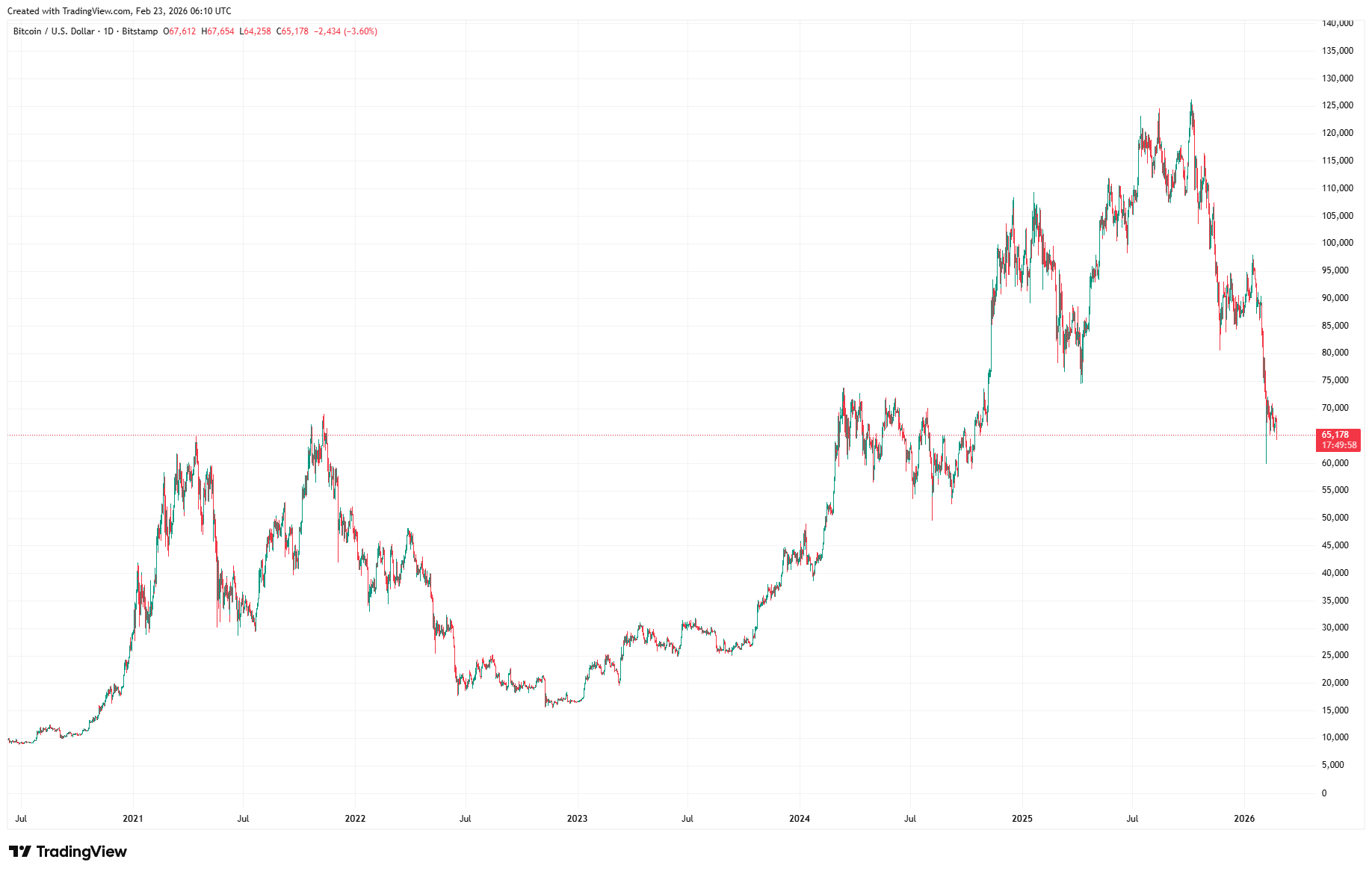
Bitcoin dropped as much as 4.8 percent in early Asian trading on Monday, falling to around $64,300. That is the lowest level since early February. Ethereum lost 5.2 percent, with smaller altcoins declining even more sharply. In total, the crypto market shed another $100 billion in value within 24 hours.
The trigger is the latest escalation in US trade policy. President Donald Trump raised the announced global tariffs from 10 to 15 percent on Sunday. The new levies take effect on February 24 at 00:01 ET. Beyond crypto assets, the US dollar, S&P 500 futures (down 0.8 percent), and Nasdaq 100 futures (down 1 percent) also came under pressure.
Supreme Court blocks Trump's tariffs, Trump pivots to new law
The background: On February 20, the US Supreme Court ruled 6 to 3 that Trump's blanket tariffs under IEEPA are unconstitutional. Chief Justice John Roberts stated unequivocally: "IEEPA does not authorize the President to impose tariffs." The power to tax lies with Congress.
Trump called the ruling "ridiculous, poorly written, and extraordinarily anti-American." Rather than backing down, he switched the legal basis. Specifically, he invoked Section 122 of the Trade Act of 1974. This law permits tariffs of up to 15 percent for a period of 150 days, unless Congress extends them. No US president has previously used Section 122.
The legal battle is likely to continue. By December 2025, the US government had collected roughly $133 billion from the previous tariffs. At the same time, over 1,000 importers have filed lawsuits seeking refunds. The new legal basis is also untested and could be challenged in court.
ETF investors pull billions
The twelve US-listed spot Bitcoin funds recorded their fifth consecutive week of net outflows. The last outflow streak this long was in February 2025. Over these five weeks, investors withdrew $3.8 billion. Since the start of the year, losses have accordingly totaled approximately $4.5 billion.
Not even the largest funds were spared. BlackRock's IBIT alone recorded $84.2 million in outflows on February 18, with Fidelity's FBTC seeing another $49 million. Total AUM across all Bitcoin ETFs stands at $83.6 billion, representing 6.3 percent of Bitcoin's total market capitalization. Institutional investors are actively reducing their crypto exposure.




Two trillion dollars wiped out since the all-time high
Bitcoin reached an all-time high above $126,000 on October 6, 2025. At the time, hopes for a more crypto-friendly Trump administration drove prices higher. Since then, Bitcoin has fallen by nearly 50 percent. The total crypto market shrank from a record $4.4 trillion by 44 percent to around $2.3 trillion. That amounts to a decline of approximately $2 trillion.
In early February 2026, Bitcoin fully erased the remaining gains since Trump's re-election in November 2024. Still, the current correction differs from the FTX collapse of 2022: no major institutional crypto firms have failed. Exchanges, custody services, and blockchain networks continue to operate. Analysts therefore describe this as a crisis of confidence rather than a systemic failure.
The Crypto Fear & Greed Index fell to 9. That is the lowest reading since June 2022, when the collapse of Terra/Luna and Three Arrows Capital shook the industry. Smaller tokens suffered particularly heavy losses.