
Hedge fund legend Stanley Druckenmiller expects stablecoins to form the backbone of global payments within 10 to 15 years. In an interview with Morgan Stanley, the founder of Duquesne Capital Management called stablecoins more efficient, faster, and cheaper than existing fiat payment infrastructure.
He specifically highlighted Tether (USDT) and Circle (USDC) as examples of productive blockchain use. At the same time, he described cryptocurrencies in general as "a solution in search of a problem." These statements come at a time when the stablecoin market capitalization has reached an all-time high of roughly $315 billion.
Druckenmiller's thesis: stablecoins replace traditional payment rails
Druckenmiller laid out his core thesis in an interview with Morgan Stanley. According to the star investor, our entire payment system will run on stablecoins in 10 or 15 years. This argument follows an economic rationale. SWIFT transfers take one to five business days and cost up to $50 per transaction. Stablecoin transfers, by contrast, settle in seconds and cost cents. For Druckenmiller, the advantage lies not in crypto ideology but in pure efficiency. Blockchain and stablecoins are "incredibly useful in terms of productivity," the investor said.
His differentiation is notable, however. Druckenmiller draws a clear line between stablecoins as infrastructure and the broader crypto market. He views the former as a concrete improvement over existing systems. Yet he considers the latter largely redundant.
Bitcoin as a brand, not a necessity
On Bitcoin, Druckenmiller was skeptical, though not dismissive. He called Bitcoin's role as a store of value unnecessary and explained his reasoning in the interview:
"I regret that it was ever used as a store of value, because that wasn't needed. But it's a brand, and people love it, so it will remain a store of value." - Stanley Druckenmiller
This assessment fits Druckenmiller's pragmatic investment style. He acknowledges Bitcoin's brand value but sees no fundamental need for it. Back in 2020, the investor had stated that Bitcoin could outperform gold as a store of value. Six years later, his verdict is more sober. Druckenmiller also weighed in on the US dollar. In his view, the dollar will no longer be the reserve currency in 50 years. Yet he conceded that no clear alternative exists. As a result, he called the dollar "the cleanest dirty shirt" among reserve currencies.
Druckenmiller's track record adds weight to these statements. He founded Duquesne Capital Management in 1981 and closed the fund in 2010 after averaging 30 percent annual returns without a single losing year. Together with George Soros, he famously bet against the British pound in 1992. Already in May 2021, the billionaire declared that blockchain could replace USD payment infrastructure. His current stablecoin prediction therefore builds on that earlier assessment.




Stablecoin market at record levels
Druckenmiller's prediction comes amid a market in motion. Total stablecoin market capitalization stands at roughly $315 billion, a new all-time high. Circulating supply has grown by more than $180 billion since early 2024. Meanwhile, adjusted transfer volume reached approximately $11 trillion in 2025.
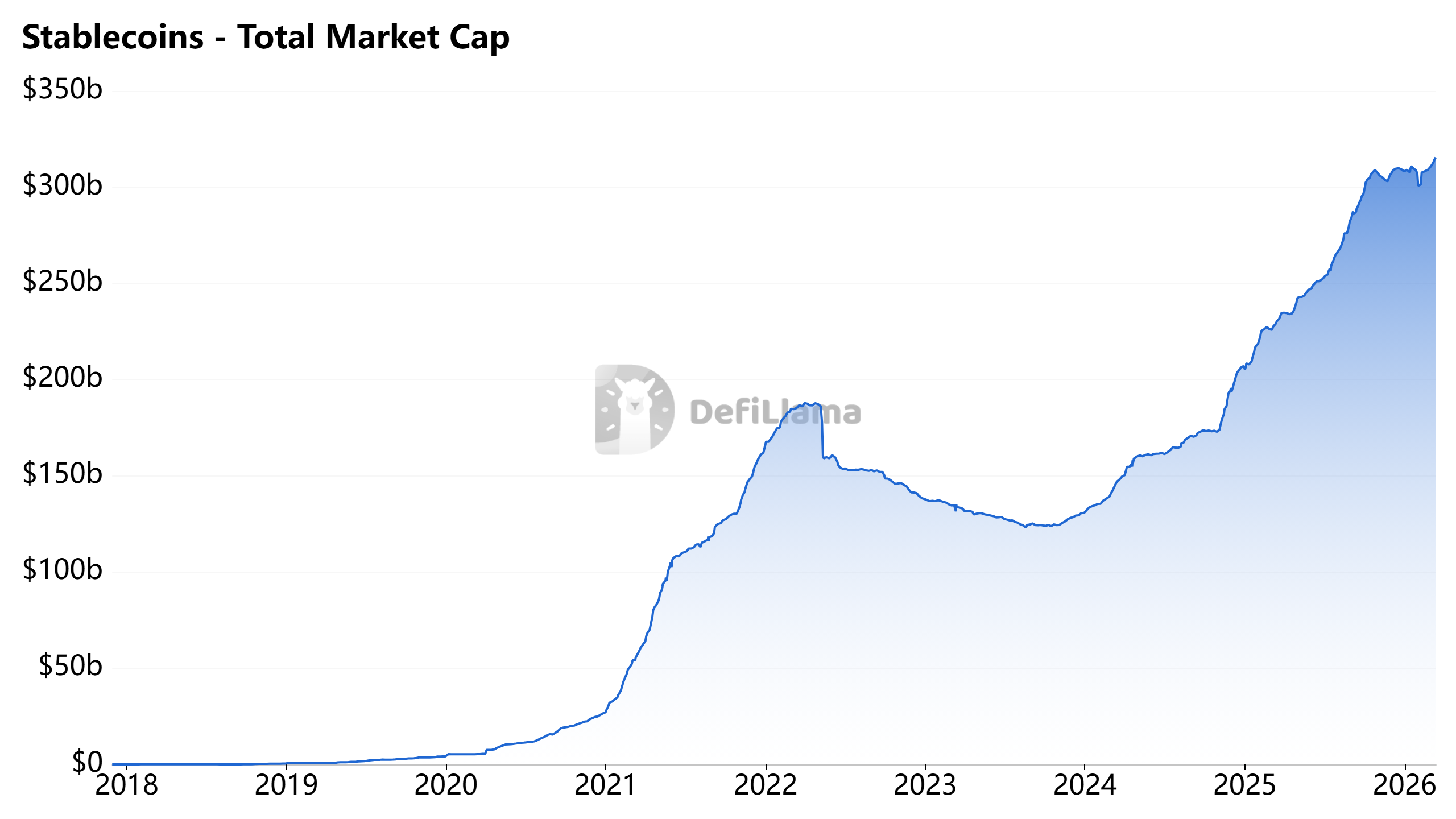
Australian investment bank Macquarie published an analysis in early March 2026 with a similar thrust. According to the report, stablecoins are evolving from a niche crypto trading instrument into a potential layer of global financial infrastructure.
Traditional financial institutions are positioning accordingly. Visa and Mastercard now support on-chain USDC settlement. JPMorgan operates a tokenized deposit product, while Citi and HSBC are testing their own token services. In addition, US Treasury Secretary Scott Bessent has stated that the stablecoin market could grow to $3 trillion by 2030.
GENIUS Act creates regulatory framework
Institutional adoption benefits from regulatory progress in the United States. President Trump signed the GENIUS Act (Guiding and Establishing National Innovation for US Stablecoins Act) on July 18, 2025. It is the first US federal law addressing crypto assets.
The law requires 1:1 backing with cash or short-term US Treasuries. It also mandates monthly reserve disclosures. Stablecoins are classified neither as securities nor as commodities but under a separate regulatory category. This gives both issuers and institutional users legal clarity.