
Close Menu
Crypto Valley Journal
    Facebook X (Twitter) Instagram
    Crypto Valley Journal
    • Hot Topics
      • News
      • Minds
    • Focus
      • Background
      • Blockchain
      • Legal & Compliance
      • Non-Fungible Token (NFTs)
    • Investing
      • Markets
      • Financial Products
      • Decentralized Finance (DeFi)
      • Exchange overview
    • Education
      • Basics
      • Glossary
      • Politicians on crypto
    • Statistics
      • Bitcoin-ETF-Flows
      • Ethereum-ETF-Flows
      • Crypto market data
      • On-chain data
    • Academy
      • Overview
      • Part 1: Blockchain
      • Part 2: Money
      • Part 3: Bitcoin
      • Part 4: Cryptocurrencies
      • Part 5: Decentralized Finance
      • Part 6: Investing
    • English
      • Deutsch
    Crypto Valley Journal
    You are at:Home»Focus»Background»More than half of all hedge funds invest in crypto
    Mehr als die Hälfte der Hedgefonds investieren in Krypto

    More than half of all hedge funds invest in crypto

    By Editorial Office CVJ.CH on 10. November 2025 Background

    A new survey by the Alternative Investment Management Association (AIMA), conducted in collaboration with PwC, reveals that 55% of hedge funds invested in cryptocurrencies during the first half of 2025 - up from 47% the previous year.

    The survey, which polled 122 hedge funds worldwide, found that the average crypto allocation stands at around 7%, although more than half of these funds invest less than 2%. The main drivers: rising cryptocurrency prices in 2025 and an increasingly crypto-friendly US regulatory environment. However, the report also warns of risks such as high leverage and insufficient market infrastructure.

    Subscribe to our newsletter

    The best articles of the week, directly delivered into your mailbox.

    Survey details and market significance

    According to Reuters, the hedge funds surveyed collectively manage around USD 982 billion in assets. Overall hedge fund capital reached a record of nearly USD 5 trillion in the third quarter of 2025. The findings indicate that crypto is increasingly being accepted by traditional asset managers - particularly through derivatives: 67% of crypto-invested funds use derivatives instead of holding cryptocurrencies directly.

    The US government under Donald Trump and recent regulatory developments are cited as accelerators. At the same time, the report references an October 2025 flash crash, during which market participants suffered losses due to excessive leverage and a lack of institutional infrastructure.
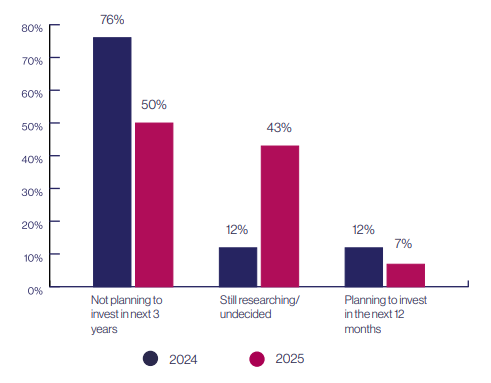

    Traditional hedge funds without exposure on future plans / Source: Global Crypto Hedge Fund Report
    Ray Dalio’s Bridgewater Associates Minds

    Star investor Ray Dalio considers Bitcoin inferior to gold

    Analysis by Bitget Research on Bitcoin quantum computing risks, ECDSA exposure, NIST post-quantum standards, and BIP-360 migration paths. Background

    Bitcoin quantum computing: What recent developments mean for network security

    JPMorgan warns: Recurring DeFi exploits and stagnant ETH-denominated TVL curb institutional engagement in the DeFi sector. DeFi

    JPMorgan: DeFi hacks and TVL losses weigh on institutional investors

    Basics

    Unit bias in crypto: Why cheap coins mislead investors

    Ray Dalio’s Bridgewater Associates Minds

    Star investor Ray Dalio considers Bitcoin inferior to gold

    Analysis by Bitget Research on Bitcoin quantum computing risks, ECDSA exposure, NIST post-quantum standards, and BIP-360 migration paths. Background

    Bitcoin quantum computing: What recent developments mean for network security

    Regional distribution and preferred investment types

    The AIMA study shows that more than 60% of crypto-active hedge funds are based in North America, followed by Europe with 25% and Asia with 10%. US-based funds in particular benefit from clearer regulation through recent legislative initiatives such as the CLARITY Act and the Stablecoin Innovation Framework. Most funds favor liquid, established assets - Bitcoin (BTC) and Ethereum (ETH) together account for more than 80% of allocations. In addition, 45% of surveyed funds said they plan to invest in tokenized bonds and real-world assets (RWA) once regulatory frameworks are fully implemented.

    The data suggest that cryptocurrencies have entered the portfolios of professional investors - albeit with a limited share. The growing use of derivatives points to strategic positioning rather than speculative mass participation. Nevertheless, integrating crypto into traditional financial structures remains risky: infrastructure and liquidity gaps, along with regulatory uncertainty, can undermine the stability of these assets. For crypto projects, however, the survey serves as a signal of improving institutional access.


    Share. Facebook Twitter LinkedIn Email Telegram WhatsApp

    About the author

    Editorial Office CVJ.CH

      The CVJ editorial staff consists of a team of Blockchain experts and informs daily and independently about the most exciting news.

      Related Articles

      Bitcoin fails again at the 80'000 USD mark, profit-taking weighs on ETH, SOL and XRP despite Strategy purchase and ceasefire.

      Bitcoin price climbs to 80’000 USD – profit-taking hits ETH, SOL and XRP

      Analysis by Bitget Research on Bitcoin quantum computing risks, ECDSA exposure, NIST post-quantum standards, and BIP-360 migration paths.

      Bitcoin quantum computing: What recent developments mean for network security

      XRPL validator analyzes quantum risk: only 0.03% of XRP supply is exposed, compared to up to 35% for Bitcoin. Google sets 2029 deadline.

      Quantum risk: Is XRP more secure than Bitcoin?

      FalconX and Sygnum open institutional access to tokenized credit via the Desygnate platform and the FalconX Credit Vault.
      6. May 2026

      FalconX and Sygnum open regulated access to tokenized credit

      FINMA tightens consumer protection in crypto, grants first DLT license to BX Digital, and plans new license categories for stablecoin issuers.
      5. May 2026

      FINMA tightens crypto supervision and warns of consumer risks

      Coinbase backs the CLARITY Act compromise on stablecoin rewards, now the Senate committee markup path opens, with passage likely.
      4. May 2026

      Crypto industry backs down: Coinbase accepts CLARITY Act compromise

      twitter image button instagram image button linkedin image button youtube image button

      About Crypto Valley Journal
      About Crypto Valley Journal

      On the pulse of the movement

      • Academy
      • Contact
      • Advertising
      • About us
      • Partner
      • Imprint
      • Privacy
      • Disclaimer
      Search

      Type above and press Enter to search. Press Esc to cancel.