
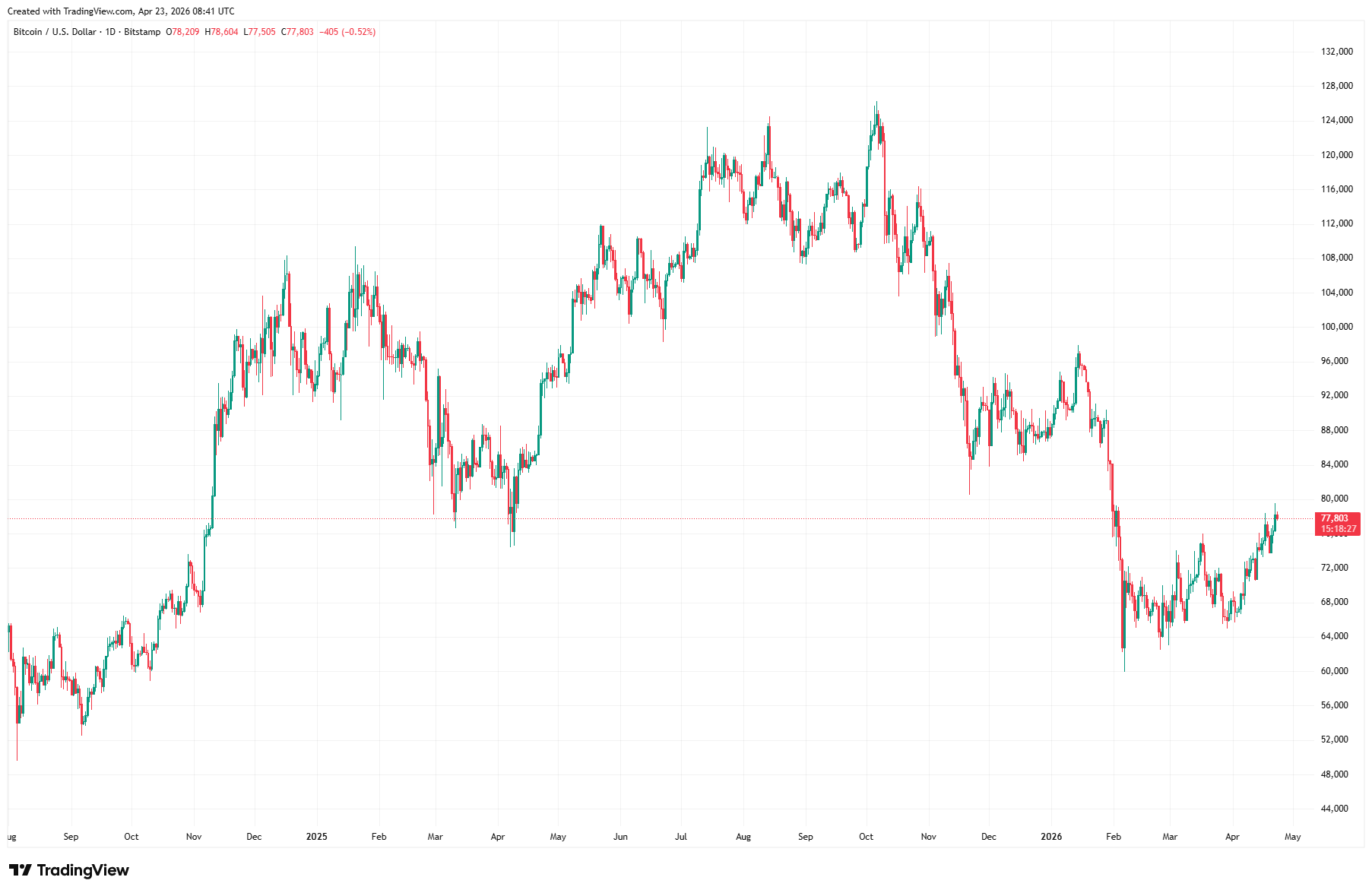
Bitcoin is trading around 78'000 USD again after the price briefly rose to 79'388 USD the day before. For the third time in a few weeks, the largest cryptocurrency therefore failed at the psychologically important 80'000 USD mark.
Ethereum, Solana and XRP gave back gains after an intraday rally, because short-term traders took profits. Total crypto market capitalisation stands at 2.61 trillion USD, with 24-hour trading volume of 144.04 billion USD. Moreover, Bitcoin holds a dominance of 60.11%, a classic pattern for a market phase led by Bitcoin. Ethereum gains 1.45% on a daily basis to 2'357.90 USD, Solana rises 2.16% to 86.14 USD, and Dogecoin adds 0.84% to 0.09631 USD. However, all three altcoins fell back from their intraday highs.
Ceasefire and whale buys drive the rally
The upward move of the past week has two clear triggers. First, US President Donald Trump extended the US-Iran ceasefire on 21 April indefinitely. Previously, Iran had closed the Strait of Hormuz on 18 April, after which the USS Spruance intercepted the Iranian vessel "Touska" in the Gulf on 19 April. As a result, the de-escalation relieved risk assets worldwide.
In addition, Strategy, the former MicroStrategy, bought 34'164 BTC on 20 April for 2.54 billion USD at an average price of 74'395 USD. This is the company's third-largest single purchase and the largest in over a year. Consequently, total holdings rose to 815'061 BTC, meaning Strategy now holds more Bitcoin than BlackRock's IBIT ETF for the first time. Cumulative Bitcoin spending now stands at roughly 61.56 billion USD, with an average cost basis of 75'527 USD.
Furthermore, institutional inflows continue. IBIT recorded weekly inflows of 871 million USD and now manages just under 64 billion USD in AUM. Globally, 1.4 billion USD flowed into crypto ETFs last week, led by Bitcoin and Ethereum products. Since the start of the year, crypto ETF inflows have therefore turned positive at 2.3 billion USD and recovered from negative territory.
Derivatives market remains defensively positioned
The discrepancy between spot demand and derivatives flows stands out. Funding rates for BTC perpetual futures have been negative for 47 consecutive days. That is the longest negative streak since November 2022, when FTX collapsed. Negative funding rates mean that short positions have to pay a premium to long positions, an indicator of defensive market positioning.
Despite this scepticism, open interest in BTC perpetuals rose by around 12% in the past month. New short positions are therefore being opened at higher price levels. In addition, liquidation data supports this picture. Forced liquidations reached around 210 million USD in the past 24 hours, of which 71.6 million USD were on Bitcoin. Short liquidations of roughly 180 million USD are stacked in the 80'000 to 85'000 USD range. A sustained break above the resistance mark could therefore trigger a short squeeze. Below 77'300 USD, by contrast, some 71 million USD in long positions are under pressure.




On-chain data show supply tightening
The structural data deliver a bullish reading. According to Bitfinex Alpha, BTC holdings on centralised exchanges fell to 2.41 million BTC, a seven-year low. This corresponds to 5.88% of circulating supply. Moreover, whale addresses accumulated 270'000 BTC in the past 30 days, the largest monthly accumulation since 2013.
At the same time, stablecoin supply grew by 2.54 billion USD over the past seven days to a total of 320 billion USD. Such liquidity inflows into stablecoins are considered potential "dry powder" for spot purchases. Technically, the price is currently meeting Glassnode's so-called True Market Mean at around 78'200 USD, which reflects the average cost basis of actively traded coins. For example, the realised price of short-term holders sits at roughly 69'400 USD and is regarded as a decisive support zone.
During the geopolitical crisis, Bitcoin also clearly outperformed traditional safe havens. Since the start of the Hormuz escalation, BTC added 7.1%, while equities lost 6.5% and gold gave up 10.1%. This relative performance strengthens the narrative of Bitcoin as a macro hedge, which institutional buyers like Strategy recently emphasised.
DeFi stress clouds the altcoin picture
While Bitcoin benefits, security incidents weigh on the altcoin segment. The KelpDAO exploit on 20 April caused a loss of 292 million USD, and in parallel Drift Protocol lost 285 million USD. As a result, DeFi losses in April 2026 sum up to 606 million USD. Within 48 hours, total value locked in the DeFi sector fell by around 15 billion USD.
The Fear & Greed Index stands at 33 points despite the price recovery, and therefore remains in fear territory. Supply tightening on exchanges, defensive positioning in the derivatives market and security issues in DeFi together explain why the rally has so far stayed narrow. Bitcoin attracts capital. By contrast, speculative altcoin segments are struggling to build momentum.
Historically, comparable negative funding streaks in 2021 and 2022 were each followed by a strong Bitcoin rally. Whether the current consolidation near 78'000 USD follows this pattern depends on spot buying. Specifically, Strategy and the ETFs must absorb the short flows in the derivatives market on a sustained basis. The 80'000 USD mark remains the central technical reference point, while 69'400 USD is the short-term support to the downside.