In recent days, the traditional financial markets have experienced increased volatility. What is commonplace in the cryptomarkets has visibly disappeared in the traditional asset classes. A look at the last few years and current events on the markets.
General macro situation of the financial markets
Let us take a quick look at the general situation without going into too much detail. If we want to understand the current situation in the traditional financial markets, the following topics stand out: zero interest rate policy, money supply expansion and leverage. Over time, the first two conditions led to a pronounced last constellation in the desperate search for yield. Borrowing for the purpose of investing in financial instruments is at a historic all-time high.
Financial crisis in 2009 leads to negative interest rates and unlimited money supply
For some years now, especially after the introduction of global "quantitative easing measures", the normal market conditions of supply and demand have been overridden by the major players in the form of the central banks. An artificial demand in the form of unlimited newly created money ensures that the market implements the dictated interest rate level. This fact is very well reflected in the bond market. Due to the zero interest/negative interest rate policy, investors must now pay money to some countries, such as Switzerland, in order to "be allowed" to lend money. A risk-return situation that makes no sense in the long term.
At the end of 2019, a bond volume of over 11 trillion USD had a negative return.
This phenomenon is also evident in the corporate bond sector. Bonds with an AAA rating may well have negative returns. However, the yield on debt securities in general is also at an all-time low. The return that a venture capitalist receives for lending his money is historically at a low point. This can be seen across the entire spectrum of bond markets, including the sub-investment grade, junk bond and emerging markets.
Investors buy yield with more duration and worse quality
The desperate search for yield drives investors a) into ever higher durations and b) into lower quality debtors. Both represent an increase in risk. An additional instrument that professional market participants like to use to obtain higher returns is the so-called "leverage". With short-term debt financing, a position is further increased in order to achieve the desired return.
Newly introduced liquidity options of the Fed, such as the repo market or the resulting "sponsored repo" market, have meanwhile attracted a much wider range of speculators in the form of hedge funds etc. to the drip of cheap liquidity for the purpose of investing in the market for bonds. On average, 50 to 100 billion dollars of daily liquidity is provided by the Fed. In normal market conditions, a profitable, often used and "financial industry compliant" strategy. In stress situations, such strategies can lead to huge bankruptcies, which can drive the world's largest investment banks into bankruptcy (see Lehman, Royal Bank of Scotland, UBS, etc.).
Investment crisis leads to inflated risk/return profiles in all asset classes
Consequently, the investment crisis has long continued in the remaining asset classes. The desperate search for returns, especially of institutional investors who are forced to invest due to obligations, is also reflected in the equity and real estate markets. The market has moved away from traditional valuation benchmarks for asset classes. For some time now, the interest rate and central bank policies of global central banks have been the highest bid on the markets. Accordingly, risk aspects have been given lower priority.
In the equity market, artificially low interest rates and easily available additional liquidity have led to changes in the landscape. On the one hand, discounted cash flows are worth much more with the new environment than in the past. The game of issuing low-interest corporate bonds, the proceeds of which are invested in share buybacks in order to increase the "EPS ratio", is now standard practice for most listed companies. Investors who want to escape the high valuations are fleeing into supposedly cheaper but more illiquid markets. Alternative asset classes such as private equity and venture capital, as well as "private loans", are recording record volumes. "Unicorns" seeking billion-dollar valuations on the stock market are writing hundreds of millions in losses.
Historically low volatility leads to full coverage mentality
The central banks' control of the markets by making more and more newly printed money available to market participants for investments in the financial markets has also led to a completely new volatility landscape. The steady rise of the markets, without excessive price setbacks, has led to low volatilities. This phenomenon has now developed into a "modus operandi" in the market. For a little extra return, volatility continues to be sold on a large scale, either directly via the VIX Index or via thousands of structured products that are found in countless portfolios as "yield enhancements" (reverse convertibles and syndicates).
The investment behaviour has changed in the sense that the investor no longer asks how much return he receives for the risk he has taken, but rather takes on as much risk as the market offers with the return target in mind.
Liquidity as the lifeline of the financial markets, when will the zenith be reached?
Over the last decade we have seen how every problem has been tackled with more resources. Monetarily and fiscally, attempts are being made to find a way out of the current problems with cheap money. Growth is to be maintained at all costs, recessions, which in themselves are an ingredient for long-term sustainability, are to be prevented. Structurally, however, no problem has been solved, but a new one created. Debt has been driven. "Zombie companies" which can only roll over their debts thanks to low interest rates are omnipresent. Fundamentally, the crisis has not been solved since 2009, but postponed until tomorrow. We have a problem that is too big to be solved.
And given that it is too big to fail, we see central banks acting very preventively. So "Whatever it takes", for lack of alternatives, is likely to be carried through to the bitter end. Negative interest rates will at some point represent a smaller benefit than the newly created problems on the provision/savings side. Thus, the obvious and only instrument of central banks is the fiscal side. QE has already been raised again by the Fed, it is of course possible to increase it further, including helicopter money.
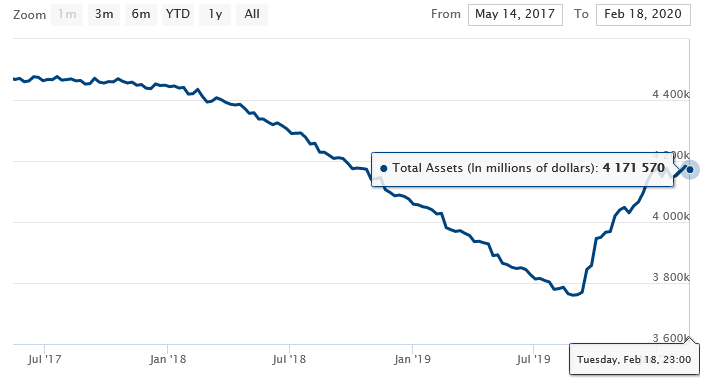
It can be seen that our currency (FIAT money), has many roles. It is reproduced at will to maintain the system. The value retention and thus the characteristics as a store of value are at the back of the list. Few people are aware that pure cash has suffered a dramatic devaluation over the years. The "lead currency" US dollar has lost more than 96% of its purchasing power since the Federal Reserve was established in 1914.
Portfolio Strategy
The shortfall risk is high, we must speak of individual blistering. For a historically minimal return, investors accept more risk than they might be aware of. Due to the structure of the international financial market, institutional investors are forced to make new investments.
How do you protect capital in such an environment of financial markets? Apart from avoiding the bond market or generally borrowing money, options are offered by the historically low volatility. This can be helpful when used correctly. If purchased in the form of portfolio insurance, it is certainly more sensible in the current environment than selling them in the form of reverse convertibles or other similar instruments*. In addition, stocks that cannot show negative interest rates and also have a limited range of products are attractive additions to the overall portfolio context. These include precious metals such as gold and silver, but also digital currencies with limited supply, i.e. the most prominent example being Bitcoin.
Bitcoin as portfolio addition
The still young asset class of crypto currencies, namely Bitcoin, can act as an attractive addition to a traditional investment portfolio. The current application growth, as well as the exponential potential, makes this still young asset class very attractive as a portfolio addition, even if it is based on pure portfolio theory.
But please do not misunderstand me. I am not one of those who recommend replacing other asset classes with Bitcoin. Compared to existing asset classes, it has excellent properties that - with the right weighting - make it an almost indispensable addition to a portfolio. We are talking about the most important criterion in the selection of assets: the risk/return profile.
*The report was written on 20.02., currently volatility has risen massively.