
Strategy (formerly MicroStrategy) now holds 738,731 Bitcoin worth roughly 55 billion USD. The company has financed a growing share of these purchases through an instrument called STRC, a perpetual preferred stock with a variable dividend. Currently, STRC pays 11.5 percent per year, distributed monthly.
Since launching in July 2025, Strategy has raised approximately 3.4 billion USD through this channel. The company used the proceeds to buy nearly 34,000 BTC. Critics draw parallels to the collapse of Terra-Luna in May 2022. Proponents, however, see an innovative financing instrument. Both sides have arguments.
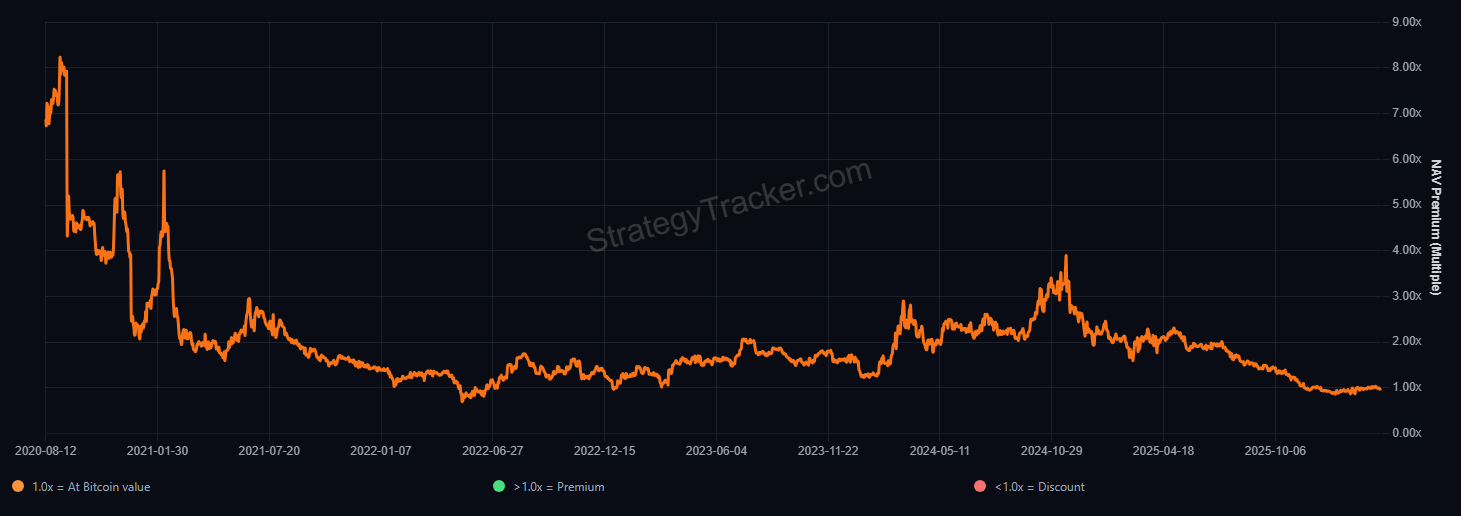
The MSTR stock trades at around 140 USD, more than 70 percent below its high of 543 USD in November 2024. Meanwhile, the mNAV, the ratio of market capitalization to the value of Bitcoin held, has fallen to roughly 1.0x. Investors no longer value Strategy above the bare Bitcoin on its balance sheet. For the business model, this poses a problem. Some of Strategy's mechanisms only function as a capital machine when the market is willing to pay a premium.
What is Strategy STRC and how does it work?
STRC stands for "Stretch" and is a so-called perpetual preferred stock. In concrete terms, it is a preferred share with no maturity date and a variable dividend. The par value sits at 100 USD per share. Strategy adjusts the dividend monthly to keep the price close to this par value. As a result, the company describes STRC as a competitor to money market funds.
If the STRC price falls below 100 USD, Strategy increases the dividend. At a volume-weighted average price (VWAP) between 95 and 99 USD, the dividend rises by 25 basis points. Should the VWAP drop below 95 USD, another 50 basis points are added. This higher yield is meant to attract buyers and stabilize the price. When STRC trades at or above 100 USD, Strategy can issue new shares through an ATM (At-the-Market) program. The company then invests the proceeds in Bitcoin.
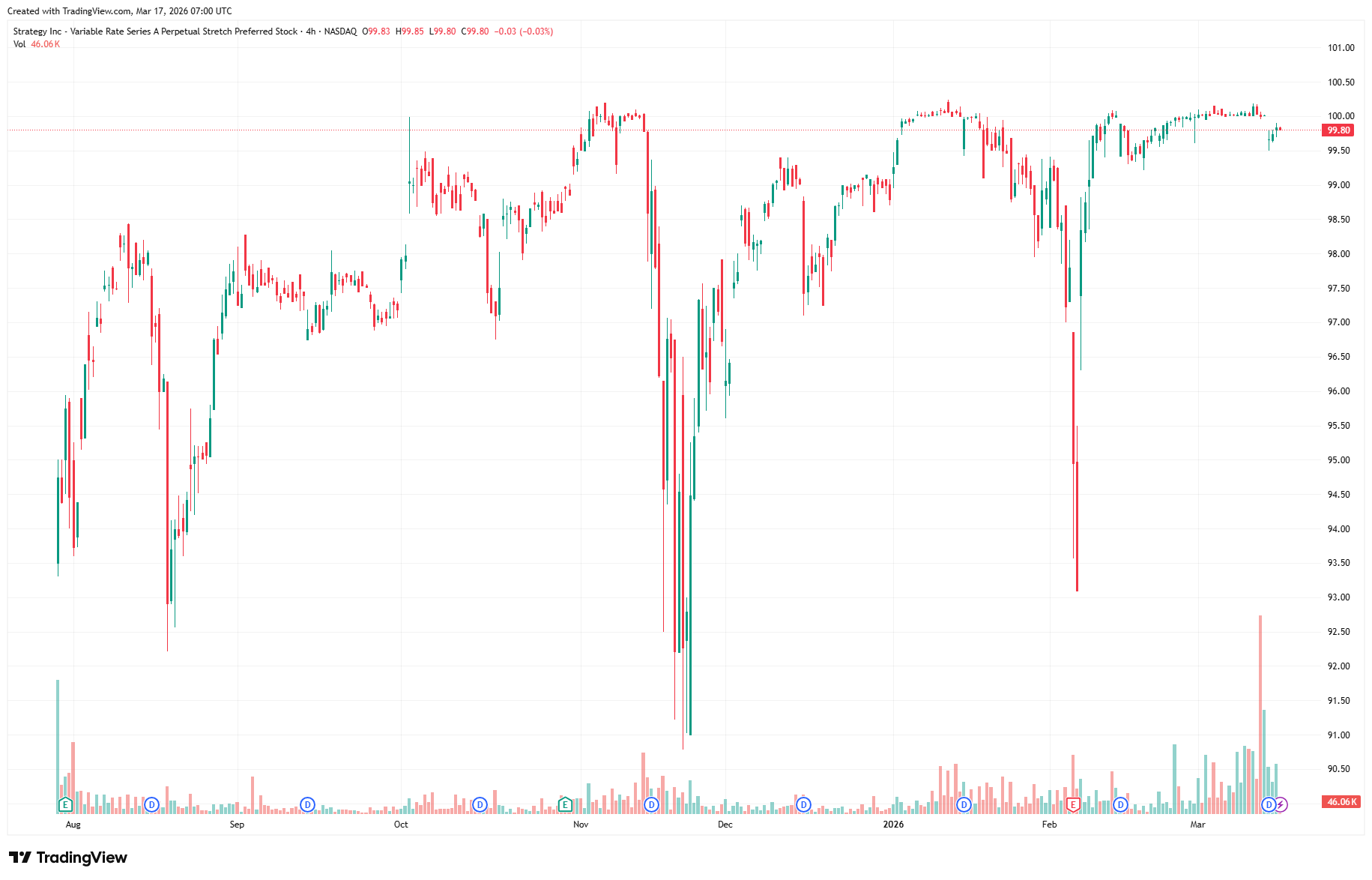
Since launching in July 2025 with a starting dividend of 9 percent, Strategy has raised the yield seven times. It currently stands at 11.5 percent. Price history confirms the mechanism has worked so far. STRC fell to 89 USD in November 2025 and to 93 USD in February 2026, but returned to par value each time. Neither Bitcoin collateral nor FDIC protection backs the instrument. In the capital structure, it ranks behind corporate debt and the more conservative preferred stock STRF.
Strategy's capital structure: the 84 billion plan
STRC is just one building block in a much larger financing structure. Strategy pursues the so-called 42/42 Plan. By the end of 2027, the company aims to raise a total of 84 billion USD. This amount is split evenly between 42 billion in equity and 42 billion in debt instruments. In 2025 alone, Strategy was the largest equity issuer among all publicly listed US companies. A total of 25.3 billion USD in capital flowed in within a single year. That represents 8 percent of the total US equity market and 33 percent of the preferred equity market.
Beyond STRC, Strategy operates four additional share classes. STRK ("Strike") offers 8 percent fixed dividend with a conversion option into MSTR common stock. STRF ("Strife") pays 10 percent fixed without conversion and is considered the most conservative variant. STRD ("Stride") also offers 10 percent fixed but is non-cumulative and therefore riskier. In total, the five preferred series bring roughly 7.8 billion USD onto the balance sheet.
On top of that, convertible bonds worth 8.2 billion USD with maturities between 2028 and 2032 are outstanding. The weighted interest rate is just 0.42 percent. Annual interest expense thus amounts to approximately 35 million USD. Total liabilities from debt and preferred stock come to nearly 16 billion USD. Against this stands a Bitcoin portfolio worth roughly 55 billion USD. That yields a coverage ratio of about 3.4x.
The comparison with Terra-Luna
In May 2022, the Terra-Luna ecosystem collapsed within days. Roughly 45 billion USD was lost in the process. The algorithmic stablecoin UST lost its dollar peg, triggering automatic hyperinflation of the LUNA token. No human could stop the mechanism. The comparison with STRC suggests itself because both instruments offer high yields. These yields are meant to attract capital inflows that in turn support the underlying asset.
Critics point to a self-referential logic. STRC issuances fund BTC purchases, rising BTC prices support the MSTR stock price, and a higher MSTR price generates demand for STRC. As long as the cycle runs, all participants benefit. But if Bitcoin falls, the spiral reverses. Less demand for STRC means higher dividends are needed, driving up costs and increasing pressure on the balance sheet. This pattern resembles Terra-Luna, at least on the surface.
Still, fundamental differences exist. With Terra, a price decline automatically and without limit triggered new LUNA tokens. No board, no CEO could intervene. With STRC, by contrast, management makes the decision on dividend adjustments. Strategy can also cut or suspend the dividend entirely. Moreover, STRC is backed by 738,731 Bitcoin with a market value of roughly 55 billion USD as a real, liquid asset. Terra-Luna was a purely algorithmic loop with no exogenous safety net.
The timescale also differs fundamentally. A Terra collapse took days. An STRC stress scenario, however, would unfold over months or years, leaving room for countermeasures. For every USD of STRC issuance, Strategy buys an additional roughly 3 USD of BTC, as parallel MSTR share issuances amplify the leverage. The capital loop is therefore not limited to STRC alone.




The risks in detail
Strategy is under pressure. In the fourth quarter of 2025, the company reported a net loss of 12.4 billion USD. Of that amount, 17.4 billion USD came from unrealized BTC valuation losses under the new FASB fair-value accounting rules. The MSTR stock fell for eight consecutive months. And dividend obligations for preferred stocks are rising from an estimated 217 million USD (2025) to 904 million USD this year.
The biggest structural risk lies in an mNAV collapse. At an mNAV below 1.0x, Strategy can no longer execute value-accretive ATM issuances. This is exactly the state that materialized in March 2026. As a consequence, the core business model - raising capital, buying Bitcoin, and increasing BTC per share - does not function in this phase. At the same time, imitators are eroding the premium. Numerous publicly listed companies now copy the Saylor model, which puts further downward pressure on Strategy's mNAV premium.
Analysts also outline a "slow burn" scenario. Bitcoin stays below the cost basis of roughly 76,000 USD. The STRC dividend climbs toward 15 percent or higher. Cash reserves of 2.25 billion USD melt away. After approximately 28 months, Strategy would need to begin selling Bitcoin - an estimated 200 million USD per month. Such sales would push the BTC price further down and create a reinforcing feedback loop. This is not an algorithmic collapse, but rather a creeping erosion scenario.
Between 2028 and 2030, convertible bonds worth 8.2 billion USD come due. CEO Phong Le confirmed in February 2026 that roughly 6 billion USD of these are intended for conversion into equity. If that fails, a cash refinancing at unfavorable terms looms.
The strengths of the structure
The other side has equally weighty arguments. All 738,731 Bitcoin are fully unencumbered. There is no pledge, no collateral, and no automatic margin calls. Unlike leveraged crypto companies such as Celsius or Three Arrows Capital, no mechanism exists that could trigger a forced sale.
The bonds contain only standard clauses for "Fundamental Change" and "Cross Default." No BTC price trigger can force early repayment. The first put option worth 1.01 billion USD does not come due until September 2027. According to a Bitwise analysis, even at a BTC price of 30,000 USD, Strategy would only need to sell about 7 percent of its Bitcoin holdings. That alone would suffice to service the 2027 maturity. The real solvency threshold, according to analysts, lies at a Bitcoin price between 3,000 and 5,000 USD.
"If Bitcoin falls 90% for four years, we will refinance the debt. We just keep stretching it out." - Michael Saylor, Executive Chairman, Strategy (CNBC, February 2026)
The dilution of common shares from 76 million to roughly 320 million is real. Yet Strategy achieved a "Bitcoin Yield" of 22.8 percent in 2025. BTC per share grew despite massive capital raises. As long as this mechanism works, existing shareholders also benefit. And the software business continues to generate approximately 123 million USD in quarterly revenue, providing an operational base separate from the Bitcoin strategy.