Ripple has launched a new share buyback program worth up to $750 million, according to Bloomberg. The tender offer targets existing investors and employees of the company. Its underlying valuation stands at $50 billion.
This puts the valuation roughly 25 percent above the last funding round from November 2025. At that time, Ripple raised $500 million at a valuation of $40 billion. Investors included Citadel Securities, Fortress Investment Group, Pantera Capital, Galaxy Digital, Brevan Howard, and Marshall Wace. Ripple itself has not officially confirmed the current buyback. All details come from anonymous sources.
Liquidity without an IPO
A share buyback of this magnitude is unusual for private technology companies, but not unprecedented. Highly valued late-stage startups use tender offers as a release valve. Employees and early investors can monetize their stakes without forcing the company to go public.
Ripple has used this instrument repeatedly over the past two years. In January 2024, the company repurchased shares worth $285 million, then at a valuation of $11.3 billion. By June 2025, a tender offer followed for $700 million at a price of $175 per share. Then in September 2025, Ripple attempted a buyback of roughly $1 billion at a $40 billion valuation. Participation, though, was lower than in any previous offer. Many employees simply did not want to sell their stakes.
The current tender offer runs through April 2026, according to Bloomberg. Since the last failed attempt, the valuation has risen 25 percent, which should increase the incentive to sell. In total, Ripple has launched buyback programs worth over $2.7 billion since the beginning of 2024.
Acquisitions exceeding $2.4 billion
The buyback comes during a phase of aggressive expansion. Ripple completed acquisitions totaling roughly $2.45 billion in 2025. The largest was the acquisition of Hidden Road, a prime brokerage, for $1.25 billion in April 2025. It was the largest acquisition in the crypto industry, surpassing Stripe's $1.1 billion deal with Bridge.
Hidden Road processes over $3 trillion annually and serves more than 300 institutional clients. After the formal closing in October 2025, the business operates under the name Ripple Prime. Volume has tripled since then. Ripple is now the first crypto company to own and operate a global multi-asset prime broker.
Beyond that, Ripple acquired treasury management firm GTreasury for $1 billion and stablecoin payments platform Rail for $200 million. In early March 2026, the company announced it had processed over $100 billion in transactions in total. The in-house stablecoin RLUSD, launched in December 2024, now reaches a market capitalization of $1.57 billion. It is set to serve as collateral in the prime brokerage business going forward.



$50 billion enterprise value, $84 billion token market cap
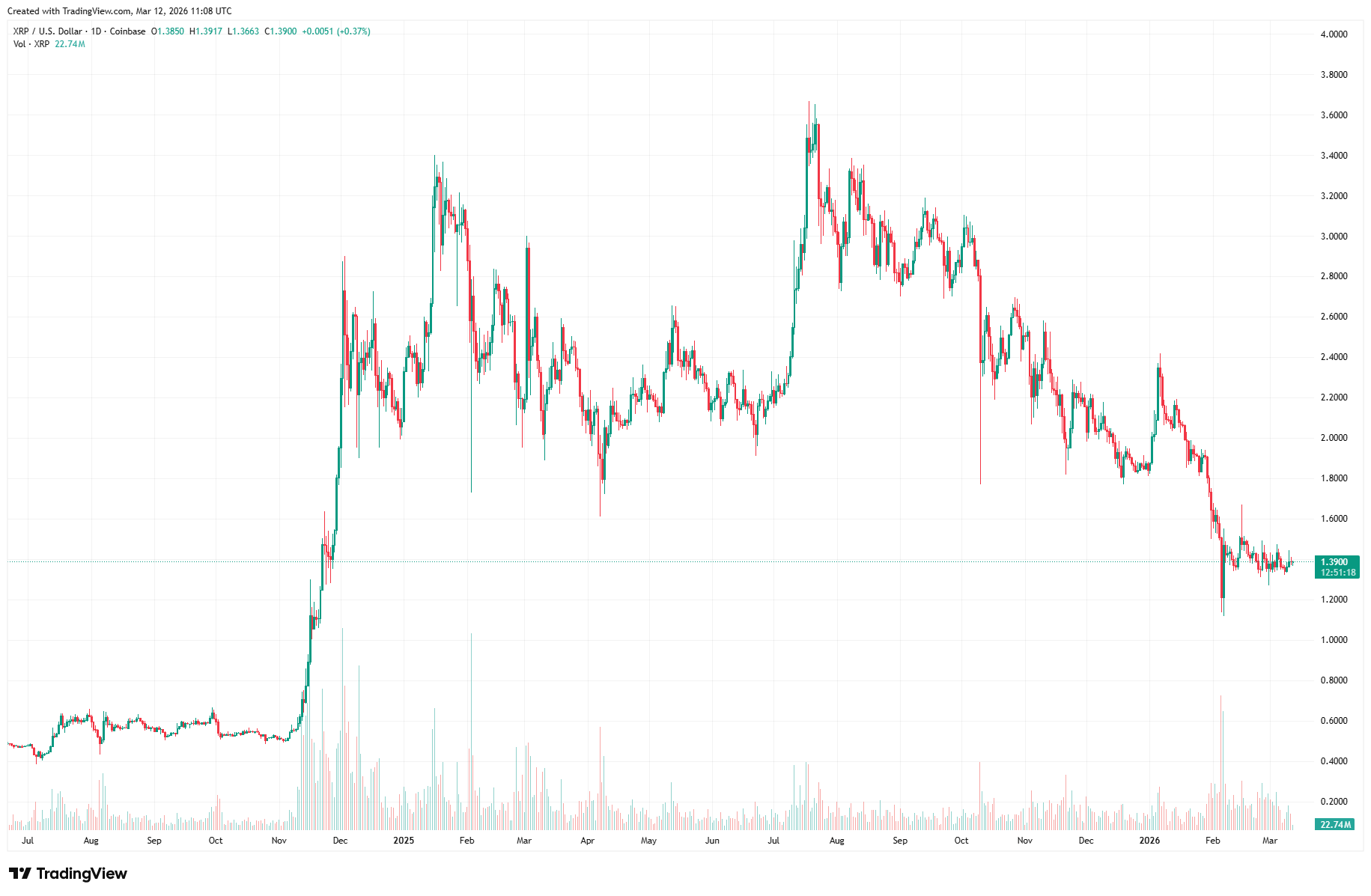
While Ripple as a company sets new valuation records, the associated token XRP paints a different picture. The price sits at around $1.39. Since its all-time high of roughly $3.56 in July 2025, it has lost over 60 percent. The ratio between the two valuations is striking. XRP's market capitalization currently stands at around $84 billion. Meanwhile, Ripple's enterprise valuation of $50 billion is increasingly approaching that mark. A significant portion of Ripple's enterprise value is based on the company's XRP holdings. Ripple holds billions of tokens, a large share of them in an escrow mechanism that releases tranches monthly.
This constellation exposes a structural asymmetry between equity and token. Shareholders benefit indirectly from the value of XRP reserves, while token holders have no claims on the company. There is neither legal clarity on the relationship between both asset classes nor any accountability toward token holders. Ripple can buy back shares, pay dividends, or execute acquisitions. Yet XRP holders have no influence over these decisions, even though the token price is directly affected.
The gap between rising enterprise valuation and falling token price illustrates this imbalance. Ripple's business model increasingly relies on institutional financial services such as prime brokerage and treasury management. As a result, the XRP token plays a subordinate role. The acquisition strategy consistently shifts the focus toward traditional financial infrastructure.
From SEC lawsuit to $50 billion valuation
Ripple's rise was not a straight line. The SEC sued the company, founded in 2012, in December 2020 over an allegedly illegal securities offering. These proceedings burdened Ripple's business and reputation for years. Only in 2025 did the SEC drop the lawsuit, clearing the path for the company's aggressive expansion strategy. Regulatory tailwinds in the United States are increasingly encouraging crypto firms to acquire traditional financial infrastructure. Ripple exploits this environment more consistently than most competitors. Accordingly, CBInsights lists the company among the global top 10 IPO candidates.
Still, Ripple is not planning an IPO in the near future. President Monica Long ruled out current IPO plans. CEO Garlinghouse put it more carefully. An IPO is "not a big priority," but the company is at a stage where it "could consider it." As long as recurring tender offers satisfy shareholders' liquidity needs, the pressure for an IPO remains low. The current program runs through April 2026.