
Bittensor is a decentralized network where participants develop, train, and trade AI models. Unlike projects such as Render or Akash, which provide computing power, Bittensor operates one layer higher: at the model layer.
In practice, this means participants do not rent out GPUs. Instead, they produce AI intelligence and evaluate its quality. The native token TAO compensates miners for their AI work and validators for quality assessment. With a market capitalization of roughly $3 billion, over 128 active subnets, and a recently completed 72-billion-parameter language model, Bittensor now attracts institutional investors. Both Grayscale and Bitwise have filed spot ETF applications with the SEC.
From Google Brain to a standalone blockchain
Jacob Steeves, a former Google engineer, conceived the idea of an AI blockchain back in 2016. Together with Ala Shaabana, a computer scientist with a PhD from McMaster University, he officially founded Bittensor in 2019. The whitepaper followed in 2020, and the network launched in January 2021.
One core design principle stood firm from the start: fair launch. Bittensor had no initial coin offering (ICO), no presale, and no pre-mined tokens. Every TAO in circulation reflects completed machine learning work. The founders deliberately chose a different path from the heavily VC-funded foundation model startups in the AI space.
However, the technical journey did not follow a straight line. Bittensor originally started as a Polkadot parachain. In March 2023, the team pivoted to an independent blockchain built on Substrate. Then, in October 2023, subnets went live on the "Finney" mainnet. This transition transformed Bittensor from a research project into a functioning network.
Architecture: Subtensor, subnets, and three roles
Subtensor forms the blockchain layer. It runs on Substrate, the framework behind Polkadot, but operates as a standalone network. The Opentensor Foundation controls the chain's Proof of Authority consensus mechanism.
Specialized subnets sit on top of Subtensor. Each subnet focuses on a specific AI task. Three participant roles define the system: miners perform the actual AI work, validators assess the quality of miner outputs and stake TAO as collateral, and subnet owners pay a TAO registration fee and set the rules for their subnet. Each subnet supports a maximum of 64 validators and 192 miners.
Subnet applications cover a wide range. Chutes (SN64) offers AI inference and receives 9.3% of all network emissions. Targon (SN4) by Manifold Labs operates a verifiable decentralized search engine and secured a Series A round of $10.5 million. Templar (SN3) focuses on LLM pretraining, while Theta (SN8) delivers trading signals. In total, the collective value of all subnets stands at approximately $550 million.
Yuma consensus: game theory instead of Proof of Work
Bittensor uses a custom reward algorithm called Yuma Consensus. Validators score the relative quality of each miner's output. Yuma Consensus then aggregates these ratings and determines TAO distribution. The algorithm applies the Shapley value approach, a game-theoretic concept for quantifying individual contributions.
The model works in a Darwinian fashion. Subnets with weak performance receive fewer emissions or drop out entirely. As a result, there is permanent competition for the best AI quality. Since July 2024, a commit-reveal mechanism encrypts validator ratings before disclosure. This prevents strategic copying between validators.
Governance follows a bicameral model. A triumvirate of three Opentensor Foundation members proposes upgrades. Subsequently, a senate composed of the twelve highest-staked validators votes on these proposals.



Tokenomics modeled after Bitcoin
TAO explicitly mirrors Bitcoin. The maximum supply stands at 21 million tokens. Before the first halving in mid-December 2025, the network emitted 7,200 TAO per day. Since then, the rate has dropped to 3,600 TAO per day. Currently, around 9.6 million TAO circulate. Approximately 73% of that supply is staked.
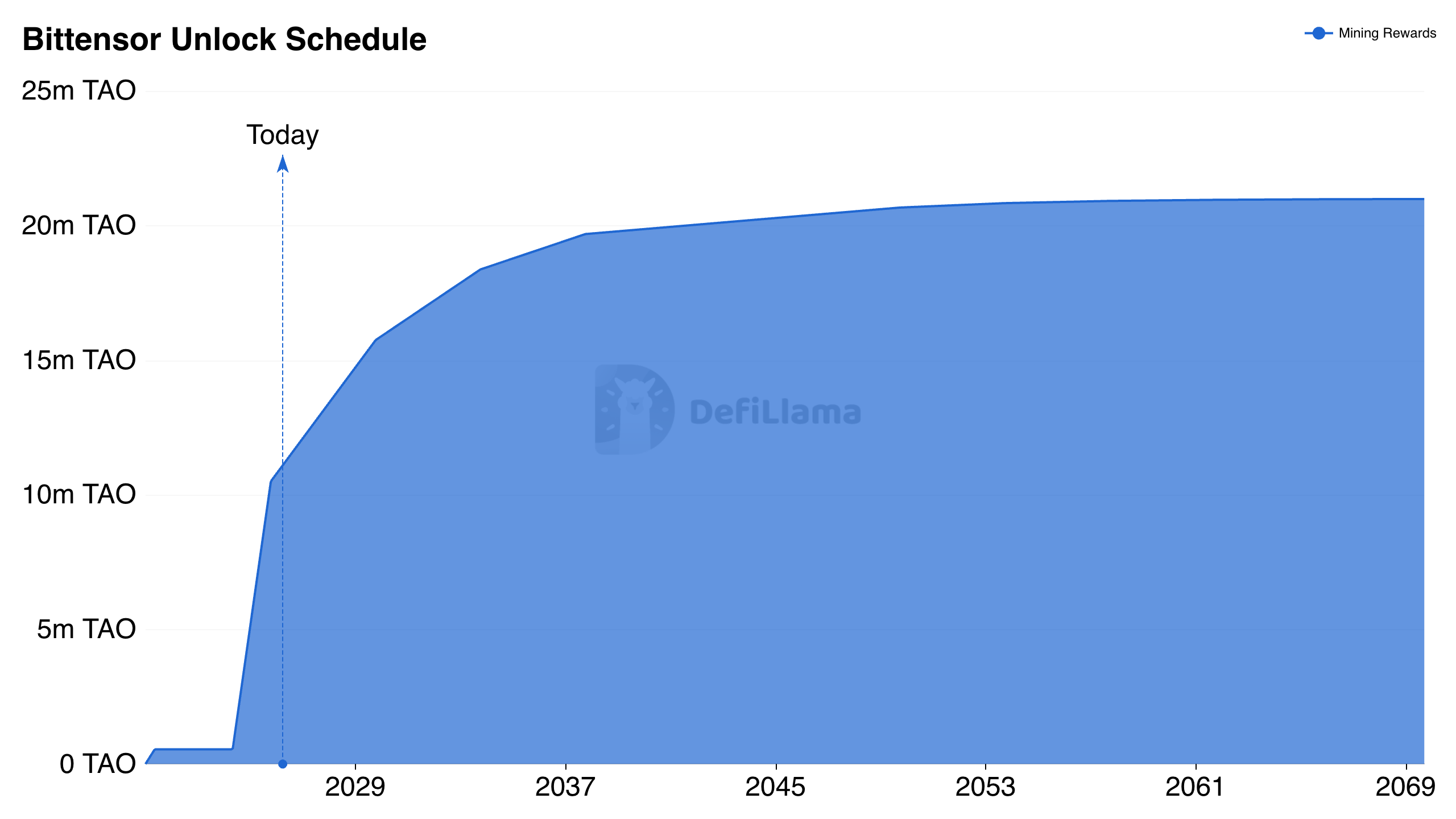
Emissions split across three network roles: 41% goes to miners, 41% to validators, and 18% to subnet owners. TAO recycling ensures that transaction fees, subnet registrations, and validator registrations flow back into the un-emitted supply. Unlike many crypto projects, the network does not permanently burn tokens. Instead, it returns them to the future emission pool.
In February 2025, the Dynamic TAO upgrade (dTAO) introduced a fundamental change. Previously, a small group of root validators controlled the entire emission distribution. Because of this structure, cronyism posed a real risk. Since dTAO, each subnet has its own alpha token, tradable against TAO on a constant-product AMM. That token's price determines emissions: more staking means higher emissions for the respective subnet. A randomized transaction order within each block prevents front-running.
Covenant-72B: decentralized training at scale
On March 10, 2026, Subnet 3 (Templar) completed the training of Covenant-72B. With 72 billion parameters, it ranks as the largest language model trained in a decentralized manner. Over 70 nodes worldwide participated. There was no whitelist: any participant with sufficient GPUs could join.
On the MMLU benchmark (zero-shot), Covenant-72B achieves a score of 67.1. This surpasses both Meta's LLaMA-2-70B and LLM360 K2. Weights and checkpoints are publicly available under the Apache license. Analysts described the training as "Bittensor's DeepSeek moment," providing proof that large language models can also emerge outside centralized labs.
The market responded quickly. TAO rose 46% within seven days. At the same time, Templar's alpha token gained 194% over the same period. Already in Q2 2025, the ecosystem had grown significantly: 50% more subnets, 16% more miners, and 28% more active wallets.
Institutional interest and ETF applications
Polychain Capital invested over $200 million in Bittensor. Digital Currency Group launched Yuma Asset Management as a dedicated vehicle for the ecosystem. Custody providers such as BitGo, Copper, and Crypto.com stake through Yuma's validator.
Furthermore, Grayscale filed an S-1 registration with the SEC on December 30, 2025. Its goal: converting the existing Grayscale Bittensor Trust into a spot ETP under the ticker GTAO on NYSE Arca. A formal spot TAO ETF application followed on March 14, 2026. Bitwise also has a pending application. Based on the 240-day review period, the SEC decision is expected by the end of 2026.
For 2026, the network plans to double subnet capacity from 128 to 256. In addition, the EVM compatibility achieved in 2025 enables direct deployment of smart contracts on subnets. This opens Bittensor to DeFi applications and a broader developer base.