
The Bank for International Settlements (BIS) has released a document addressing the recent turbulence in the crypto markets and the potential risks to the financial system. The report highlights the importance of promoting solid innovation through regulation and programmable central bank digital currencies (CBDCs).
The report of the "central bank of central banks" delves into various policy options for addressing these risks, including the prohibition of certain crypto activities, the isolation of cryptocurrencies from traditional finance (TradFi) and the real economy, and the regulation of the sector in a similar manner to traditional assets. Additionally, the BIS proposes an alternative CBDC approach that promotes solid innovation in the traditional financial world, in order to improve the existing monetary system and capitalize on the potential benefits of crypto technology.
Ultimately, the report concludes that the crypto market does not yet pose a significant threat to financial stability. However, it is important that authorities consider these policy options and take proactive measures to protect consumers and investors, preserve market integrity, and secure financial stability.
Crypto bankruptcies reignite debate
The recent bankruptcies of FTX and other crypto companies have reignited the debate over the appropriate political response to the risks posed by the crypto industry. According to the BIS, the crypto ecosystem and the "shadow banking systems" operated by centralized crypto firms (CeFi) and decentralized finance protocols (DeFi) exhibit many of the vulnerabilities associated with traditional finance (TradFi).

However, several factors exacerbate these standard risks, including high leverage, liquidity and maturity mismatches, and significant informational asymmetries. Political measures should consider how to appropriately address these sources of risk given the borderless nature of cryptocurrencies.




BIS considers complete crypto ban
The most extreme option for the BIS is a general ban on crypto activities. The pros and cons of this option can be easily assessed at an abstract level. In terms of benefits, if a ban were effective, it would eliminate any potential harm to the financial system, and investors would not suffer losses due to the misconduct of crypto providers. The biggest drawback would be that all useful innovations in the crypto field would be lost or delayed. The implementation of this option would be associated with the problem of enforcement. Enforcing decentralized crypto activities (DeFi) is already difficult due to their borderless nature. Therefore, it is not an ideal solution for the BIS.
The second option would mean isolating and limiting crypto activities so that they lead a more niche existence. This could primarily be done by limiting the flow of money into and out of the crypto industry and by limiting other connections to the traditional financial world. At the same time, containment would aim to prevent any link to the real economy (e.g. as a means of payment for goods and services or as a result of tokenization of real assets). There could be several possible reasons for this approach. Like bans, it would be a reasonable response if cryptocurrencies are seen as not providing a solution to a practical problem in the real world. It would also be appropriate according to the BIS if it is assumed that crypto activities would disappear with a restriction.
Hybrid regulation as the most sensible approach?
The third option is to regulate the sector in a similar manner to traditional finance (TradFi). By identifying the key economic functions of crypto activities and assessing how regulation could impact these, authorities could apply familiar principles and instruments to the crypto markets. This approach would ensure coherence in the regulation of financial activities, promote the policy objectives that are at the core of existing regulatory frameworks, and give the responsible actors the opportunity to innovate within the regulatory compliance and supervision.
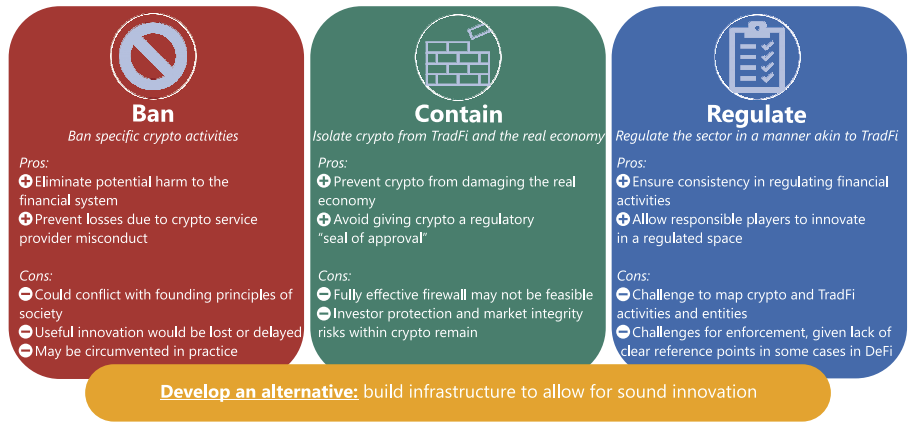
The greatest challenge of this approach, according to the BIS, is enforcement as identifying crypto firms can be difficult and their businesses may not adapt as well to the usual regulatory and supervisory instruments. Additionally, it can be difficult to assign crypto activities and facilities to their traditional counterparts and to create the appropriate legal frameworks. Ultimately, authorities could combine specific bans, containment and regulation depending on the specific characteristics of the crypto world and the relative effectiveness of individual measures to address the risks in the industry identified by the BIS.
CBDCs: a separate alternative
Central banks also play a role in addressing these risks by promoting solid innovation in the traditional financial sector. The BIS proposes developing an alternative, which could contribute to a more efficient currency system. Central banks are in a unique position to do this as they are at the center of the money and financial system. Their role is to create the trust that underpins this system. An important part of such a strategy could be improving the quality and reducing the costs of payments. One possibility is to introduce faster mass payment systems, such as India's Unified Payment Interface (UPI), Brazil's Pix, the upcoming FedNow system in the United States, or initiatives like the Single Euro Payments Area (SEPA).
Another option is the issuance of central bank digital currencies (CBDCs) that meet real needs. If CBDCs are properly designed and implemented, such initiatives could support solid innovation by the private sector. They could contribute to reducing the costs of payment systems, improving financial inclusion, strengthening the integrity of the system, and promoting user control over data and privacy, according to the BIS. The innovation present in certain areas of the crypto industry could be leveraged to improve the way services are provided in the traditional financial sector, using these CBDC initiatives to support new technical possibilities, particularly programmability, composability, and tokenization, thus increasing the efficiency of traditional systems.