
Close Menu
Crypto Valley Journal
    Facebook X (Twitter) Instagram
    Crypto Valley Journal
    • Hot Topics
      • News
      • Minds
    • Focus
      • Background
      • Blockchain
      • Legal & Compliance
      • Non-Fungible Token (NFTs)
    • Investing
      • Markets
      • Financial Products
      • Decentralized Finance (DeFi)
      • Exchange overview
    • Education
      • Basics
      • Glossary
      • Politicians on crypto
    • Statistics
      • Bitcoin-ETF-Flows
      • Ethereum-ETF-Flows
      • Crypto market data
      • On-chain data
    • Academy
      • Overview
      • Part 1: Blockchain
      • Part 2: Money
      • Part 3: Bitcoin
      • Part 4: Cryptocurrencies
      • Part 5: Decentralized Finance
      • Part 6: Investing
    • English
      • Deutsch
    Crypto Valley Journal
    You are at:Home»Investing»A valuation model for the cryptocurrency Ether (ETH)
    While Bitcoin has long been the "gold standard" of the crypto world, institutional investors are increasingly betting on Ethereum.

    A valuation model for the cryptocurrency Ether (ETH)

    By Editorial Office CVJ.CH on 21. June 2024 Investing

    Ethereum, a groundbreaking platform in the crypto world, has far surpassed the traditional boundaries of blockchain technology. Originally designed for peer-to-peer payments similar to the bitcoin model, Ethereum has revolutionized the possibilities of blockchain through smart contracts.

    To understand this transformation, we can explain it with an urban analogy to blockchain. The Ethereum blockchain has created a thriving ecosystem, led by its decentralized financial district (DeFi). A central component of this ecosystem is Ether (ETH), the native cryptocurrency of the Ethereum network. Much like oil powers machines, Ether powers the platform. Users must pay a "gas fee" in the form of ETH for every transaction they perform on the platform.

    Subscribe to our newsletter

    The best articles of the week, directly delivered into your mailbox.

    Valuation of Ether (ETH)

    A key challenge for investors is the valuation of cryptocurrencies such as Bitcoin or Ethereum. The valuation of bitcoin is particularly challenging due to its lack of yield, which requires the use of comparative valuation methods.

    Ethereum, on the other hand, uses a Proof-of-Stake (PoS) system in which validators stake ETH to earn recurring returns from network activity. Therefore, Ethereum can be valued using the Discounted Cash Flow (DCF) method. This method takes into account estimated future cash flows, which in this case are generated by transaction fees and staking returns. While the accuracy of any DCF model is highly dependent on the underlying assumptions, this approach demonstrates that traditional valuation frameworks can indeed be adapted for some assets in the crypto space.
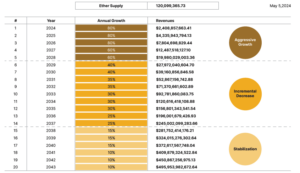
    cumulative Ether returns 21Shares Ether revenues with continuous growth / Source: 21Shares Research Report on Ethereum

    Ray Dalio’s Bridgewater Associates Minds

    Star investor Ray Dalio considers Bitcoin inferior to gold

    Analysis by Bitget Research on Bitcoin quantum computing risks, ECDSA exposure, NIST post-quantum standards, and BIP-360 migration paths. Background

    Bitcoin quantum computing: What recent developments mean for network security

    JPMorgan warns: Recurring DeFi exploits and stagnant ETH-denominated TVL curb institutional engagement in the DeFi sector. DeFi

    JPMorgan: DeFi hacks and TVL losses weigh on institutional investors

    Basics

    Unit bias in crypto: Why cheap coins mislead investors

    Ray Dalio’s Bridgewater Associates Minds

    Star investor Ray Dalio considers Bitcoin inferior to gold

    Analysis by Bitget Research on Bitcoin quantum computing risks, ECDSA exposure, NIST post-quantum standards, and BIP-360 migration paths. Background

    Bitcoin quantum computing: What recent developments mean for network security

    Fair value of Ether

    Assumptions about the discount rate play a crucial role in the valuation of cryptocurrencies such as ETH. In business valuation, the discount rate is the deduction used to determine the present value of future cash flows, reflecting the time value of money and investment risk. A lower discount rate implies a higher present value for Ethereum, while a higher discount rate implies a lower value.

    Using a discount rate of 9.70% (the average annual return of the Invesco QQQ Trust ETF over the past 10 years), we derive an implied price for ETH of approximately $6,974. This would be a significant increase from the current price of $3,132. Using a higher discount rate of 20.88% (determined using the Fama and French three-factor model), the implied price would be approximately $1,912. Investors must interpret such valuations with caution and make their own assumptions about future cash flows and risk premiums.

    Ether valuation based on discount rate

    Ether valuation based on discount rate / Source: 21Shares Research

    In summary, Ethereum is not only a technological innovation, but also sets new standards for the valuation and understanding of cryptocurrencies. The use of staking returns and transaction fees as proxies for future cash flows shows that traditional valuation frameworks can be adapted.


    Share. Facebook Twitter LinkedIn Email Telegram WhatsApp

    About the author

    Editorial Office CVJ.CH

      The CVJ editorial staff consists of a team of Blockchain experts and informs daily and independently about the most exciting news.

      Related Articles

      JPMorgan warns: Recurring DeFi exploits and stagnant ETH-denominated TVL curb institutional engagement in the DeFi sector.

      JPMorgan: DeFi hacks and TVL losses weigh on institutional investors

      Bitcoin fails again at the 80'000 USD mark, profit-taking weighs on ETH, SOL and XRP despite Strategy purchase and ceasefire.

      Bitcoin price climbs to 80’000 USD – profit-taking hits ETH, SOL and XRP

      BitMine reports USD 3.818 billion quarterly loss on ETH writedowns. Tom Lee's treasury holds 4.87 million ETH despite price pressure.

      BitMine reports USD 3.818 billion quarterly loss on ETH writedowns

      FalconX and Sygnum open institutional access to tokenized credit via the Desygnate platform and the FalconX Credit Vault.
      6. May 2026

      FalconX and Sygnum open regulated access to tokenized credit

      FINMA tightens consumer protection in crypto, grants first DLT license to BX Digital, and plans new license categories for stablecoin issuers.
      5. May 2026

      FINMA tightens crypto supervision and warns of consumer risks

      Coinbase backs the CLARITY Act compromise on stablecoin rewards, now the Senate committee markup path opens, with passage likely.
      4. May 2026

      Crypto industry backs down: Coinbase accepts CLARITY Act compromise

      twitter image button instagram image button linkedin image button youtube image button

      About Crypto Valley Journal
      About Crypto Valley Journal

      On the pulse of the movement

      • Academy
      • Contact
      • Advertising
      • About us
      • Partner
      • Imprint
      • Privacy
      • Disclaimer
      Search

      Type above and press Enter to search. Press Esc to cancel.