Bitcoin's price fell to an intraday low of $83,383 overnight. This represents a daily decline of 6.4 percent and the lowest level since November 2025. Since the all-time high of $126,000 in October 2025, the drawdown now totals roughly 33 percent.
At the same time, US spot Bitcoin ETFs recorded net outflows of $1.14 billion during the week of January 20 to 26. Fidelity's FBTC lost $757 million, BlackRock's IBIT shed $509 million, and Grayscale's GBTC saw between $290 and $408 million in redemptions. As a result, three funds were responsible for 92 percent of all outflows.
Capital rotation into commodities and rebalancing
The Bitcoin sell-off is part of a broader capital rotation. Gold reached $5,268 per ounce on January 28, with a brief intraday spike above $5,600 the following day. Meanwhile, silver rose 65 percent in January 2026 to $120 per ounce. Investors are clearly favoring traditional safe-haven assets.
The technology sector also came under pressure. The Nasdaq fell 1.5 percent, and Microsoft dropped 11 percent after its quarterly earnings. In addition, new US tariffs on rare earths and Chinese export restrictions added to the uncertainty. The CoinMarketCap Altcoin Season Indicator stands at 25 out of 100 points. Ethereum lost 6 percent, Solana 3.4 percent.
ETF outflows in historical context
The January outflows are part of a longer trend. In November and December 2025, US spot Bitcoin ETFs already lost a combined $4.57 billion. November alone saw $3.48 billion in outflows. Brief optimism returned at the start of 2026: on January 2 and 3, the funds recorded $1.16 billion in inflows. But starting January 6, the direction reversed again.
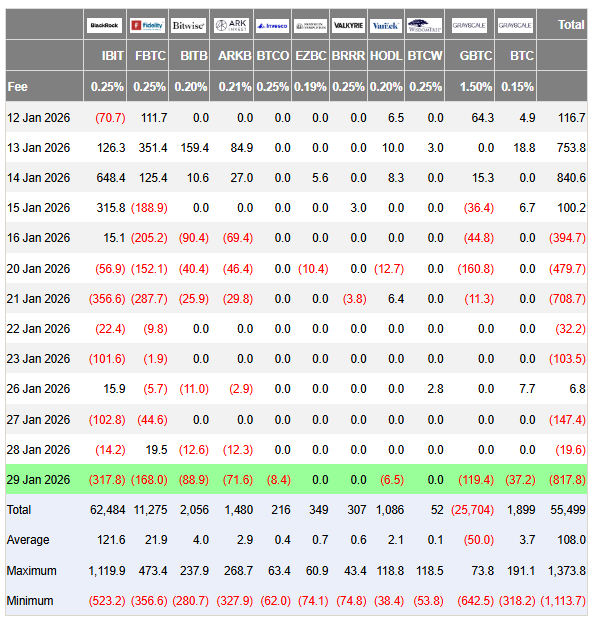
Despite the recent outflows, US spot Bitcoin ETFs still manage over $110 billion in AUM. Since their launch in January 2024, cumulative net inflows total around $57.5 billion. Grayscale's GBTC has recorded cumulative outflows of over $25 billion since its conversion to a spot ETF. Meanwhile, newer products such as XRP and Solana ETFs, which launched in late 2025, attracted steady inflows. Also, the AI sector absorbed risk capital that had previously flowed into the crypto market.




Derivatives market under pressure
The decline triggered $319 million in liquidations within 24 hours. In the options market, 97 percent of call options were out-of-the-money, while 50 percent of put options were in the money. Long-term holders also pulled back: in 2025, they sold Bitcoin worth nearly $300 billion.
Futures open interest fell from $94.1 billion to $54.6 billion, a reduction of 40 percent since the all-time high. On a technical level, Bitcoin broke below the 100-week SMA at around $85,000. The next relevant support zone sits at $80,000. Resistance levels are at the 100-day EMA at $96,000 and the 200-day EMA at $99,500.
Fed policy and political uncertainty
The Federal Reserve held its benchmark rate at 3.50 to 3.75 percent on January 28. This decision was neutral for crypto markets, as it matched expectations. Yet the political dimension carries more weight. Jerome Powell revealed that the Department of Justice had issued grand jury subpoenas to the Fed. He described the investigation as punishment for the Fed's refusal to cut rates at Trump's request.
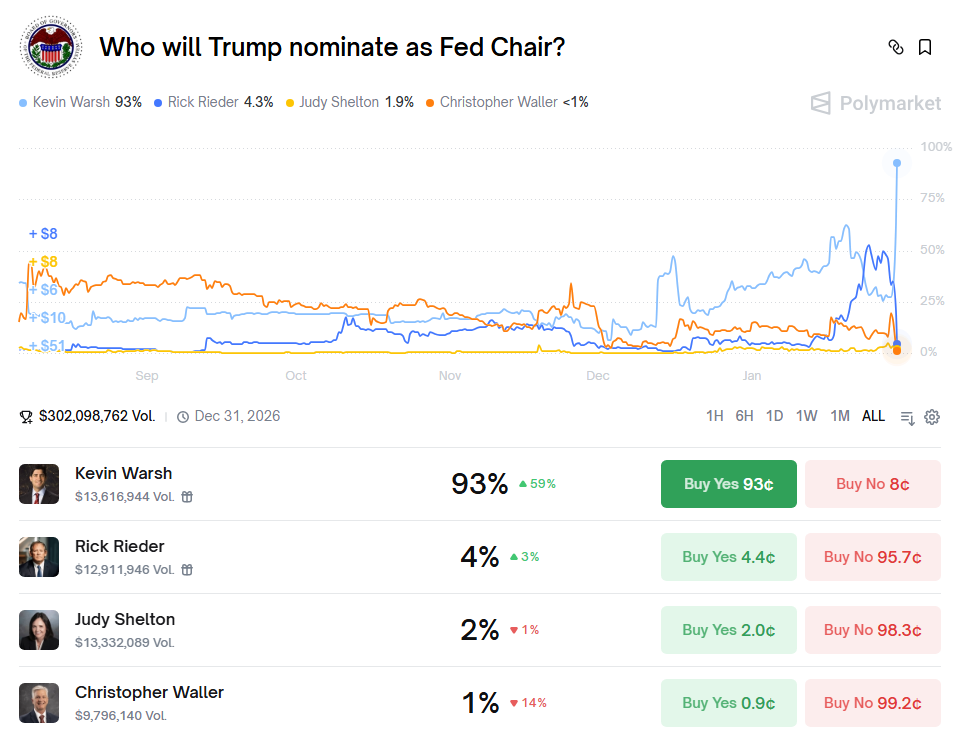
President Trump announced he would name Powell's successor on January 30. Powell's term ends in May 2026. On Polymarket, Kevin Warsh leads with 80 percent as the favorite. Other candidates include Kevin Hassett, Christopher Waller, and Rick Rieder. A dovish Fed chair could accelerate rate-cut expectations. Still, the current frontrunner is considered a hawk focused on strengthening the reserve currency.