Algorithm-based stablecoins are gaining momentum in the world of decentralized financial applications (DeFi). An introduction to the leading decentralized stablecoin TerraUSD (UST) with its stabilization mechanisms, adoption history, and risks.
Algorithmic stablecoins, unlike their centralized counterparts, do not have collateral attached to them. Therefore, they are also referred to as non-collateralized stablecoins. The algorithm or protocol underlying these stablecoins acts as a "central bank." It helps in increasing the supply in case of a deflationary trend of the token or decreasing the supply in case of a decline in purchasing power. With a market capitalization of over $10 billion, Terra's UST emerged as the poster child of the sector. However, even the largest algorithmic stablecoin hides considerable risks.
The stabilization mechanism for TerraUSD (UST)
Terra uses a dual token system for maintaining the fiat peg. On the one hand, the LUNA token is used for paying network fees, holding governance votes, participating in the consensus process (PoS), and minting stablecoins. But the real stablecoin is TerraUSD (UST), whose binding is ensured by a unique seigniorage system.
The majority of traditional stablecoins are backed by deposited assets that can be redeemed or liquidated in the event of a binding loss. Terra's system instead uses a burn mechanism in conjunction with the platform token LUNA. To create a new TerraUSD (UST), the same dollar amount in LUNA must be destroyed. Thus, 1 dollar in LUNA can always be exchanged for 1 UST and vice versa. This creates an arbitrage opportunity for market participants if the TerraUSD exchange rate differs from 1 dollar. Also, the mechanism exerts deflationary pressure on LUNA if UST gains adoption.
The Anchor decentralized savings protocol
The Anchor protocol was developed by Terraform Labs and launched in March 2021. It was created in part to increase aggregate demand for UST. It is a decentralized savings protocol that offers low fluctuating returns on Terra Stablecoin deposits (around 20% per year). The Anchor interest rate is fed by a diversified stream of staking rewards from large proof-of-stake blockchains, and should therefore be more stable than traditional money market interest rates.
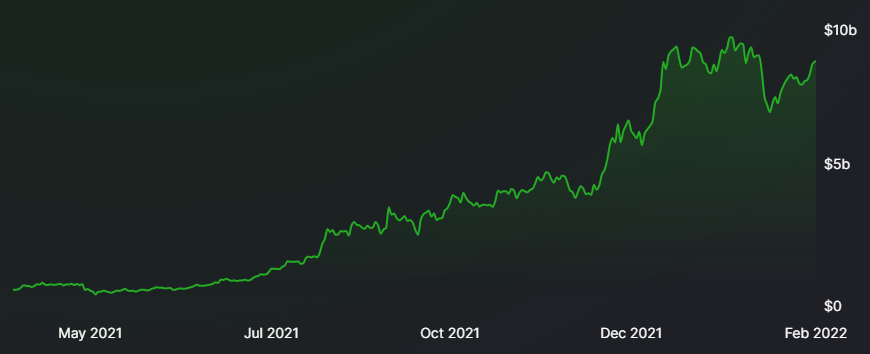
The open, permission-free Anchor protocol defines a money market between a lender who wants to earn stable returns on its stablecoins and a borrower who wants to borrow stablecoins on deposited assets. To borrow stablecoins, the borrower locks bonded assets (bAssets) as collateral and borrows stablecoins below the liquidation barrier defined by the protocol. The diversified stream of staking rewards accruing to the global pool of collateral is then converted into Stablecoin and granted to the lender in the form of a stable return. Among several other DeFi applications and e-commerce solutions, Anchor ensures the highest demand for TerraUSD.
Risks of UST stablecoin
The biggest risk with TerraUSD, similar to other algorithmic stablecoins, lies in keeping the 1:1 dollar peg. Since UST is directly linked to the LUNA token, large price fluctuations can drastically affect the peg. With a market cap of $22 billion, the number of UST (11 billion) is currently "backed" by enough LUNA. However, if the market capitalization of the LUNA token falls below the 11 billion mark (around -50%), a loss of commitment becomes increasingly likely. This is exactly what happened during the general market crash on May 23, 2021, when the 2 billion UST was only covered by 1.6 billion USD in LUNA.
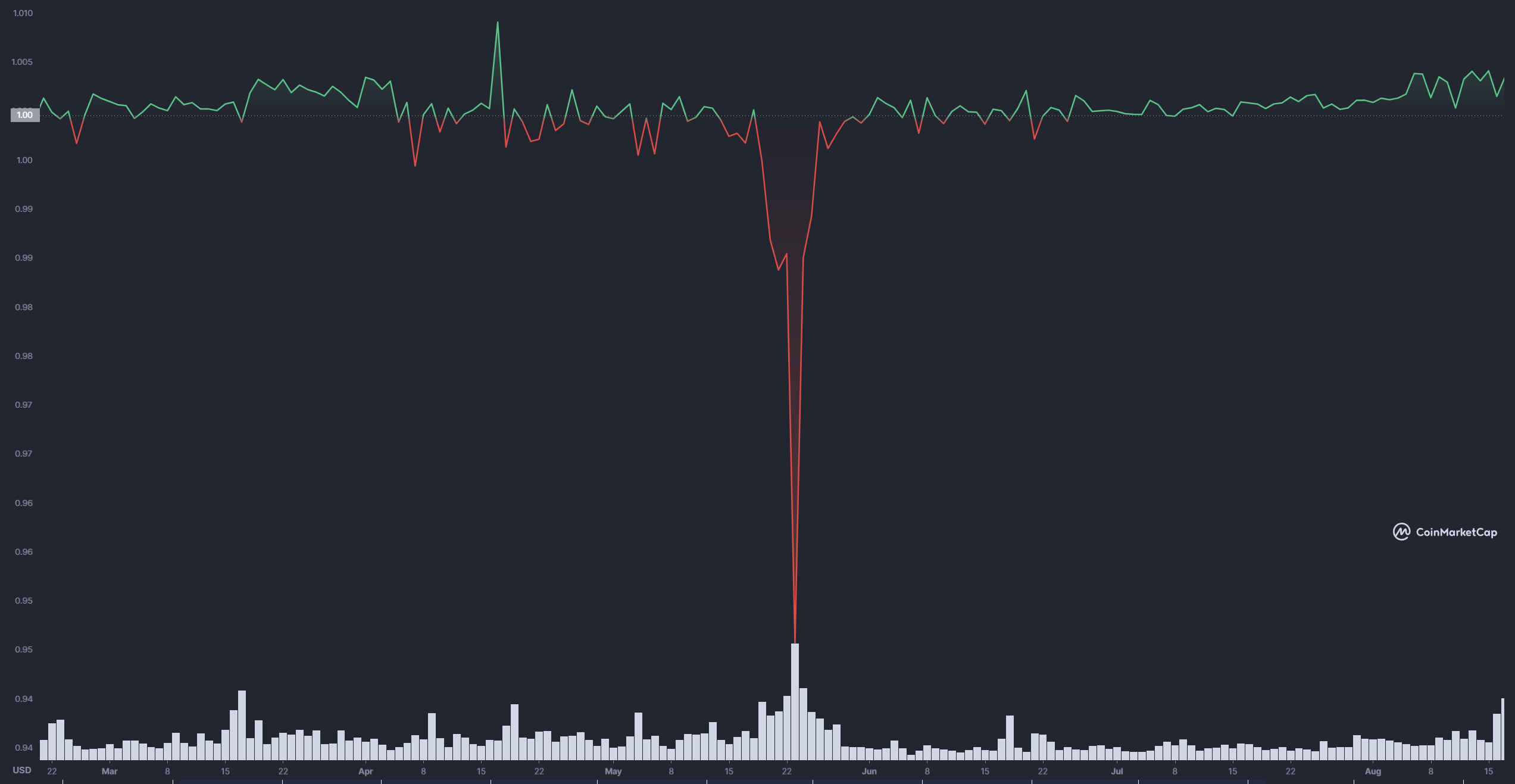
The peg was only able to recover when Terraform Labs and investors behind the project bought out LUNA and restored the 1:1 dollar price. Since then, however, TerraUSD's market cap has quintupled and a similar event would be devastating. UST, meanwhile, is deposited in countless DeFi platforms as a dollar stablecoin that rely on the preservation of the peg. A binding loss would impact billions of assets in the ecosystem.
Anchor returns critical to UST binding
As mentioned earlier, the majority of UST demand comes from the Anchor savings protocol, which offers a very attractive return on stablecoins at just under 20% per year. These are generated through the mechanisms mentioned above. But as money market rates and staking yields fluctuate along with the market environment, the protocol has established an emergency reserve pool. In times of a weak market, Anchor can access these reserves to ensure continued high returns. According to Terraform Labs, this is a temporary solution until UST demand on other platforms is sufficiently high.
Once the reserve pool is empty, Anchor returns will be left entirely to market forces. If current mechanisms cannot guarantee a 20% return, this would have a negative impact on UST demand. Capital migration to other platforms with more attractive opportunities would lead to large-scale UST redemption and put corresponding downward pressure on the LUNA price. With a falling LUNA price, the likelihood of a commitment loss then increases, exacerbated by leveraged positions on Anchor (leveraged UST with deposited LUNA collateral).




Stabilization Measures
To address this risk, the LUNA community has decided to replenish the reserve pool again with $450 million. The reserve replenishment is intended to ensure 20% p.a. returns on Anchor for three more quarters and prevent capital migration for the remainder of the year. In addition, the Anchor team will accelerate development work on their new v2 loan model, which should restore UST returns to 20% p.a. even without the reserve pool.
Other protocols in the ecosystem have also set their sights on tether preservation of the TerraUSD stablecoin. One example is the so-called "White Whale" protocol. The Terra decentralized platform uses arbitrage opportunities between LUNA and UST to generate additional returns on deposits. In the event of a commitment mismatch, White Whale can access deposited UST holdings and restore the commitment through arbitrage. These projects, in combination with Anchor reserve replenishment, make an important contribution to supporting the TerraUSD stablecoin, while not completely eliminating the risks of a binding loss.