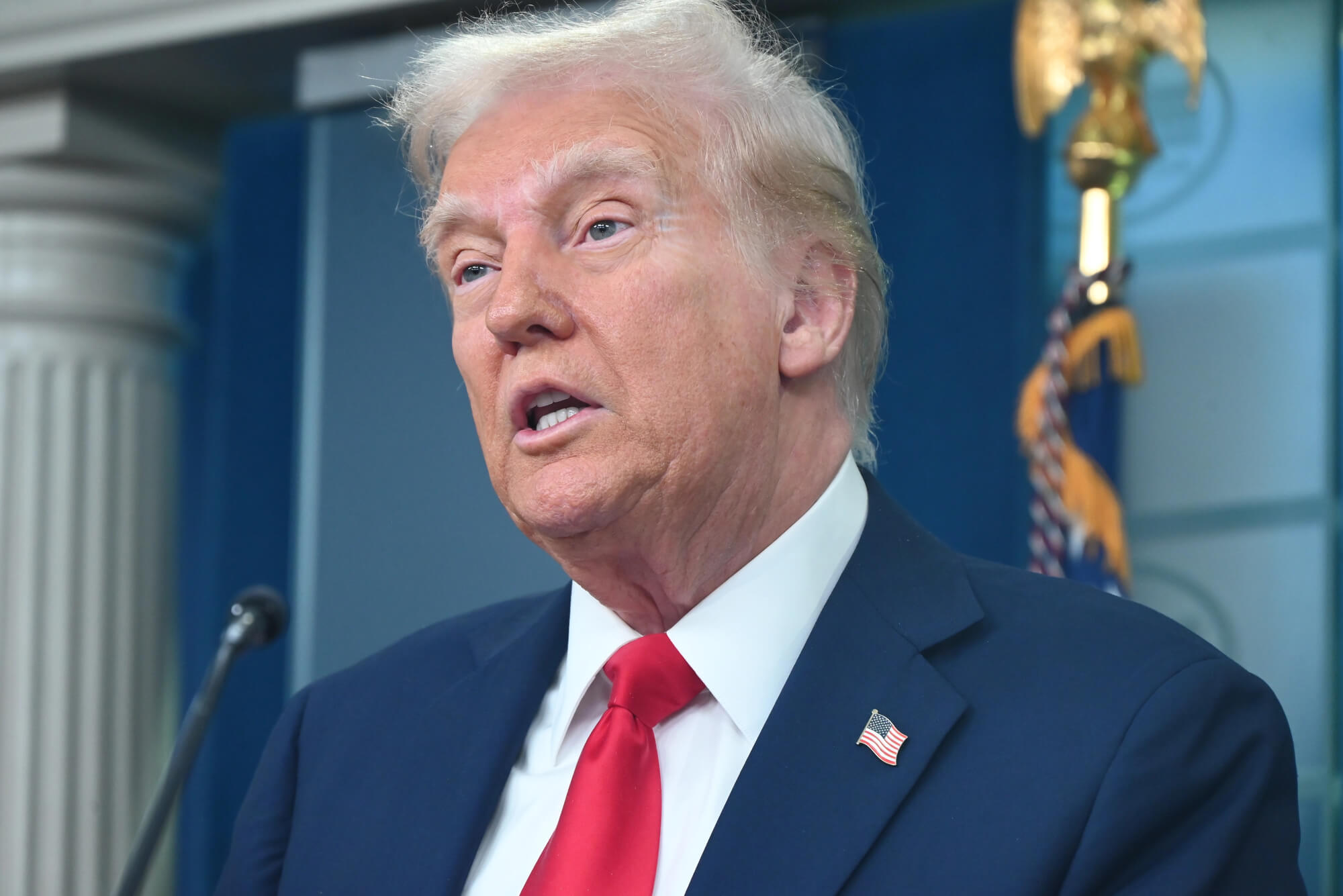
US President Donald Trump has publicly stated that he will sign the CLARITY Act as soon as the crypto market structure bill reaches his desk. That, however, is exactly where the problem lies. Since the House of Representatives passed the Digital Asset Market Clarity Act of 2025 in July 2025, the legislation has been stuck in the Senate.
Senator Cynthia Lummis (R-Wyoming) warned on 11 April 2026 that the Senate Banking Committee must schedule a markup by 25 April. Otherwise, a delay until 2030 looms. That deadline has since passed without any date being set. As a result, the window is narrowing further, because the Memorial Day Recess begins on 21 May 2026, after which the campaign calendar effectively takes over.
Five steps, a tight window
Before Trump can even sign, five sequential steps are required. First, the Senate Banking Committee under Chair Tim Scott (R-SC) must conduct a markup. After that comes the full Senate vote, which requires 60 votes. In parallel, the Senate Agriculture Committee is working on its own version, which must also be voted on. Both chambers will then reconcile the Senate texts with the House draft from July 2025. Only then can the president sign.
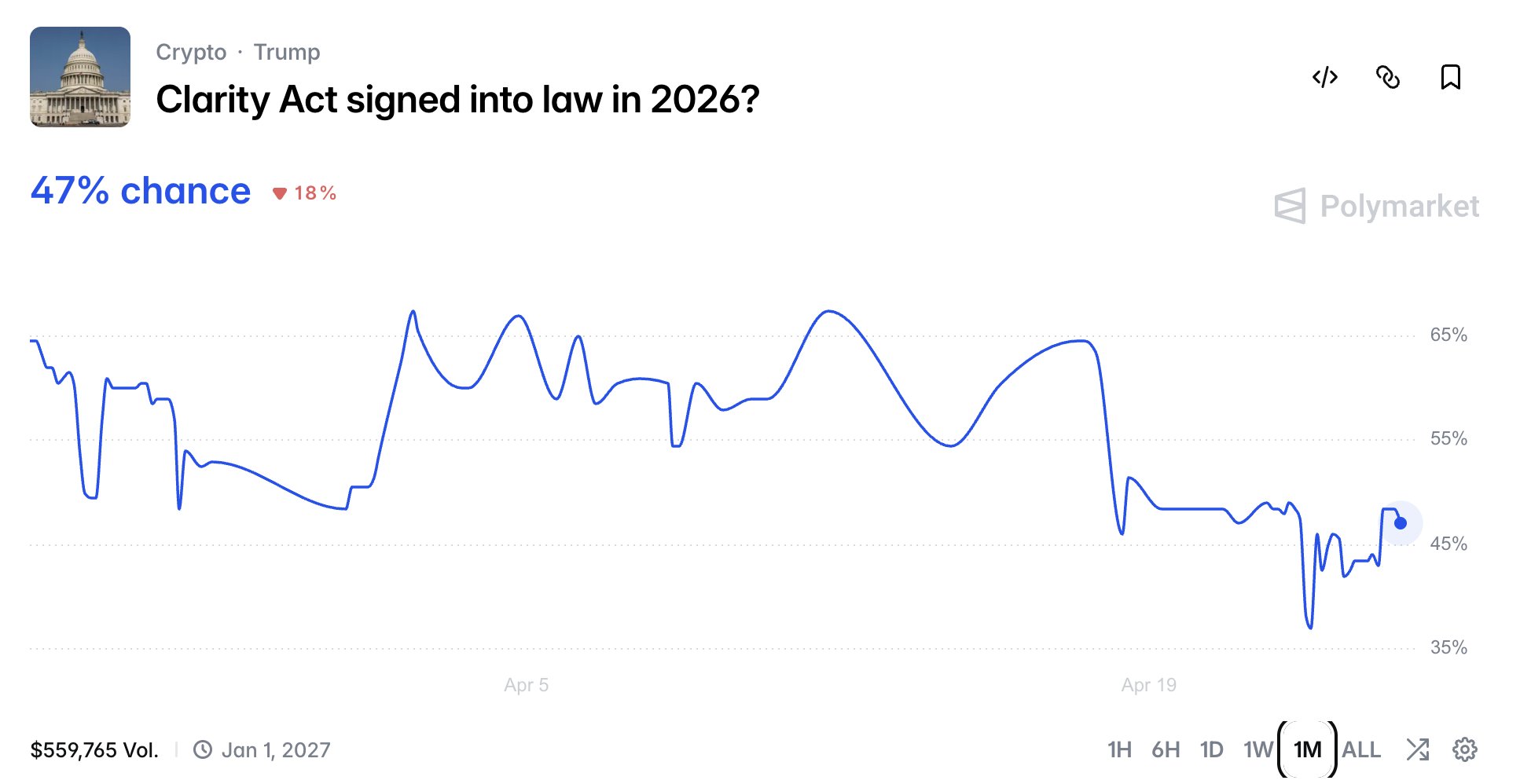
Senator Bernie Moreno (R-Ohio) stated publicly on 22 April 2026 that the CLARITY Act must clear Congress by the end of May. Galaxy Digital puts the chances at roughly 50 percent, possibly lower. Polymarket traders currently see the probability at 47 percent, down from 82 percent in February.
The background to the delay threat is structural. The midterms on 3 November 2026 will reset all pending legislative procedures. If the CLARITY Act fails to clear the current Congress, the entire process restarts in the next legislative term. Historically, no US Congress has ever passed comprehensive crypto market structure legislation.
Trump's SAVE Act ultimatum blocks the pipeline
In March 2026, Trump posted a statement on Truth Social that upended the entire legislative agenda. He would not sign a single bill until the SAVE America Act passes in its strongest form. In his words: "It takes precedence over everything else. MUST GO TO THE FRONT OF THE LINE."
The SAVE America Act requires proof of citizenship and a photo ID for federal voter registration. In the House, it passed narrowly with 218 to 213 votes. In the Senate, it awaits a vote where Democrats are expected to push back hard. Trump has thereby effectively pushed every other bill, including the CLARITY Act, into a holding queue.
While his crypto adviser David Sacks declared in January 2026 that passage was "closer than ever", the president himself is blocking the pipeline with a condition of his own. For the crypto industry, this means: even if the Senate delivers, Congress must first resolve the voter ID dispute.




Bank lobby and Coinbase as brakes
Within the Senate, a dispute over stablecoin yields is blocking the process. Bank lobbyists have convinced enough senators to vote against stablecoin reward programs because they come too close to interest on deposits. The 278-page Senate Banking Committee draft prohibits stablecoin service providers from offering interest or yield for the mere holding of stablecoins. Activity-based incentives remain permitted. On 18 April 2026, the North Carolina Bankers Association mobilized its members to contact Senator Thom Tillis (R-N.C.). Tillis is regarded as a key swing vote.
Coinbase CEO Brian Armstrong withdrew his company's support in January 2026. He cites four objections: restrictions on tokenized equities, DeFi provisions with broad state data access, erosion of CFTC authority in favor of the SEC, and the elimination of stablecoin yields. The latter accounted for around 20 percent of Coinbase's Q3 2025 revenue. Armstrong's message in substance: no bill is better than a bad one.
The crypto industry is not united. The Digital Chamber called for an immediate markup in a formal letter on 20 April 2026, and 120 crypto firms issued a similar appeal to the Senate on 25 April. At the same time, one of the largest players is actively working against the current text. Senator Moreno commented on the bank lobby pressure tersely, saying that much of the noise in the market is inauthentic.
What 2030 would mean
The CLARITY Act would be the first comprehensive market structure law for digital assets in the United States. It would clarify which crypto assets fall under SEC jurisdiction as securities and which come under the CFTC as commodities. This question occupied the industry for years under the Biden administration, when the SEC operated through enforcement actions rather than clear rules.
A delay until 2030 would carry concrete consequences. US crypto firms would have to operate in a regulatory gray zone for another four years, while jurisdictions such as the EU with MiCA, Switzerland with its DLT laws, and Hong Kong with its own frameworks set the pace. Tokenized equities, DeFi protocols, and stablecoin business would continue to run under the old regime.
The next four weeks will decide. If Tim Scott does not schedule a markup by mid-May, the window closes until after the midterms. Polymarket odds rose from 38 to 46 percent following Moreno's end-of-May ultimatum on 22 April. That reaction shows how sensitively the market responds to every Senate movement. The Banking Committee has not announced a date so far.