
The FTX/Alameda saga keeps entering new levels of strange. On Friday, both FTX and FTX US filed for bankruptcy, along with 134 related entities, highlighting just how tangled the exchange’s corporate web had become. A market analysis of how the collapse will influence crypto's liquidity.
Just a few hours after the bankruptcy filing, the exchange suffered what now appears to be a massive hack, with more than $600mn siphoned from both FTX and FTX US wallets, instantly triggering rumors of an inside job. Perhaps most alarming, though, was a bombshell report by Reuters claiming SBF had built a secret backdoor to funnel funds between Alameda Research and FTX without auditors noticing. Today, we will focus on the impact that Alameda’s market making operations had on crypto, and what their collapse could mean for liquidity as a whole.
The Alameda gap
Alameda Research was one of the largest market makers in crypto, providing billions of dollars worth of liquidity for high-cap and low-cap tokens alike. Their entire trading operation, it now increasingly seems is the case, was supported by FTX and a shady commingling of client funds. Last Thursday, Alameda Research announced they would officially wind down trading. What does this mean for market-wide liquidity?
Crypto liquidity is dominated by just a handful of trading firms, including Wintermute, Amber Group, B2C2, Genesis, Cumberland and (the now defunct) Alameda. With the loss of one of the largest market makers, we can expect a significant drop in liquidity, which we will call the “Alameda Gap.” This gap is exacerbated by losses that other market makers incurred due to the collapse of FTX. To date, Amber Group, Wintermute, and Genesis have each announced they have funds trapped on FTX, which could impact their overall market making operations.
Liquidity typically drops during times of volatility as market makers pull bids/asks from order books to manage risk and avoid toxic flow. But the drop in liquidity we have observed over the past week is far larger than any other previous market drawdown, which suggests the Alameda Gap in liquidity could be here to stay, at least in the short term.
Market depth drops sharply
Since November 5, the day that CoinDesk published its investigation of Alameda’s balance sheet, BTC liquidity within 2% of the mid price has fallen from 11.8k BTC to just 7k, its lowest level since early June.
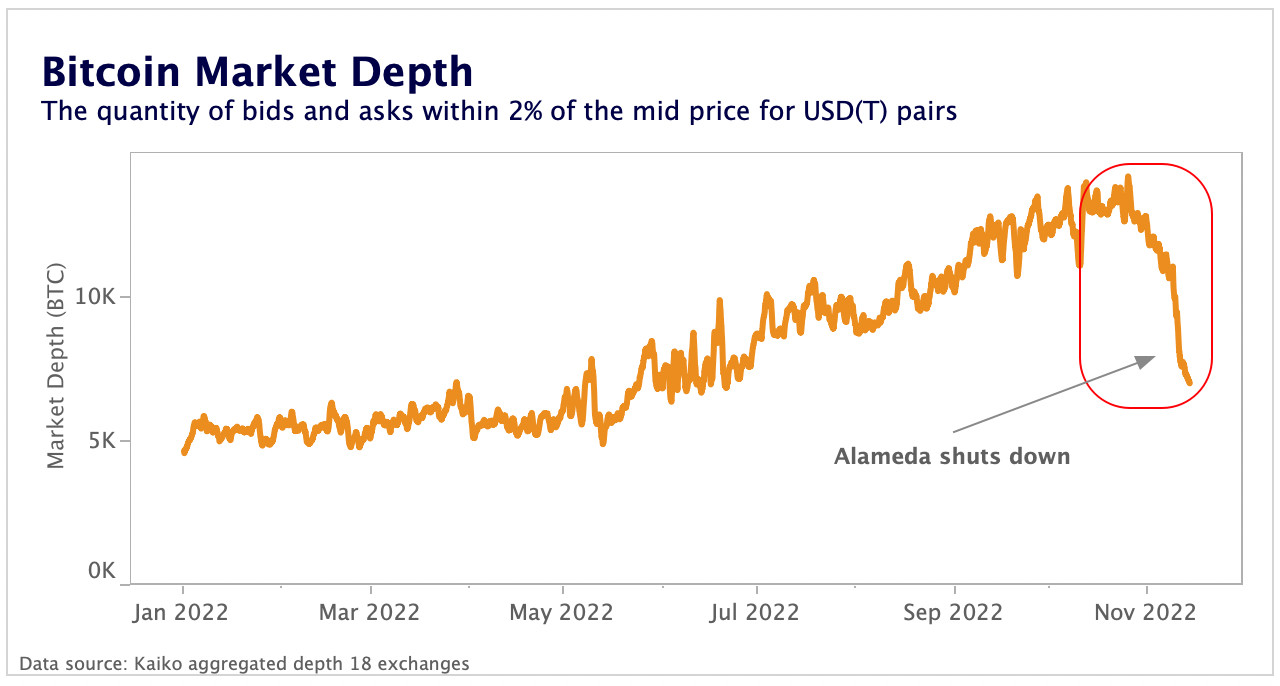
The chart above aggregates market depth across 18 exchanges including FTX, which no longer has any real market making activity. Even when excluding FTX from the chart, there is still a huge drop in depth, which suggests market-wide liquidity was significantly impacted by Alameda’s collapse and losses incurred by other market makers. Since November 5, Kraken’s BTC depth has fallen by 57%, Bitstamp’s by 32%, Binance’s by 25%, and Coinbase’s by 18%. ETH markets were also affected by the collapse, with 2% market depth falling to late May levels.
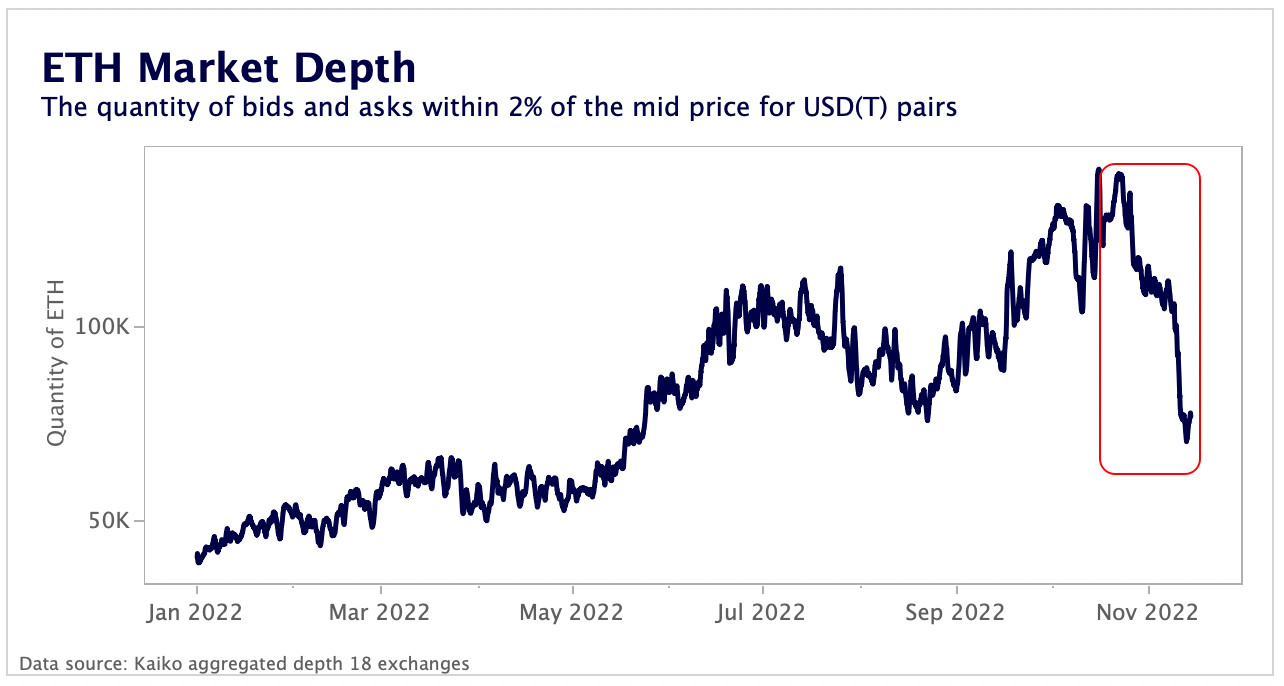
Thankfully, market-wide Bitcoin (BTC) and Ethereum (ETH) liquidity had been steadily increasing since the crypto credit crisis in May/June, so hopefully the drop in depth will not too disruptive. What is more concerning is liquidity for altcoins. Alameda invested in dozens of projects and held millions of dollars worth of low liquidity tokens. But because Alameda was also a market maker, we can assume they were also a primary liquidity provider for these same tokens.
Solana ecosystem most impacted
It remains unclear what the full breakdown in tokens held by Alameda vs. FTX looks like, but here is a breakdown of FTX’s balance sheet provided by the Financial Times, which ranks assets held by their liquidity:
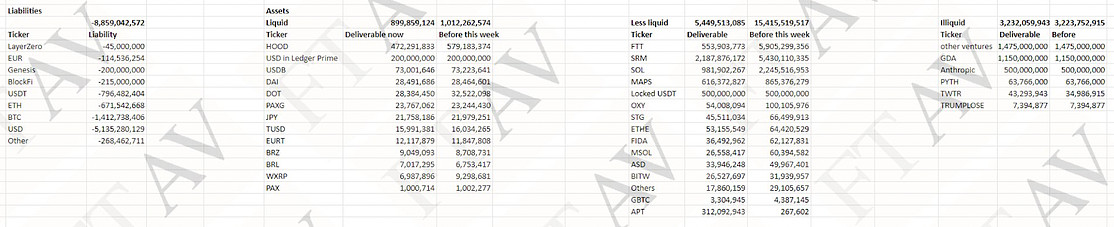
Under the “less liquid” category, the first four are FTT (the source of it all), a Solana DEX token called Serum (SRM), Solana’s native token SOL, and a token called MAPS. Let’s take a look at liquidity for SRM, SOL and MAPS, pre- and post-Alameda collapse. The below chart takes aggregated depth across 9 exchanges that offer SOL trading pairs. Total market depth has fallen 50% from 1 million SOL to under 500k aggregated across all order books, and this drop was felt on every single exchange.
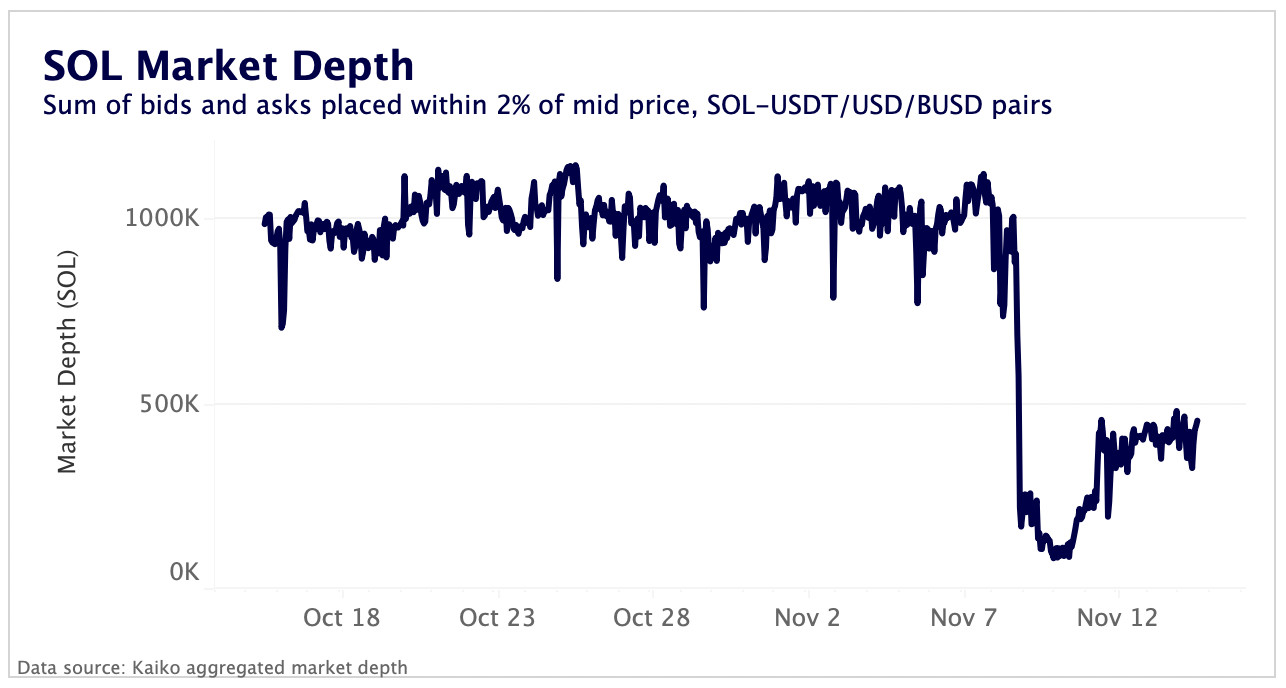
SRM and MAPS have also seen a huge drop in depth. We denominate depth in the native units of each token to avoid price effects, which suggests that market making activity has been severely impacted by Alameda’s collapse.
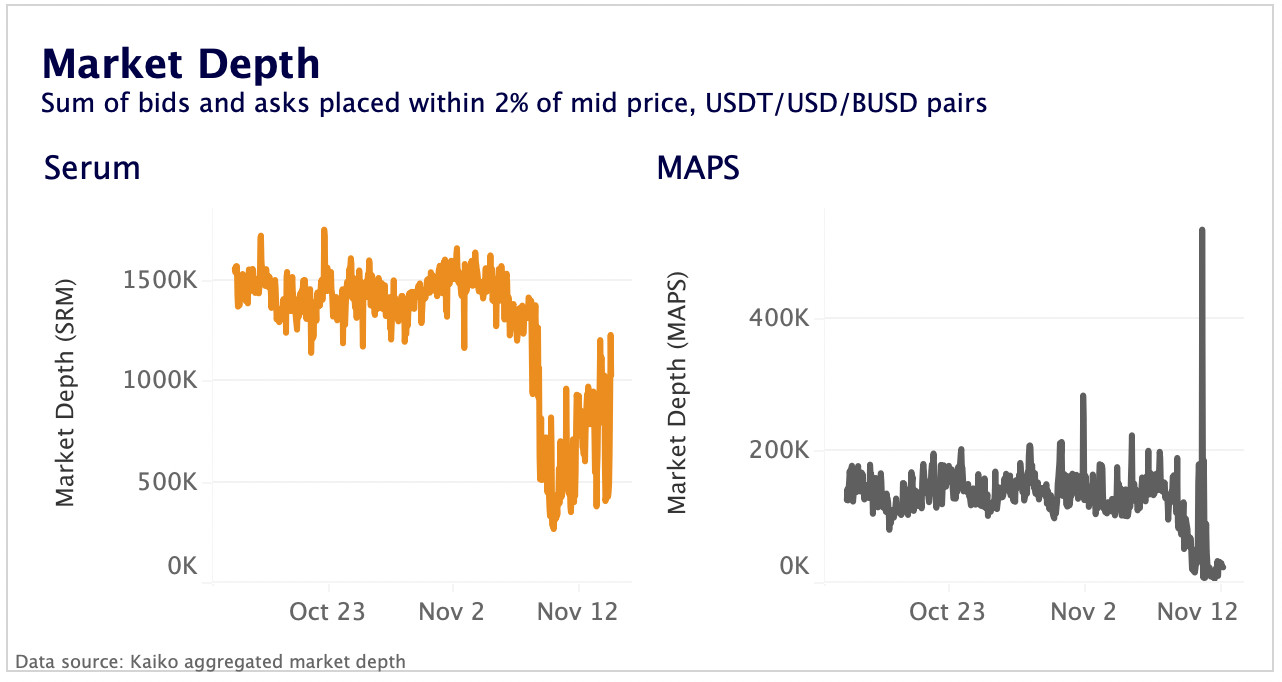
Alameda held a huge amount of illiquid tokens while (almost certainly) being a market maker for these same tokens, which put the firm in a nearly impossible position when faced with insolvency. Overall, it can be expected that liquidity will be very thin in the near future for altcoins, especially those that had significant investment from the FTX/Alameda entity.
Are stablecoins at risk?
While illiquid altcoins account for a significant portion of Alameda/FTX’s balance sheet, Alameda also holds millions in stablecoins. The below Dune Analytics dashboard produced by 21Shares Research tracks the holdings of known Ethereum wallet addresses associated with Alameda.
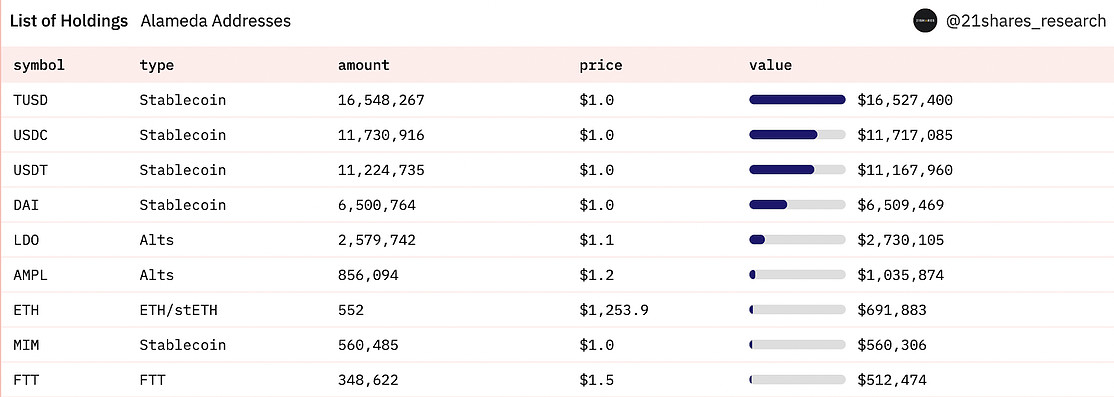
As of Monday morning, Alameda holds over $46mn worth of stablecoins with its largest stablecoin holding being TrueUSD (the 6th largest stablecoin by market cap), followed by $11.7M of USDC and $11M of USDT. Its USDC holdings have declined five-fold since the end of last week. While TUSD is one of the least liquid stablecoins, with active trading on just 10 centralized exchanges, its price on CEXs has held relatively steady over the past week.
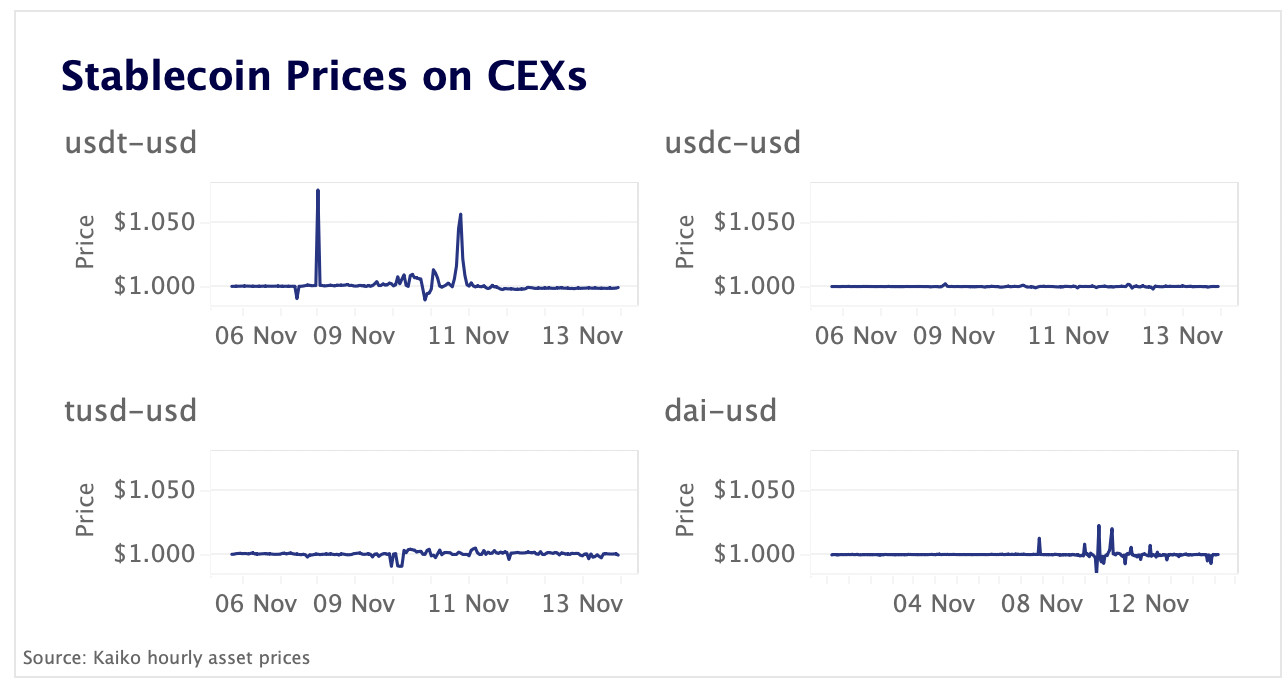
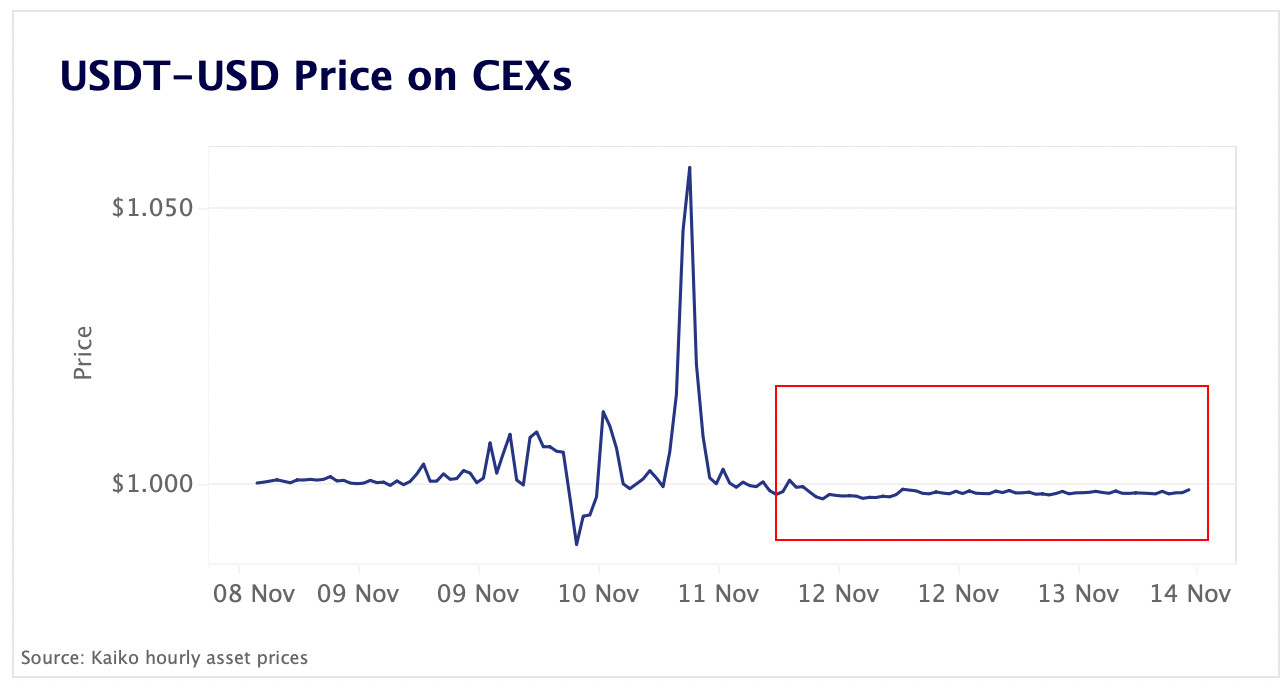
Tether (USDT) exhibited the sharpest price moves, initially falling to $0.989 on Nov 10th before surging to $1.058 on Nov 11. It has been trading at a very small discount since then, suggesting persistent selling pressure on centralized spot markets.
There was even speculation that Alameda was aggressively shorting USDT by borrowing USDT using USDC on Aave, and then selling it on other exchanges such as Curve. Below, activity on Curve’s 3pool shows that heavy selling of USDT for USDC and DAI resulted in USDT’s price (blue) briefly falling 2 cents below its peg. It has since recovered and is now just 10 bps below its peg.
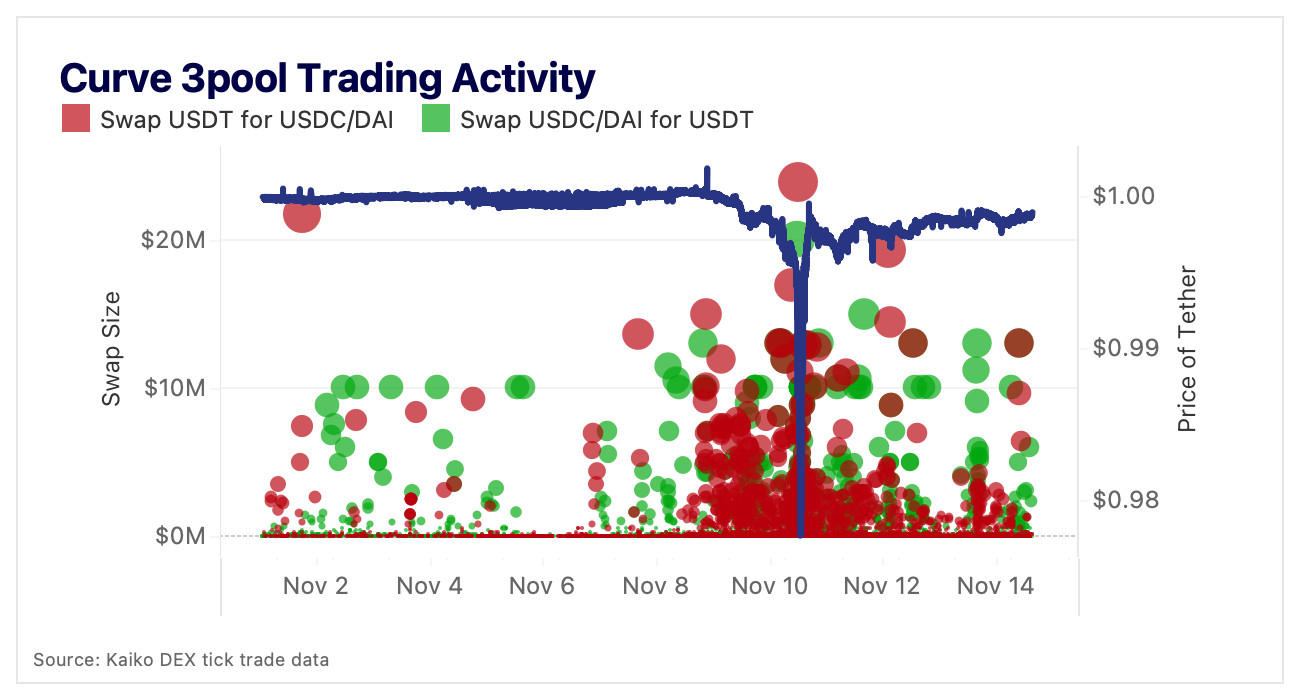
The majority of market activity still happens on centralized exchanges, so despite a slight discount on DeFi markets, stablecoins appear to be holding steady.




Extreme volatility in derivatives markets
Last week was undoubtedly one of the most volatile in crypto history, with both BTC and ETH registering their largest one-day drop in more than five months after Binance backed out of acquiring FTX on November 9. Perpetual futures open interest plummeted double-digits as the violent move in spot prices spurred cascading long liquidations of $875mn in just 24 hours.
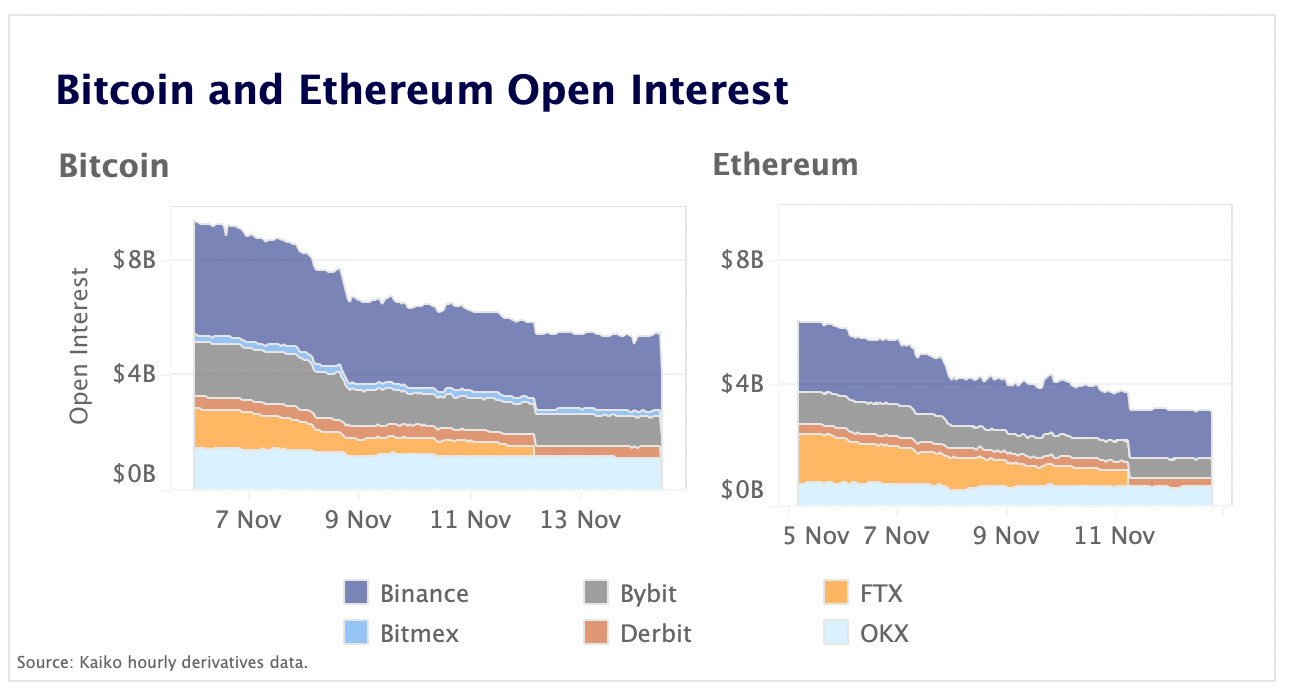
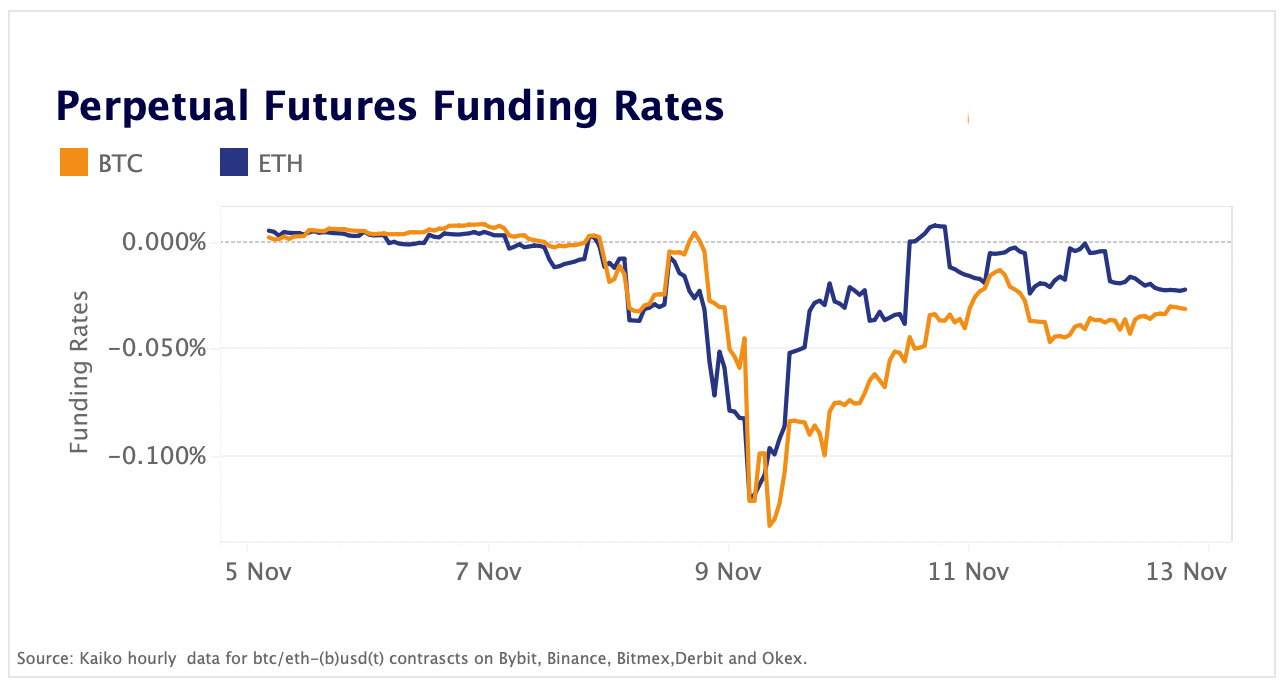
BTC open interest on 5 exchanges (excluding FTX) fell from around $8bn to $5.5bn during the week while ETH declined from $4bn to $3bn. FTX’s implosion will likely have a significant impact on derivatives markets as it accounted for 14% of total BTC open interest and 28% of ETH open interest as of early November. Last week’s events had a particularly strong impact on market sentiment. Both BTC and ETH funding rates turned deeply negative and remained in-the-red as of Monday morning as the market has turned resolutely bearish.
The abrupt shift in sentiment was also visible in options markets, with the implied volatility for BTC and ETH options surging on November 8-9. The implied volatility is a gauge of option traders’ expectations for future price swings.
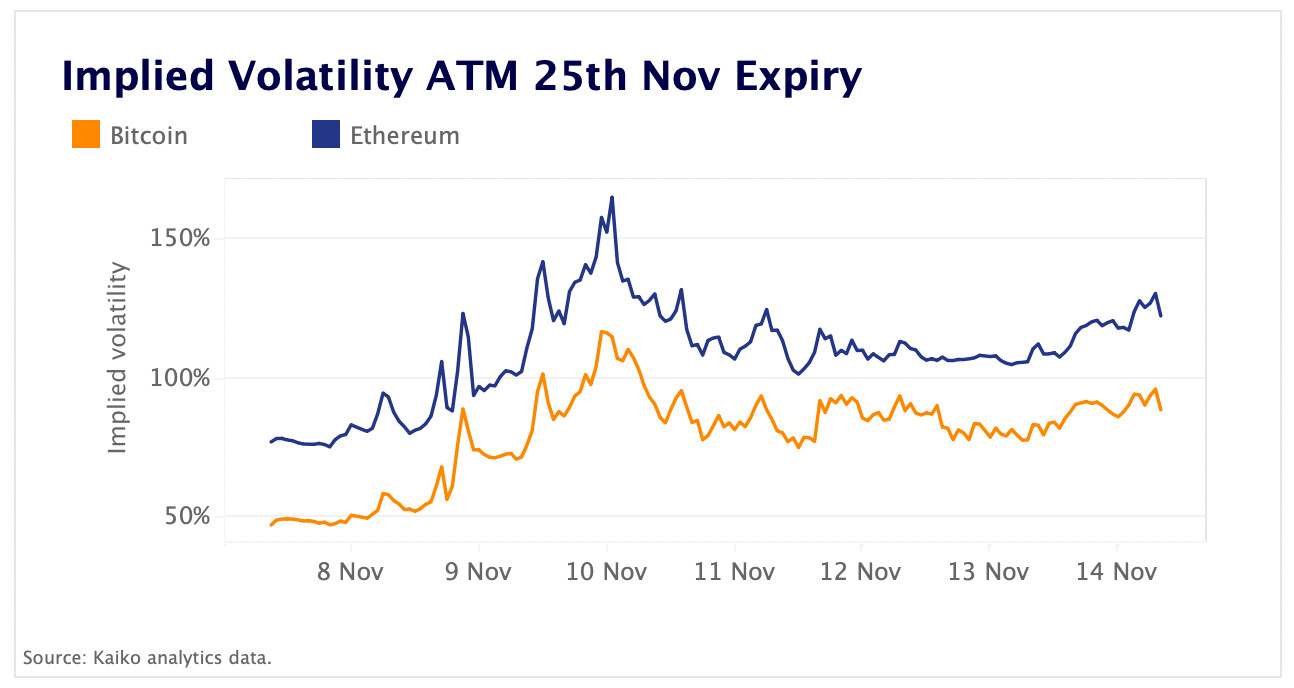
BTC ATM implied volatility for the November 25 expiry more than doubled from around 50% to over 117% in just 24 hours. ETH ATM implied volatility followed a similar path, surging to a whopping 165% before retreating slightly. Implied volatility remains elevated, which suggests the market vision of risk has changed dramatically.
Decorrelation from traditional markets
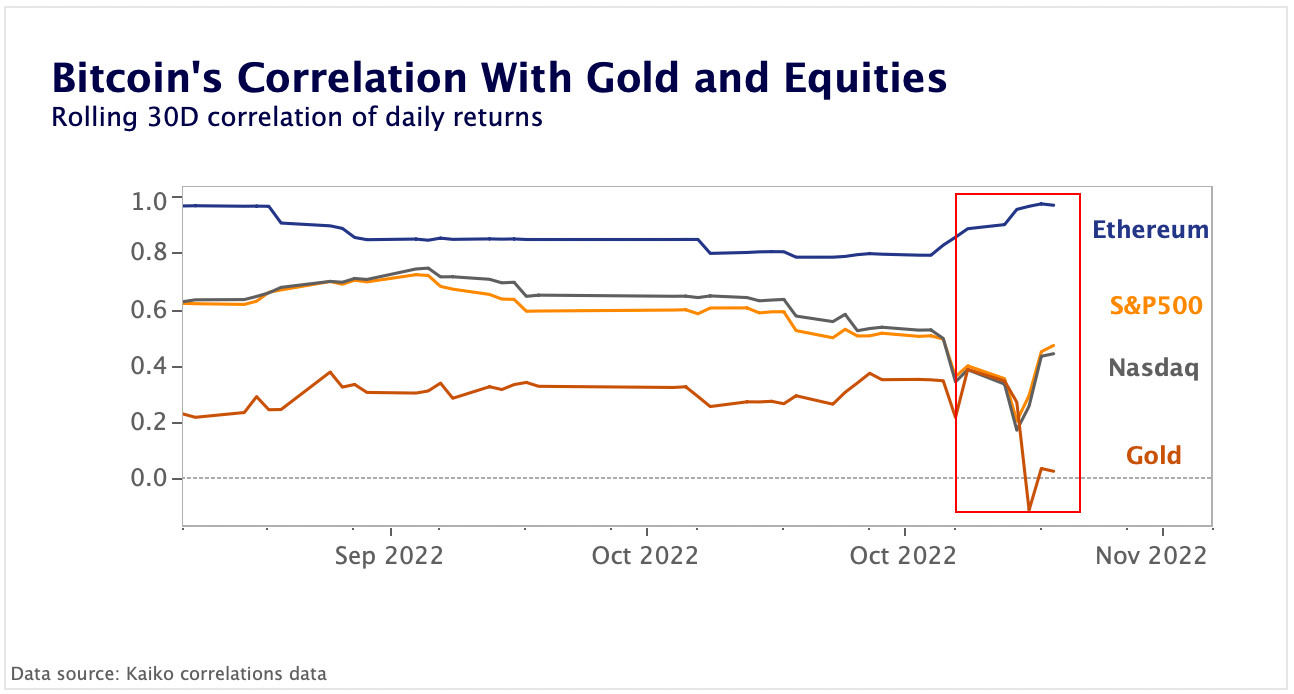
On any other week, crypto markets would have almost certainly experienced a significant bounce after last week’s inflation print, which fueled hopes that inflation may be peaking and the Fed will slow its monetary tightening. While crypto assets tumbled, the Nasdaq 100 and the S&P 500 jumped by a whopping 8.8% and 5.9%, respectively. As such, BTC's 30-day rolling correlation with U.S. equities fell to just 0.17, its lowest level since November 2021, before recovering to 0.4. After rising over the past few months, BTC's correlation with gold turned negative, ending the week close to zero. By contrast, its correlation with ETH spiked to its highest level in over a year.
The upheaval in crypto markets resulted in a sharp drop in crypto-linked stocks, which underperformed the broad market by a large margin amid falling confidence in the industry and contagion fears.
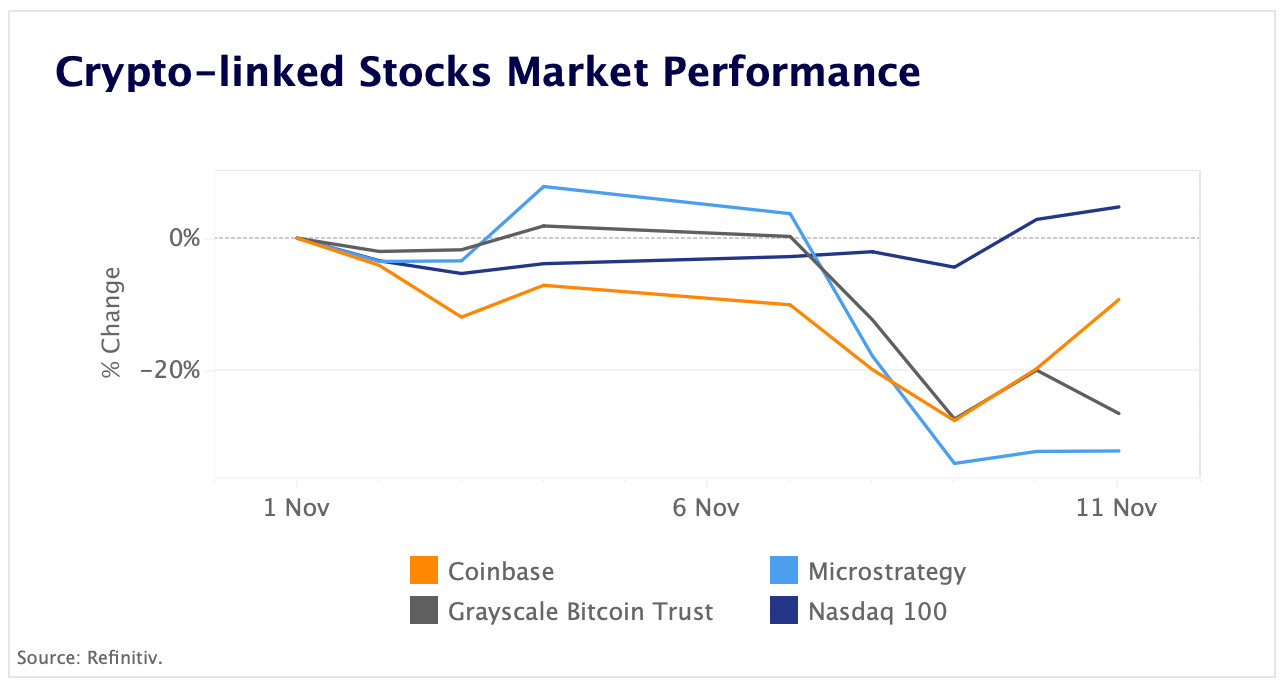
Microstrategy, which saw the value of its 130k BTC holdings plummet by roughly $500mn in 5 days registered the largest drop in its share prices, ending the week down by 37%. The largest BTC investment vehicle, Grayscale Bitcoin Trust (GBTC), lost 28% of its value. The move added to the ever-widening Grayscale discount, which hit a record low of over 41%. The discount is the difference between GBTC’s share prices and the market value of its Bitcoin holdings. It has been widening since February 2021 due to structural reasons and rising competition. Rumors that Alameda Research had significant GBTC positions likely added to the selling pressure. Despite ending the week slightly in the red, the only publicly traded crypto exchange - Coinbase recovered most of its losses on Friday as buying demand remained strong.
Contagion risk
The breadth of FTX contagion is only just emerging. Over the weekend, Blockfi announced they would be forced to halt withdrawals after accepting a bailout from FTX during the crypto credit crisis. The hedge fund Galois Capital admitted that half of its funds are stuck on FTX. FTX’s investors, including SoftBank and Sequoia, have since written down their investments to zero. Ultimately, it will take months for the extent of the collapse to be fully understood.
FTX Contagion Tracker:
- Genesis trading lost $7mm and has $175mm on the exchange
- BlockFi has paused withdrawals
- Voyager bailout from FTX likely paused
- Other funds losses of unknown size: CMS Holdings, Wintermute, Multicoinif you have more info please let me know
— Akrasia (@0xAkrasia) November 11, 2022