Close Menu
Crypto Valley Journal
    Facebook X (Twitter) Instagram
    Crypto Valley Journal
    • Hot Topics
      • News
      • Minds
    • Focus
      • Background
      • Blockchain
      • Legal & Compliance
      • Non-Fungible Token (NFTs)
    • Investing
      • Markets
      • Financial Products
      • Decentralized Finance (DeFi)
      • Exchange overview
    • Education
      • Basics
      • Glossary
      • Politicians on crypto
    • Statistics
      • Bitcoin-ETF-Flows
      • Ethereum-ETF-Flows
      • Crypto market data
      • On-chain data
    • Academy
      • Overview
      • Part 1: Blockchain
      • Part 2: Money
      • Part 3: Bitcoin
      • Part 4: Cryptocurrencies
      • Part 5: Decentralized Finance
      • Part 6: Investing
    • English
      • Deutsch
    Crypto Valley Journal
    You are at:Home » Focus » Blockchain » Lens Protocol: the decentralized alternative to social media
    Logo Lens Protocol

    Lens Protocol: the decentralized alternative to social media

    By Editorial Office CVJ.CH on 10. November 2022 Blockchain

    The Lens Protocol was introduced by the Aave Protocol team in early February 2022 and is intended to provide the decentralized basis for social interactions on the web3. The user's profile and contacts are mapped to a social graph in a censorship-resistant manner, with content monetized directly via the blockchain.

    The Lens Protocol is based on the Polygon blockchain and is not a standalone social network. Rather, it is a permission-free, composable and decentralized social graph. The idea came from Aave's founder Stani Kulechov and the smart contracts were developed by the same team. The protocol serves as a foundation so developers can focus on creating a social network rather than scaling their users.

    Decentralized "social graph"

    A social graph generally uses a centralized graph database (GDB). The graph structures of the known companies contain various other properties besides nodes and relationships to enrich profiles with information and to utilize them. The centralized storage enables the companies to evaluate the profiles. The preferences, the behavior on the platform and the relationships allow the company to monetize the profiles by displaying personalized ads or even selling the enriched user data to third parties.

    The user himself has no control over his data, let alone the platform's evaluation mechanisms and is completely dependent on the network. The Lens Protocol uses a decentralized, open source and composable social graph. This can be freely used by creators to set up their own social media platform on the web3. User profiles are represented by NFTs and stored on Polygon. Currently, cross-platform interoperability is achieved through browser-based wallets; compatible wallets include MetaMask, Gnosis Safe, and Argent. The leading Lens application Lenster represents the web3 alternative to Twitter.
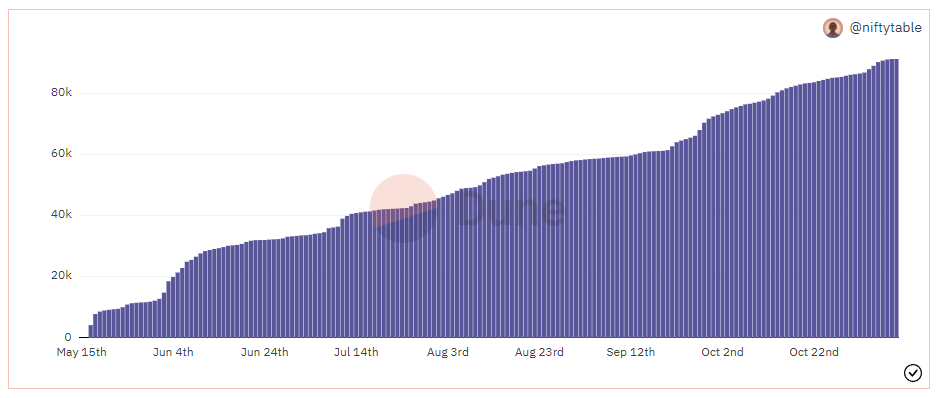
    Number of blockchain addresses with a Lens profile / Source: Dune Analytics

    An alternative to Twitter & Co.

    In the Lens Protocol, the essential functions of social media are mapped in the context of blockchain technology and enforced through the use of smart contracts. All content produced by authors, curators and users is considered to be published. In addition to content posts, this also includes comments and so-called mirrors. Mirrors are similar to reposts or retweets and serve to disseminate the content. The "mirrored" post is subject to the conditions specified by the original profile.

    Features Lens Protocol
    Various applications of the Lens Protocol / Source: Lens


    As usual, users follow each other to follow the content of the profiles. This mint a follow NFT to define the nature and conditions of this connection to the profile. In doing so, the profile can set a fee that the follower must pay before they can access the creator's content. Follow NFTs also have a built-in governance feature that allows the profile to easily perform voting. All that has to be done is to set up a new smart contract, which provides the appropriate interface to interact with the owners of the follow NFT.

    In addition, "Collect" gives users a method to collect individual contributions. Again, users mint the content as NFT with the terms set by the original publisher. On the one hand, this offers creators new monetization opportunities and on the other, users of the platform can interact more closely with their idols.


    Share. Facebook Twitter LinkedIn Email Telegram WhatsApp

    About the author

    Editorial Office CVJ.CH
    • Website
    • Twitter
    • LinkedIn

    Since 2018, the editorial team at Crypto Valley Journal has been reporting from Zug - the heart of Switzerland’s Crypto Valley - on Bitcoin, cryptocurrency, blockchain, and regulatory developments in digital assets. Behind the publication’s collective editorial voice is a team of writers with backgrounds in financial markets, law, and technology.

    Related Articles

    JPMorgan, Citi, Bank of America and Wells Fargo plan a network for tokenized deposits from 2027, operated by The Clearing House.

    JPMorgan, Citi, BoA and Wells Fargo plan network for tokenized deposits

    China expands the digital yuan: interest on balances, double the operator banks, and mBridge settling over $55 billion cross-border.

    China advances the digital yuan (e-CNY) on a broad front

    BIS and more than 40 banks present the Project Agorá prototype: cross-border payments tokenized and now in the real-money testing phase.

    Project Agorá: BIS and banks tokenize cross-border payments

    CVJ Weekly review
    6. June 2026

    Weekly review: Strategy sells Bitcoin and shakes up the market

    Strategy and BitMine are deep in the red: around USD 21 billion in unrealized losses. The Digital Asset Treasury (DAT) sector is wobbling.
    5. June 2026

    Strategy and BitMine underwater: USD 21 billion unrealized loss

    JPMorgan, Citi, Bank of America and Wells Fargo plan a network for tokenized deposits from 2027, operated by The Clearing House.
    5. June 2026

    JPMorgan, Citi, BoA and Wells Fargo plan network for tokenized deposits

    twitter image button instagram image button linkedin image button youtube image button

    About Crypto Valley Journal
    About Crypto Valley Journal

    On the pulse of the movement

    • Academy
    • Contact
    • Advertising
    • About us
    • Partner
    • Imprint
    • Privacy
    • Disclaimer
    Search

    Type above and press Enter to search. Press Esc to cancel.