While cryptocurrencies are making their way into the traditional financial world, illegal activity remains a key concerns for regulators. However, new research from leading crypto market researcher Chainalysis proves that illegal transactions represent a tiny fraction of the total volume.
In February 2022, Chainalysis released its sixth annual Crypto Crime Report. This report considers the illicit use of cryptocurrencies in the broader context to assess the importance of this phenomena and ongoing and anticipated regulatory actions. The Chainalysis report is not exempt from criticism, particularly regarding the lack of definitional and methodologic transparency, and analysts and regulators consider its conclusions to be very optimistic. However, the Chainalysis report has the advantage of presenting a consistent time series of six years, which is a long period in the crypto space.
We first examine the activities in scope in the report and then summarise the key findings. We focus on DeFi and mention alternative measures of illicit cryptocurrency activities; finally, we review current and anticipated regulatory responses.
Identification of illegal activities
The Chainalysis report considers different illicit activities. One of them is malware, which is the use of viruses, worms, and trojans to steel cryptos. Another illegal activity is the use of crypto to finance terrorism as well as the outright to steel crypto funds. In addition, also scams, namely crypto investment fraud are included and the evasion of sanctions trough crypto. Ransomware, such as blocking the computer until a sum of cryptos is paid and cybercriminal administration, which is defined as addresses attributed to individuals connected to a cybercriminal organisation are also prohibited.
Further also fraud shop, for instance fake online shops requesting advance payments or darknet markets, offering illicit goods and services against cryptos or handling of child abuse material are counted as illegal activities. We note that these categories are more comprehensive than a category such as money laundering or terrorism financing and – along other commentators – the lack of transparency and depth regarding these definitions.
Relative decrease in monitored illegal transactions
The Chainalysis report monitors the magnitude of the above-mentioned illicit activities through the crypto-transactions involving addresses associated to these activities. The key finding is that while illicit transactions reached an all-time high in absolute terms in 2021, they scored an all-time low in relative terms. In other words, licit transactions are growing much faster than illicit transactions. This is a trend confirmed since 2017, when measurements began.
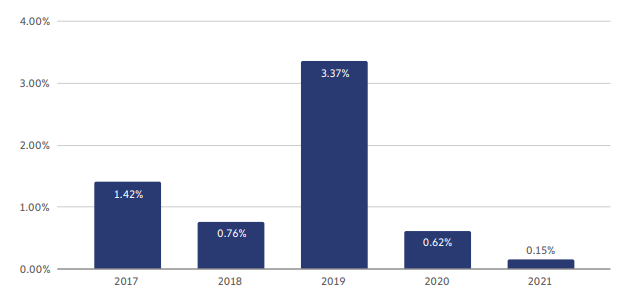
The total cryptocurrency value received by illicit addresses associated to the above-mentioned activities was estimated to be USD 7.8 billion in 2020 and USD 14 billion in 2021. While the growth in value of illicit transactions from 2020 to 2021 was nearly 80%, the total volume of transactions grew by 567% over the same period. Thus, the value of transactions involving illicit addresses represented only 0.15% of the total transactions value in 2021 (against 0.62% in 2020). The report evidences that stolen funds and investment scams were the categories that grew most year-on-year.
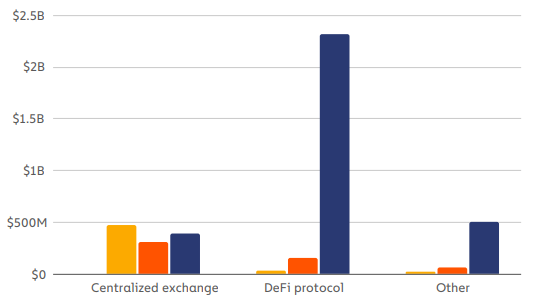
According to the report, DeFi explains to a large extent the growth of illicit activities related to stolen funds and investment scams. More than 35% of the increase in the value of investment scams came from ‘rug pulls’ – involving developers to build an apparently legitimate crypto project, raising crypto-funds and disappearing with it. All rug pulls tracked by Chainalysis but one involved DeFi projects. The report also illustrates that approximately 70% of the funds were stolen from DeFi protocols. In conclusion, DeFi emerges as a space where the growth of overall activity and illicit activities (stolen funds and investments scams) are closely correlated. The low governance standards observable in the DeFi space (the absence of audits in particular) is often quoted as the main reason for this result.
A rapidly growing sector
S. Foley, in his seminal paper issued in 2019 and based on data up to 2017, suggested that approximately 25% of bitcoin users were involved in illegal activities and 46% of bitcoin transactions concerned illegal activities. The author used an estimation technique different from the one applied by Chainalysis. Foley did not inspect suspect addresses; he investigated the network and behaviours of the users of cryptocurrencies and applied statistical processes to analyse them and extrapolate the results. To the best of our knowledge, Foley’s research was a unique exercise. Hence, there is a lack of time-series compared to the Chainalysis reports. Foley conducted his research based on data up to 2017.
Cryptocurrencies have developed substantially over the last five years, in terms of number, valuation, use cases, and adoption, and 2019 estimates based on 2017 data are likely to be hardly relevant in 2021. The Financial Action Task Force (FATF) carried out in depth research on the illicit use of cryptocurrencies in the context of the adaption of its anti-money laundering and prevention of terrorism financing guidelines to new technologies such as cryptocurrencies. It relied on multiple sources (data from up to seven blockchain analytic companies) and concluded that the Chainalysis estimates should be considered as bare minimum and the estimates differ too much in terms of scope and methodology to enable reaching a consensus on the actual magnitude of the illicit use of cryptocurrencies associated to money laundering and terrorism financing activities.
Crypto regulation continues to evolve
Data from 2021 showed that the ability of enforcement to combat crypto crime is improving, particularly from the US regulators. Chainalysis recalls the charges filed by the Commodity Futures Trading Commission against crypto investment scams, discredit by the Federal Bureau of Investigation of a ransomware, sanctions by the Office of Foreign Assets Control of two crypto services, and seizure by the Internal Revenue Service of over USD 3.5 billion of cryptocurrencies (all from non-tax investigations).
From a regulatory policy perspective, in March, the European Parliament voted to introduce new checks on the identities of those involved in any crypto payment, irrespective of the size of transaction and involvement of hosted or unhosted wallets; moreover, the FATF renewed its determination to get member countries to swiftly implement all approved international rules introduced to prevent the use of crypto-assets for money laundering and terrorist financing purposes. The FATF rules also apply to the DeFi sector.
Estiamtions and outsight for the future
The United Nations recalls that the estimated amount of money laundered globally in one year is 2 - 5% of the global GDP or USD 800 billion – USD 2 trillion in current US dollars’. The Chainalysis statistics point to a value of USD 14 billion of cryptocurrency-based illicit activities in 2021, of which USD 8.6 billion is attributable to money laundering activities. Even conceding along the FATF that such an estimate is to be considered as a bare minimum and applying a generous multiplier, accordingly, all point to the conclusion that in any event, the bulk of money laundering activities occurs in the fiat environment, not in the cryptocurrency environment, and this by a factor that may lie well above 100.
The current status of analyses and studies which aimed to assess the role of cryptocurrencies in money laundering, terrorism financing, and illicit activities more broadly, suffers from a lack of methodological consistency, absolute number of analyses, relevant time series, and definitional transparency. There is no consensus around the figures. Nevertheless, a few conclusions seem possible:
- The bulk of illicit activity takes place in fiat and not in cryptocurrencies (the level of adoption/penetration of cryptocurrencies is key).
- The proportion of illicit activities performed with cryptocurrencies is relatively small and decreasing over time in relative terms (due to increasing adoption of cryptocurrencies and their regulation).
- From a regulatory policy perspective, regulators should continue to fight illicit usages and discourage them through appropriate rules and enforcement.
- The industry should (continue to) cooperate.