
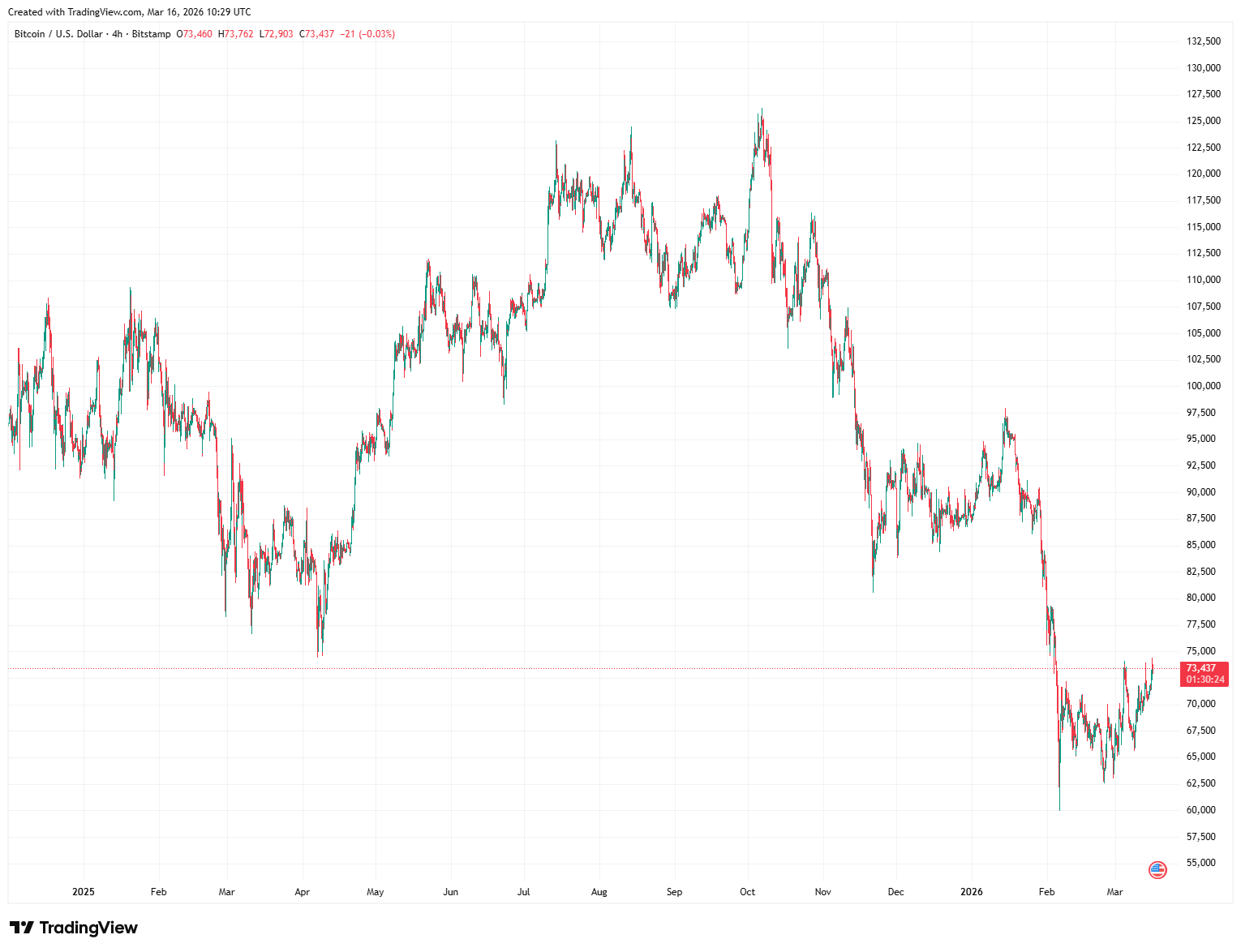
Bitcoin (BTC) rose as much as 3.7% to $74,416 during Monday's Asian trading session. The largest cryptocurrency reached its highest level since the war began on February 28. Ethereum (ETH) climbed 7.4% to $2,287. Meanwhile, Solana and XRP gained 6.2% and 4.9%, respectively.
This recovery coincides with early signals of de-escalation in the Iran conflict. US President Trump called on other nations to help reopen the Strait of Hormuz. For the first time since the war started, two tankers passed through the strategically vital waterway. At the same time, the twelve US-listed spot Bitcoin ETFs recorded net inflows of $763 million last week.
Bitcoin outperforms gold and equities since the start of the war
The numbers are clear. Since the outbreak of war on February 28, Bitcoin has gained more than 12%. Gold lost around 5% over the same period. The S&P 500 shed about 1%, and silver dropped 9%. Brent crude briefly surged above $115 per barrel, driven by Iran's mining of the Strait of Hormuz.
This trajectory follows a pattern that has become familiar. At the outbreak of war, Bitcoin initially fell 8.5% to around $63,100. Over $128 billion in crypto market capitalization evaporated within minutes. But the sell-off proved short-lived. By early March, the price stabilized at $66,000 and then advanced in a series of higher lows. On March 7, the low was $68,000. After the tanker attacks on March 12, the price held at $69,400. Following the strike on Kharg Island on March 14, it held at $70,596.
For the first time in a major geopolitical conflict, Bitcoin is showing consistent outperformance against gold and silver over more than two weeks.
ETF inflows signal institutional conviction
Institutional investors are increasing their Bitcoin positions despite geopolitical uncertainty. The twelve US spot Bitcoin ETFs recorded net inflows of $763 million in the week of March 9 to 13. It was the third consecutive week of positive flows. Total net inflows for March now stand at $1.3 billion.
BlackRock's iShares Bitcoin Trust (IBIT) dominates the flows. Around 78% of weekly inflows went to IBIT alone. On March 13, the fund absorbed $143.6 million, roughly 2,040 BTC, accounting for 80% of all daily ETF inflows.
Since January 2024, the US spot Bitcoin ETFs have attracted over $55 billion in cumulative net inflows. Total AUM stands at roughly $62 billion. In parallel, BlackRock launched the iShares Staked Ethereum Trust (ETHB) on the Nasdaq on March 12. This is the asset manager's first crypto ETF with integrated staking yield.




Historical parallels and the macro hedge effect
The pattern echoes Russia's invasion of Ukraine in February 2022. Back then, Bitcoin also dropped initially before staging a quick recovery. And in June 2025, US strikes on Iran briefly pushed Bitcoin below $100,000 before the price climbed to $123,000.
Still, the current situation differs in one key respect. Before the Iran war, the crypto market had already corrected significantly. From the October all-time high through late February, the market shed roughly $800 billion in capitalization. Leveraged positions worth $2.5 billion were wiped out in liquidations. As a result, the outbreak of war hit an already-cleansed market.
Risk factors and upcoming catalysts
In the options market, traders are aggressively buying call options at the $74,000 and $75,000 strike prices expiring March 27. At the same time, the correlation between Bitcoin and the S&P 500 remains elevated at 0.78. A hawkish tone from the Federal Reserve could therefore quickly stall the rally.
The FOMC meets on March 17 and 18, presenting the immediate stress test for all risk assets. Should the Fed signal a more restrictive stance in response to rising energy prices, Bitcoin would likely come under pressure as well. On March 27, large call option positions at the $74,000 and $75,000 strikes expire. Both dates could decisively shape the near-term direction of the crypto market.