
Strategy (formerly MicroStrategy) recorded an unrealized loss of $14.46 billion on its Bitcoin holdings in the first quarter of 2026. This figure comes from an 8-K filing the Bitcoin treasury company submitted to the SEC on April 6.
As of the March 31 balance sheet date, Bitcoin traded at $82,445. Against a total cost basis of $58.02 billion, the carrying value of the entire portfolio dropped to $51.65 billion. That produces a balance sheet deficit of $6.37 billion. Loss per share came in at -$16.53, far worse than the -$0.11 analysts had expected. Meanwhile, the software segment also disappointed, generating $111.1 million in revenue - 3.6 percent below the consensus estimate of $117 million.
New accounting rules amplify quarterly swings
These extreme fluctuations trace back to FASB standard ASC 350-60, which took effect in 2025. Companies must now carry digital assets at fair value. As a result, gains and losses flow directly into the income statement. For Strategy, holding roughly 762,000 BTC at quarter-end, every $1,000 move in price translates to a $762 million balance sheet impact.
For context: in Q4 2025, Strategy booked an unrealized loss of $17.44 billion. While the Q1 figure is smaller, it remains at historically elevated levels. CFO Andrew Kang put the numbers in perspective by pointing to the current quarter. At a Bitcoin price of around $97,300, Q2 would already show a latent fair-value gain of approximately $8 billion.
Still, the asymmetry in the business model is striking. Strategy's software division generates $111 million in quarterly revenue. Yet the Bitcoin portfolio, with a carrying value of $51.65 billion, dwarfs the operating business by a factor of 465. In effect, the core business has become immaterial on the balance sheet. Strategy is now a publicly traded Bitcoin fund with a software company attached.
Strategy Bitcoin loss does not stop its buying program
Despite the loss, Strategy did not slow its purchasing program. In the first quarter, the company acquired 88,594 BTC for $7.25 billion at an average price of $80,929. Between April 1 and 5 alone, it added another 4,871 BTC for $330 million - this time at a significantly lower average of $67,718.
Strategy now holds 766,970 BTC, representing roughly 3.65 percent of Bitcoin's total circulating supply. Among publicly listed companies, the firm's dominance is overwhelming: 94 percent of all corporate Bitcoin purchases in Q1 came from Strategy. By comparison, the remaining 194 companies bought a combined 4,000 BTC. Globally, Strategy controls around 65 percent of all Bitcoin held on corporate balance sheets.
However, the timing was poor. According to an analysis, Strategy bought above the respective weekly average price in 80 percent of its weekly Q1 transactions. Looking at Q1 purchases alone, this produces a $1.25 billion loss - roughly $14,100 per Bitcoin acquired. Systematic buyers accept such cycles as part of the process.




Financing through ATM programs and preferred shares
Strategy funds its purchases through a web of capital market instruments. Between March 30 and April 6, the company raised $474 million net through at-the-market programs. Of that total, $330 million came from the preferred stock class STRC, while $72 million came from regular MSTR common shares.
Under the so-called "42/42 Plan," Strategy aims to raise $84 billion in capital by 2027. That breaks down to $21 billion each for MSTR and STRC shares via ATM, plus $2.1 billion through STRK preferred shares. For the STRC program alone, $22.65 billion in unused capacity remains. This dilution machine is just getting started.
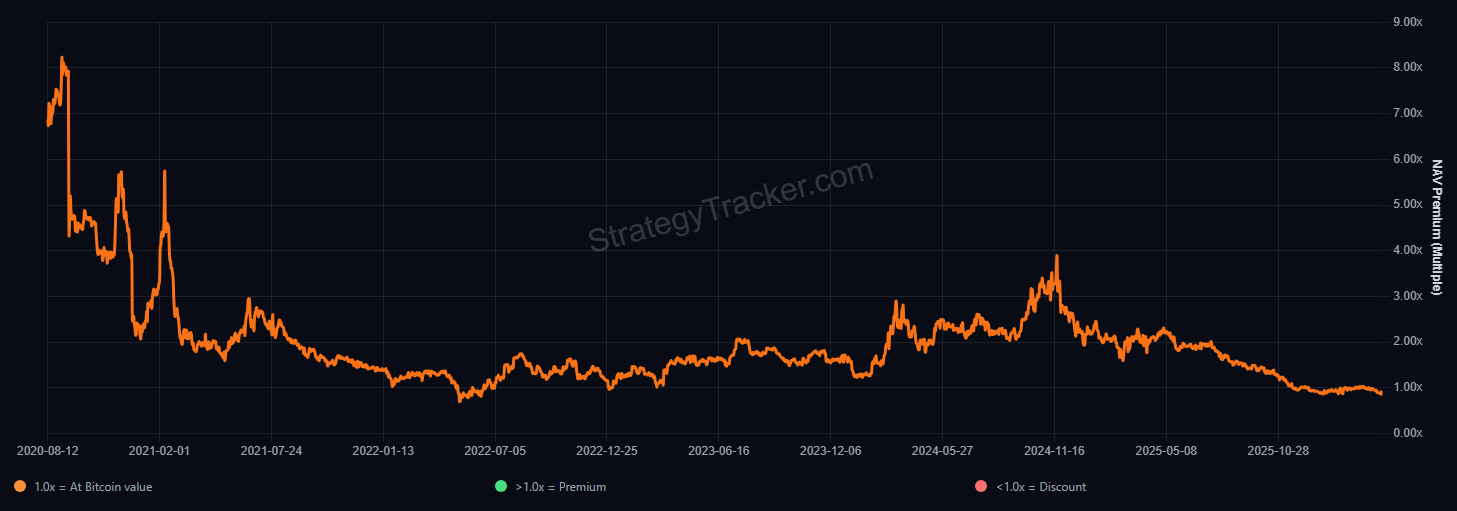
For existing shareholders, this creates a double burden. MSTR stock trades 21 percent below its year-start level and 74 percent below its 52-week high. Meanwhile, the mNAV - the ratio of market value to Bitcoin net asset value - sits just below 1x. In other words, the market no longer assigns any premium to Strategy's Bitcoin reserves. At peak, the premium exceeded 8x. What often gets overlooked: the lower the premium falls, the less sense MSTR makes compared to direct Bitcoin exposure.
Strategy's Bitcoin bet since 2020 in context
Since August 2020, Strategy has systematically invested in Bitcoin. Back then, the company under CEO Michael Saylor started with an initial investment of $250 million and positioned itself as a "Bitcoin Treasury Company." In 2026 alone, Strategy acquired 94,440 BTC in 13 transactions for $7.59 billion. Across all purchases since 2020, the weighted average price stands at $75,644 per Bitcoin.
Tax implications of the fair-value accounting prove complex. From the Q1 loss, a deferred tax asset of $2.42 billion emerges. Yet Strategy already took a valuation allowance of $1.73 billion, as realization remains uncertain. On top of that, the company expects a $500 million valuation allowance on deferred tax assets from the software segment. Net, the tax benefit remains modest.
These numbers tell a clear story. Buying MSTR means acquiring a leveraged Bitcoin proxy with dilution risk. At an mNAV below 1x, the market no longer pays a premium for it. Saylor's response is well known. He keeps buying.