
Close Menu
Crypto Valley Journal
    Facebook X (Twitter) Instagram
    Crypto Valley Journal
    • Hot Topics
      • News
      • Minds
    • Focus
      • Background
      • Blockchain
      • Legal & Compliance
      • Non-Fungible Token (NFTs)
    • Investing
      • Markets
      • Financial Products
      • Decentralized Finance (DeFi)
      • Exchange overview
    • Education
      • Basics
      • Glossary
      • Politicians on crypto
    • Statistics
      • Bitcoin-ETF-Flows
      • Ethereum-ETF-Flows
      • Crypto market data
      • On-chain data
    • Academy
      • Overview
      • Part 1: Blockchain
      • Part 2: Money
      • Part 3: Bitcoin
      • Part 4: Cryptocurrencies
      • Part 5: Decentralized Finance
      • Part 6: Investing
    • English
      • Deutsch
    Crypto Valley Journal
    You are at:Home » Hot Topics » News » DeFi unleashes a wave of innovation in finance

    DeFi unleashes a wave of innovation in finance

    By Editorial Office CVJ.CH on 15. February 2021 News

    Innovations of blockchain-based banking have recently gained a lot of traction. The architecture of decentralized finance (DeFi) can create an immutable and highly interoperable financial system with unprecedented transparency, equal access rights, and little need for custodians.

    The St. Louis Federal Reserve Bank has recently published an in-depth paper by Fabian Schär (Professor at the University of Basel) on the sector of decentralized finance (DeFi). They propose a multi-layered framework to analyze the implicit architecture and the various DeFi building blocks. Blocks including token standards, decentralized exchanges and debt markets, but also blockchain derivatives and on-chain asset management protocols without custodians.
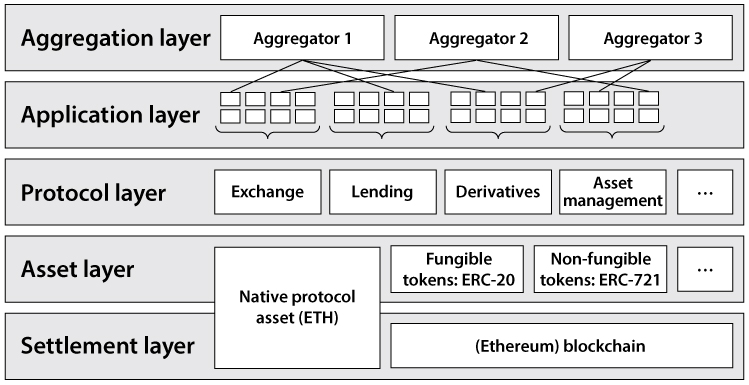
    The DeFi Stack
    The DeFi Stack / Source: Economic Research Federal Reserve Bank of St. Louis

    Ecosystem for open and permissionless banking

    The new ecosystem can create new financial instruments, not only for distributed lending and borrowing, but also for different assets and the unbanked. This makes it easy to trade crypto assets and tokenized versions of stocks or other real world goods on decentralized markets. Other examples of smart contract applications are atomic swaps, autonomous liquidity pools, decentralized stablecoins, and flash loans. DeFi recently crossed 35 billion USD in TVL, which doesn't reflect transactions, but rather refers to total value locked in protocols.

    While replicating the existing financial services in an open and transparent way, intermediaries and their additional fees can be avoided completely. The self-determination of the Individual might also experience a comeback. Early users need to understand that they are "beta testers" though, which includes taking on the risk that banks usually handle. On top of that most implementations in DeFi are limited to ERC-20 tokens on the Ethereum blockchain. They heavily also depend on price oracles and third-party protocols. If a smart contract has an issue or an oracle gets tricked, the consequences could affect multiple applications and end users.

    Democratization of Finance

    The opportunities for a transparent, efficient and decentralized financial-system, without any third parties, are immense. According to the St. Louis Fed, DeFi has the potential to create a path towards a more open and transparent future. The largest concern for the Federal Reserve is currently the regulatory uncertainty. Regulators need to understand the democratic potential of open decentralized protocols before it can be used to the fullest.

    When done right, DeFi could also be called the Democratization of Finance. If well-known companies have to invest transparently and smart contracts set the restrictions, there would be less need for politics and lobbying. There might be less shadow-banking and investments into polluting or otherwise malicious companies.


    Share. Facebook Twitter LinkedIn Email Telegram WhatsApp

    About the author

    Editorial Office CVJ.CH
    • Website
    • Twitter
    • LinkedIn

    Since 2018, the editorial team at Crypto Valley Journal has been reporting from Zug - the heart of Switzerland’s Crypto Valley - on Bitcoin, cryptocurrency, blockchain, and regulatory developments in digital assets. Behind the publication’s collective editorial voice is a team of writers with backgrounds in financial markets, law, and technology.

    Related Articles

    CVJ weekly review

    Weekly review: SIX and TWINT join sandbox for Swiss franc stablecoin

    The revised Clarity Act runs to 630 pages ahead of the first Senate vote on September 15, but Democrats have not yet backed it.

    Clarity Act: Senate revises bill ahead of September vote

    Bitcoin Suisse job cuts put up to 60 positions in Zug at risk, as the group moves back-office tasks to Bratislava and Vietnam.

    Bitcoin Suisse plans job cuts at its Zug headquarters

    CVJ weekly review
    12. September 2026

    Weekly review: SIX and TWINT join sandbox for Swiss franc stablecoin

    The revised Clarity Act runs to 630 pages ahead of the first Senate vote on September 15, but Democrats have not yet backed it.
    11. September 2026

    Clarity Act: Senate revises bill ahead of September vote

    Bitcoin Suisse job cuts put up to 60 positions in Zug at risk, as the group moves back-office tasks to Bratislava and Vietnam.
    11. September 2026

    Bitcoin Suisse plans job cuts at its Zug headquarters

    twitter image button instagram image button linkedin image button youtube image button

    About Crypto Valley Journal
    About Crypto Valley Journal

    On the pulse of the movement

    • Academy
    • Contact
    • Advertising
    • About us
    • Partner
    • Imprint
    • Privacy
    • Disclaimer
    Search

    Type above and press Enter to search. Press Esc to cancel.