
The CLARITY Act is set to shape the future market structure of digital assets in the United States. The Senate draft restricts stablecoin interest payments, preserves protocol-based incentives and strengthens protections for non-custodial developers. For DeFi, this would mark the most significant regulatory breakthrough in years.
Senators Thom Tillis (R-NC) and Angela Alsobrooks (D-MD) released the long-awaited language for Section 404 of the Digital Asset Market Clarity Act in early May. The move ends months of deadlock within the Senate Banking Committee, which had largely centered around one question: should stablecoin issuers or crypto platforms be allowed to distribute yield to users?
The new draft provides a politically precise answer. Deposit-like interest payments on payment stablecoins would be prohibited, while activity-based rewards would remain explicitly permitted. This gives banks regulatory protection against direct stablecoin competition in the deposit business, while preserving core DeFi mechanisms such as staking, liquidity provision and platform-based incentives. Section 404 therefore does not mark the end of on-chain yield, but rather the political price for a much broader market structure reform.
The Stablecoin Compromise
Section 404 prohibits digital asset service providers from paying interest or yield when it is derived solely from holding a payment stablecoin. Banks view exactly this structure as direct competition to traditional deposits. Rewards tied to actual usage, transactions or protocol activity, however, would remain unaffected.
This distinction is crucial. The draft separates passive stablecoin holding as a deposit-like product from active participation in digital networks. Permitted mechanisms include rewards linked to payments, wallet or platform usage, loyalty programs, liquidity and collateral mechanisms, as well as governance, validation, staking and other forms of ecosystem participation. For DeFi, this is a major development: lawmakers are, for the first time, drawing a clear line between bank-like yield products and native protocol incentives.
As a result, the debate is shifting. The question is no longer whether stablecoins should be allowed to generate yield at all, but rather what type of yield should be treated as a substitute for bank deposits from a regulatory perspective. This distinction is central for US-aligned market participants such as Coinbase, Circle and Ethena. More importantly, it preserves staking, liquidity provision and other on-chain incentive systems from falling under a blanket yield prohibition.
Why the CLARITY Act matters for DeFi
Even more significant than Section 404 is Section 604. The provision incorporates the Blockchain Regulatory Certainty Act and protects non-custodial developers, wallet providers and infrastructure operators from being treated as money transmitters solely for providing software.
The draft defines so-called “non-controlling developers or providers” as entities that lack the legal or unilateral ability to control, initiate or execute user transactions. Such providers would not be classified as a Money Transmitting Business or as engaging in money transmission, as long as they merely publish software, enable self-custody or provide infrastructure for distributed ledger systems.
Section 301 draws a second important line. A distributed ledger application or software code would not need to register with the SEC in its own right, and the launch or operation of such an application could not be prohibited solely on that basis. Regulation would instead target individuals or groups that control trading protocols which are not genuinely decentralized while performing functions such as brokerage, dealing, trading, execution, clearing or custody.
For DeFi, this is the real breakthrough. The United States would not only regulate individual tokens or platforms, but for the first time establish a legal distinction between neutral software, non-custodial infrastructure and controlled financial intermediation. After years of enforcement risk and legal uncertainty for developers, this would represent a structural turning point.
Despite political backing from the Trump administration and public support from Treasury Secretary Scott Bessent, the CLARITY Act had until now struggled to move forward in a meaningful way. As discussed in earlier analyses, the primary obstacle remained resistance from the banking lobby against stablecoin-related yield products.




Banks defend legacy revenue models
The banking lobby is nevertheless pushing for further tightening of the draft. Its core argument remains the potential migration of bank deposits into stablecoins. Yet the analysis from the Council of Economic Advisers paints a far less dramatic picture. According to the report, banning stablecoin yield would increase bank lending by only USD 2.1 billion, equivalent to roughly 0.02% of total credit creation. At the same time, the analysis estimates consumer welfare losses at USD 800 million. The debate therefore appears less about immediate systemic risk and more about the future distribution of deposits, payments, settlement and financial intermediation.
Large banks themselves are also no longer acting purely as defensive incumbents. In his annual shareholder letter, Jamie Dimon described blockchain, stablecoins, smart contracts and tokenization as an emerging competitive landscape. At the same time, JPMorgan continues to expand its digital asset infrastructure and programmable payment capabilities. This places the banking lobby’s position in growing tension with the infrastructure strategy of the largest US banks.
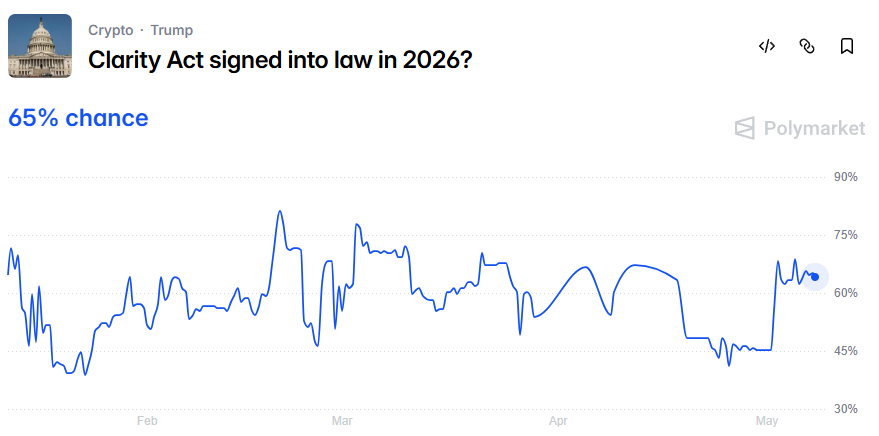
The dividing lines are therefore becoming clearer. While banking associations continue to push for stricter limitations, leading crypto industry participants increasingly accept the stablecoin compromise as the political price for a broader market structure reform. Following public support from Coinbase CEO Brian Armstrong, Polymarket odds for the CLARITY Act being signed into law by the end of 2026 jumped from around 46% to above 60%. The move reflects less a shift in market sentiment than the easing of a key political bottleneck ahead of the May markup process.
May window becomes critical
The timeline remains tight. Senate Banking Committee Chairman Tim Scott recently described the CLARITY Act as being “in the red zone” and signaled a markup process in May. May 21 is viewed less as a formal deadline and more as an important political window before the next phase of the congressional calendar begins. If the markup is pushed back further, the risk increases that budget negotiations, election campaigning and midterm dynamics once again sideline digital asset market structure legislation.
The key issue is therefore not whether individual platforms will continue to offer stablecoin-related rewards. Section 404 represents the compromise with the banking sector. Section 604 represents the structural breakthrough for DeFi. Together, the two provisions establish a new regulatory framework in which bank-like stablecoin yield products are restricted, while non-custodial software, protocol incentives and digital commodity markets receive a significantly clearer legal foundation. For DeFi, developers and digital assets treated as commodities, this would mark a major step out of the regulatory grey zone.