The Board of Peace founded by Donald Trump is considering the introduction of a US dollar-pegged stablecoin for the Gaza Strip. According to the Financial Times, the initiative is still in a preliminary phase. Concrete implementation details are not yet available.
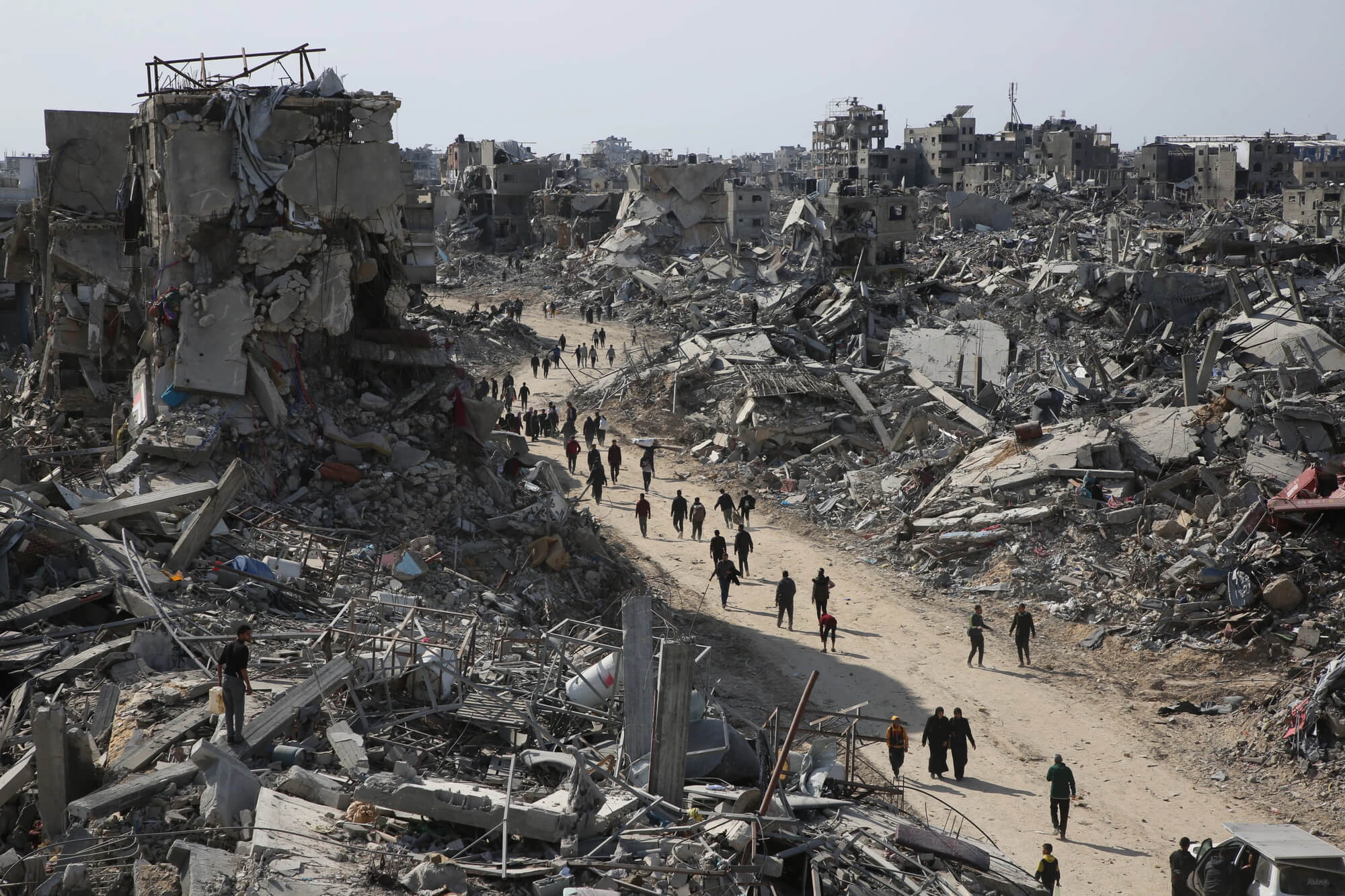
Still, the project addresses an acute problem: 98 percent of Gaza's banking infrastructure has collapsed, and only 3 of 94 ATMs remain functional. Behind the project is Liran Tancman, an Israeli tech entrepreneur and unpaid advisor to the Board of Peace. He presented the plans at the inaugural meeting on February 19, 2026, in Washington D.C. Gaza would receive a digital payment instrument, not a new Palestinian currency. This approach aims to decouple the region from cash so that Hamas cannot generate financial resources.
Banking infrastructure almost completely destroyed
Gaza's financial system has effectively ceased to exist. According to the World Bank and the Palestinian news agency WAFA, 93 percent of bank branches are damaged or destroyed. For microfinance institutions and insurance companies, the destruction rate stands at 88 percent. At the same time, Israel halted cash transfers to the Gaza Strip since October 2023, and the cash reserves of local banks are virtually depleted.
The economic consequences are devastating. Gaza's GDP shrank cumulatively by 87 percent to $362 million in 2023 and 2024. In many sectors, inflation exceeds 500 percent. Nearly 500,000 jobs were lost. Poverty now affects over 63 percent of the population.
The Palestine Monetary Authority is not permitted to issue its own currency. Formally, the Israeli shekel serves as legal tender, alongside circulating US dollars and Jordanian dinars. But without functioning banks and with limited access to cash, payment transactions have largely ground to a halt. A stablecoin could at least partially close this gap.
Board of Peace: $17 billion and a stabilization force
Trump founded the Board of Peace in January 2026 on the sidelines of the World Economic Forum. UN Security Council Resolution 2803 established it as the oversight body for the Gaza peace plan. His charter designates him as "Chairman for Life." A permanent seat costs $1 billion.
At the Washington Summit on February 19, the United States committed $10 billion. Nine additional member states pledged $7 billion. Total commitments thus amount to $17 billion. Nickolay Mladenov, former Bulgarian foreign minister and former UN Special Envoy for the Middle East, serves as High Representative. He oversees the operational implementation on the ground. An international stabilization force of 20,000 soldiers from Albania, Indonesia, Kazakhstan, Kosovo, and Morocco is set to secure the peace plan. Additionally, 12,000 police forces, trained by Egypt and Jordan, will support the effort.
"Ceasefire violations must stop so the Palestinian technocratic committee can assume governmental responsibility in the Gaza Strip." - Nickolay Mladenov, High Representative of the Board of Peace


Stablecoins in crisis zones: precedents from Ukraine and Afghanistan
The idea of deploying stablecoins for humanitarian purposes is not new. The UN refugee agency UNHCR already uses USDC for thousands of war-displaced people in Ukraine. There, nearly $100 million in crypto donations flowed into emergency relief during the early phases of the conflict. Meanwhile, the World Food Programme also uses dollar stablecoins for aid disbursements.
In Afghanistan, Mercy Corps partnered with HesabPay to pilot a stablecoin-based aid system for 100 smallholder farmers. This project distributed $30,000 in HAFN, a stablecoin pegged to the afghani. As a result, costs dropped by 29 percent and disbursement accelerated by 10 hours compared to traditional money transfer agents. Crucially, the system relied on offline-capable physical cards for users without smartphones or internet access.
Yet Gaza faces additional hurdles. Currently, the strip operates on a 2G mobile network only. An upgrade to a higher generation is not planned until July 2026. Power outages significantly hamper the operation of digital infrastructure. Blockchain-based traceability of all transactions could create transparency and eliminate intermediaries. But it also raises questions about surveillance of an entire population.
Conflicts of interest and open questions
The stablecoin initiative faces significant governance challenges. Critics point out that the Board of Peace charter concentrates power with Trump personally. According to the FT, the main financial infrastructure would run through a private stablecoin venture with ties to the Trump family and foreign capital, as the FT reports.
Tancman himself is a controversial figure. As co-founder of the Israeli Cyber Command, he also served as an officer of the Israeli Intelligence Corps. In addition, he founded the Gaza Humanitarian Foundation. His background in the Israeli security apparatus and his role as architect of a digital payment system for Gaza raise questions. Several human rights organizations criticize that Tancman's biometric registration system for aid recipients turns humanitarian zones into surveillance checkpoints.
Equally unresolved is the currency model. According to the Financial Times, a dollar-pegged stablecoin is under discussion. By contrast, the Atlantic Council proposed a shekel-backed stablecoin as a reconstruction tool in an analysis. Which model will ultimately be adopted remains open. What is clear: a digital payment system for over two million people requires robust governance structures. Observers warn that different payment systems could economically decouple Gaza from the West Bank.
Next steps
The network upgrade in Gaza from 2G to a higher generation is scheduled for July 2026. Only after that would a digital payment system become technically feasible. In parallel, the 14-member Palestinian technocratic government NCAG is working to assume governmental responsibility in the Gaza Strip. Meanwhile, the US Congress is discussing comprehensive stablecoin legislation that could define the regulatory framework for such projects.