As blockchain networks mature, staking has become one of the most common ways for investors to earn yield on digital assets. The concept is intuitive: investors lock up tokens, help secure the network, and receive rewards in return.
Over the past few years, however, a second approach has emerged. Liquid staking changes how staking works in practice, even though the underlying economic exposure remains largely the same. Understanding the distinction between traditional staking and liquid staking is increasingly important for investors evaluating projects such as JitoSOL and, more broadly, for understanding how crypto infrastructure is evolving.
First, how does staking work?
Staking is a core security function for many modern blockchains. On proof-of-stake networks such as Ethereum or Solana, validators are responsible for processing transactions and maintaining the network. To ensure honest behaviour, validators are required to stake tokens as collateral. If they act correctly, they earn rewards; if they do not, they can be penalized.
Investors participate in this process by delegating their tokens to validators. In return, they receive a share of the rewards generated by the network. These rewards typically come from newly issued tokens and a portion of transaction fees.
Traditional staking has several defining characteristics. Once tokens are staked, they are usually locked or subject to a holding period during which they cannot be transferred or sold. Investors must also take on operational responsibilities, such as selecting validators, monitoring performance, and managing rewards. Returns are relatively predictable and closely tied to protocol-level factors like inflation rates and network activity.
In essence, traditional staking represents a yield-for-lockup trade-off: investors earn income, but sacrifice flexibility.
The limits of staking
While staking is effective as a security mechanism, it introduces friction for investors. Capital locked in staking cannot be easily redeployed, sold quickly during periods of market volatility, or used as collateral for other financial strategies.
For long-term holders, these constraints may be acceptable. For investors who place a higher value on liquidity, or for institutions operating under balance-sheet, risk, or liquidity constraints, the trade-off can be limiting. This tension between earning yield and retaining flexibility is what led to the development of liquid staking.




Second, what is liquid staking?
Liquid staking separates economic exposure from operational lock-up. Instead of staking tokens directly, investors deposit them into a staking pool operated by a liquid staking protocol, such as the Jito Protocol. The pool stakes the tokens on the network in the same way traditional staking would, so from the network’s perspective, nothing changes.
In return, investors receive a liquid staking token that represents their claim and the rewards they generate. Rather than being locked, this token can be transferred, traded, or held like any other asset.
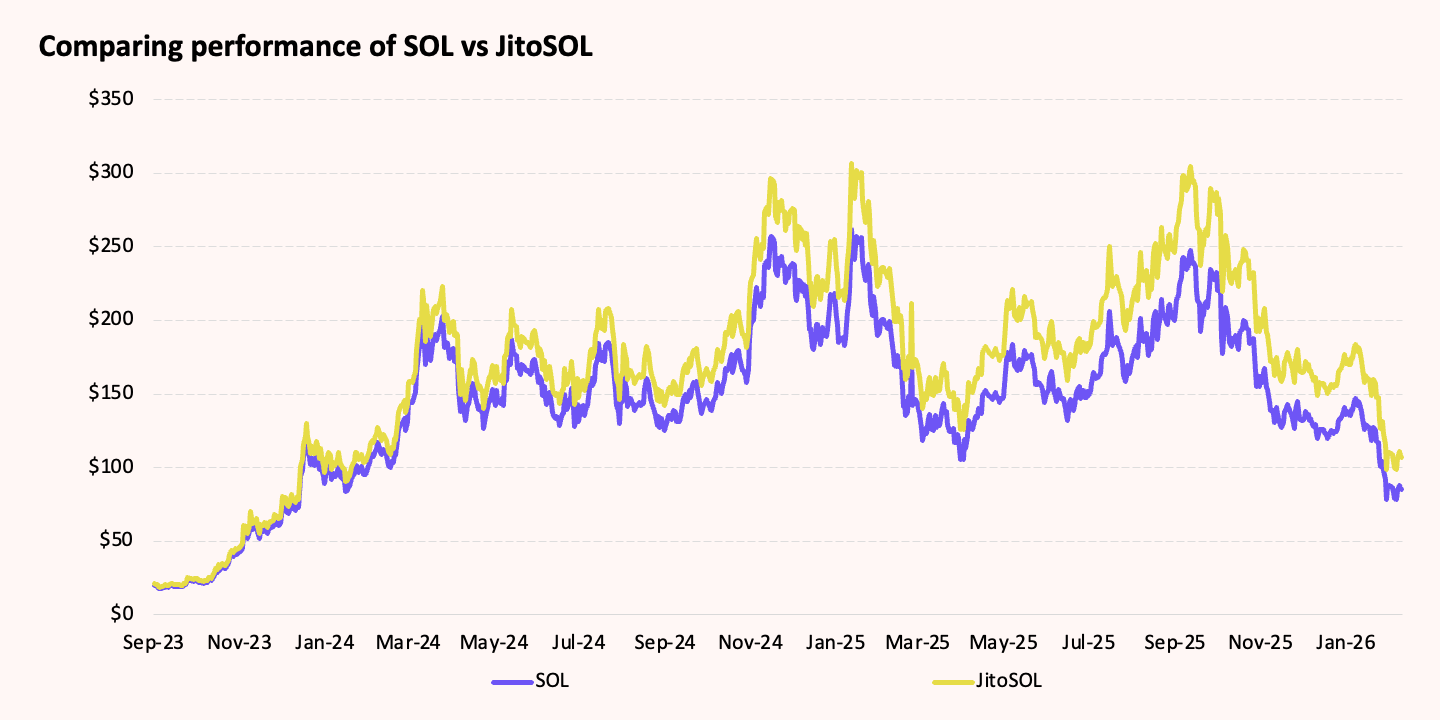
Staking rewards are typically not paid out as periodic cash flows. Instead, they accrue through an exchange-rate mechanism: over time, one unit of the liquid staking token represents an increasing amount of the underlying asset as rewards are earned.
Put simply, traditional staking earns rewards at the cost of liquidity, while liquid staking preserves liquidity by issuing a tokenized claim on the staked position.
Staking vs. liquid staking: Key trade-offs
The most visible difference between traditional staking and liquid staking is liquidity. In traditional staking, assets are locked or held for a period of time. With liquid staking, economic exposure remains accessible through the liquid token.
This structure also introduces greater flexibility. Capital can continue earning staking rewards while remaining usable within a portfolio, even if the investor chooses not to actively deploy the token elsewhere. Operational complexity is also reduced, as validator selection, delegation, and reward management are handled by the protocol rather than the investor.
However, liquid staking introduces additional layers of risk. In addition to the underlying asset’s price risk, investors are exposed to the smart-contract risk of the liquid staking protocol, protocol governance and design risk, and liquidity or pricing risk in the secondary market for the liquid token. Traditional staking avoids many of these structural risks, but does so by giving up flexibility.
Enhanced yield: Where does it come from?
Some liquid staking protocols go beyond standard staking rewards. On Solana, for example, Jito captures execution-related income generated by transaction prioritisation. Certain users are willing to pay higher fees to have their transactions processed first, and this additional income flows to validators and, through the staking pool, to stakers.
This mechanism does not change the fundamental nature of staking, but it can increase total yield. At the same time, it introduces greater variability in returns, as this income depends on network activity and demand for transaction prioritisation.
Why this distinction matters
A useful mental model is the difference between a fixed-term bank deposit and a tradable, yield-bearing fund. Both generate income from similar underlying sources, but one sacrifices liquidity for simplicity, while the other preserves liquidity by introducing additional structure.
As crypto markets mature, yield is no longer just about headline returns. Liquidity, ease of use, and how assets fit into a broader portfolio matter just as much. Liquid staking reflects this shift by allowing investors to earn staking returns without the operational constraints of traditional staking.
Understanding this shift helps explain products like JitoSOL and shows how staking is moving beyond a technical process into a more flexible financial tool.