
Ethereum co-founder Vitalik Buterin offloaded a total of 17,196 ETH through decentralized exchange aggregator CoW Protocol in February 2026. According to Arkham Intelligence, the total value amounts to approximately $35 million.
Buterin stated the funds will flow into open-source projects spanning security, privacy, and decentralized infrastructure over several years. Still, the timing has sparked debate. ETH lost around 37 percent of its value in February, though no one has established a causal link to the transactions.
Staggered sales over three weeks
Buterin began his selling series on February 5 with 2,961 ETH at an average price of $2,228 per token. Just one day later, the cumulative volume had doubled to 6,183 ETH. A single transaction comprised 6,958 ETH for $14.78 million. Rather than placing large individual orders, Buterin split his sales into many small swaps following a clear pattern.
He broke each transaction into packets of 7 to 70 ETH. This approach bypassed so-called MEV bots. Such bots extract value from transactions by front-running or mimicking orders on the blockchain. CoW Protocol, a decentralized aggregator using batch auctions, minimizes this risk. Buterin routed all documented transactions through this channel.
Sales then intensified again in the last week of February. Between February 21 and 22, 3,500 ETH went out. One day later, another 1,869 ETH followed for $3.67 million. From February 24 to 26, roughly 2,300 to 3,765 ETH were added. As a result, the average price dropped significantly over the course of the month, falling from above $2,200 in early February to below $2,000 toward month-end.
Open-source infrastructure as the stated goal
On January 30, Buterin announced via X that he had unstaked 16,384 ETH. This number is no coincidence but a power of 2 (2^14), fitting Ethereum's developer culture. He named building an "open-source, secure and verifiable full stack" of software and hardware as the overarching goal. Sectors Buterin wants to address include finance, communication, governance, operating systems, secure hardware, and biotech. Specific projects range from open silicon to encrypted messaging apps.
Vensa, for example, develops open silicon chips for security-critical applications. Meanwhile, the project ucritter.com works with zero-knowledge proofs, fully homomorphic encryption, and differential privacy. At the same time, Buterin cited air quality monitoring and public health applications as use cases. He is also exploring decentralized staking options to eventually use staking yields for funding.
This ETH sale falls in a period where the Ethereum Foundation has officially communicated a "mild austerity" stance. The multi-year belt-tightening phase is intended to secure long-term operational capacity and protect the integrity of the base protocol. Buterin personally took on tasks that would otherwise have fallen under special projects by the Foundation.




Price action and market context
The sales period coincided with a significant ETH price decline. At the start of the month, ETH was still trading at around $3,000. By February 23, the price had fallen to $1,875, a drop of 37 percent. On February 23 alone, ETH slid from $1,988 to $1,875 within hours. Yet the volume figures put the impact of the sales into perspective. Daily ETH trading volume across spot and derivatives markets stands at roughly $17 billion. Buterin's total sales of $35 million represent about 0.2 percent of a single trading day. Structurally, it amounts to a rounding error.
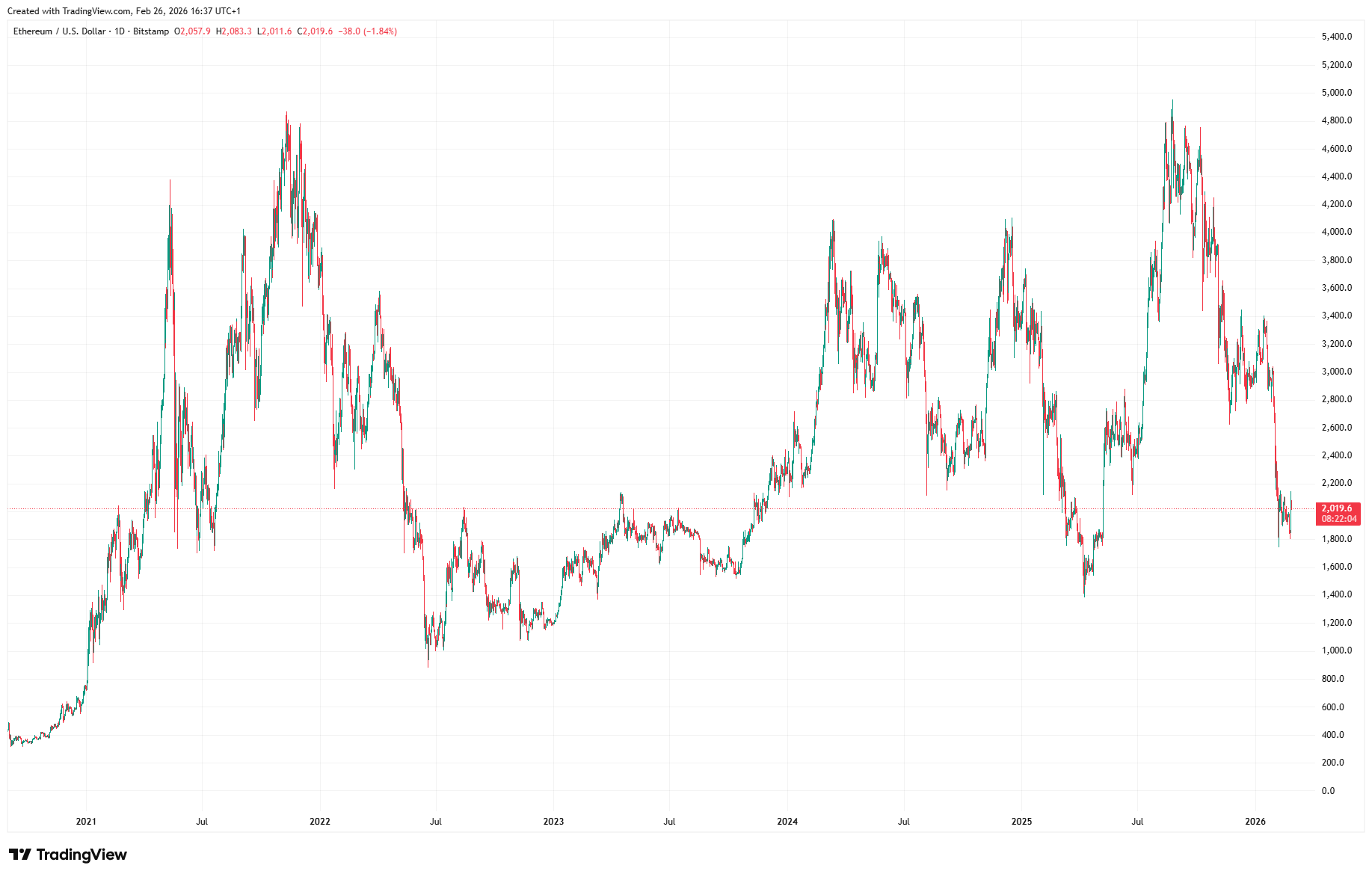
In total, the broader crypto market had been in a downtrend since the turn of 2024/2025. This downturn wiped out around $2 trillion in market value. Macroeconomic factors played a significant role. Whether Buterin's transactions amplified the ETH price decline or merely ran parallel to the downtrend cannot be determined conclusively. On February 26, ETH was already up nearly 10 percent within 24 hours, reaching as high as $2,100.
Wallet holdings and historical context
Despite the sales, Buterin still holds roughly 224,000 ETH in his wallets according to Arkham Intelligence. At the start of February, his holdings stood at approximately 241,000 ETH. He remains one of the largest individual ETH holders globally. At the current price of around $2,000, his holdings are worth over $440 million.
However, sales and donations by the Ethereum co-founder are nothing new. Buterin has repeatedly sold portions of his holdings throughout Ethereum's history. This current selling series differs in that Buterin announced a specific volume in advance for the first time and communicated the intended uses transparently. In January, he stated on X that 2026 would be the year Ethereum reclaims lost ground on self-custody and trustlessness.
Following the Fusaka upgrade in December 2025, the Ethereum network itself is in a phase of declining transaction fees alongside rising mainnet activity. More than 30 percent of the total ETH supply is locked in staking. Currently, the staking yield stands at around 2.8 percent. ETH is still trading roughly 60 percent below its all-time high of approximately $4,950 from August 2025.