
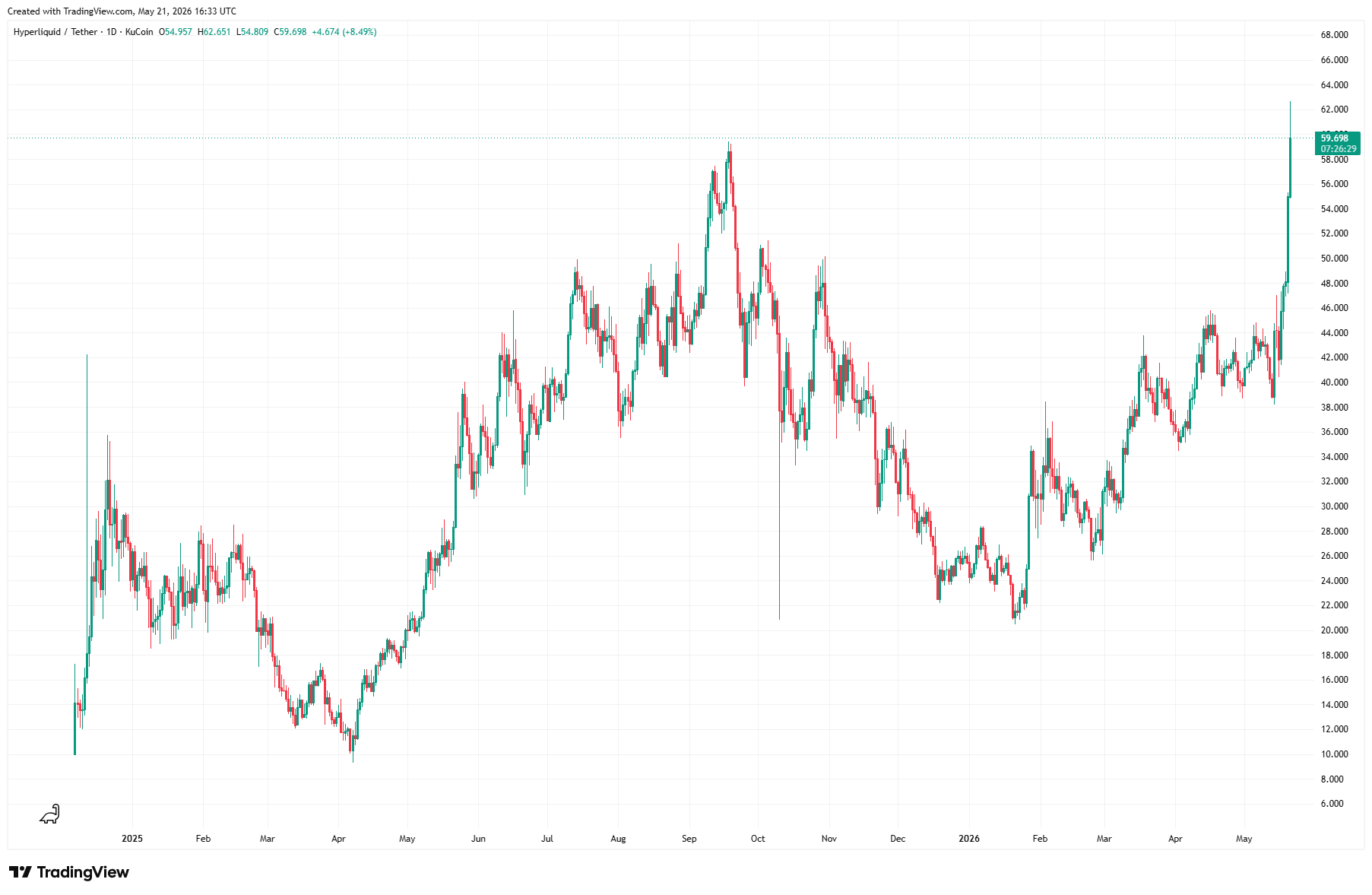
The US spot Hyperliquid ETFs THYP and BHYP recorded daily inflows of 25.5 million USD on Wednesday. At the same time, the HYPE token climbed roughly 18 percent to an all-time high of 62 USD.
Hyperliquid is an on-chain perpetual futures exchange running on its own Layer-1 blockchain and now ranks as the dominant decentralized platform for leveraged crypto derivatives. The associated HYPE token was distributed in November 2024 via a community airdrop without VC participation. Furthermore, the token ties platform fees directly to an ongoing buyback mechanism. In May 2026, 21Shares launched the first US spot ETFs on the token on Nasdaq, with Bitwise following a few days later with BHYP on the NYSE. As a result, regulated US investment products on an altcoin beyond the established top tier now exist for the first time. Cumulative net inflows across both products have reached around 54 million USD after seven trading days, with daily inflow momentum accelerating noticeably in recent sessions.
THYP and BHYP deliver record day with different approaches
21Shares brought two products to Nasdaq at once. In addition to the spot ETF THYP, the leveraged counterpart TXXH launched with daily 2x exposure. THYP charges a 0.30 percent management fee and stakes its HYPE holdings via Figment, with trust and provider splitting the proceeds 70/30. The first distribution is scheduled for June 2026. TXXH is significantly more expensive at a 1.89 percent fee and therefore targets tactically active traders.
Bitwise followed a few days later and listed BHYP on the NYSE. The asset manager charges 0.34 percent, however waives fees for the first 500 million USD in AUM during the initial month. Unlike 21Shares, the provider uses proprietary on-chain infrastructure for staking instead of a third party. Moreover, 10 percent of all fees flow into HYPE purchases on its own balance sheet. As of early April 2026, Bitwise managed a total of 11 billion USD in client assets.
On the record day itself, cumulative net flows for both products rose well above the 30.82 million USD posted the day before. THYP alone increased its daily inflow from 5.3 to 16.7 million USD, more than triple the previous day's figure. BHYP contributed the remaining 8.8 million USD and likewise came in above its prior run since trading began.
Hyperliquid ETF beats XRP and Solana in the inflow comparison
In direct competition among altcoin ETFs, the Hyperliquid ETF moves clearly to the front. On the day before the record, the two HYPE products combined attracted 11 million USD. XRP and Solana ETFs by contrast pulled in only about 5.3 million USD combined. At the same time, Bitcoin and Ethereum spot ETFs lost a combined 393 million USD in assets on the same day. Consequently, more capital flowed into two young altcoin products than into the established market leaders during this trading session.
The picture becomes even sharper on a market-cap-adjusted basis. Measured against the size of the underlying, the HYPE ETFs outperformed the Bitcoin spot ETFs on three of six trading days. They beat the Ether products on five of six days. In addition, ETF buyers accumulated roughly 2.5x more HYPE during the first six trading days than the Hyperliquid Assistance Fund burned over the same period. As a result, supply pressure on the open market intensifies, especially since the floating supply already shrinks through ongoing burns.
Many analysts use the Bitcoin spot ETF launch from January 2024 as a benchmark for institutional adoption. The fact that an altcoin ETF attracts capital faster than that reference product on a market-adjusted basis counts as a meaningful signal. Whether this strength holds or fades as a pure launch effect should ultimately become clear from upcoming inflow dynamics.



The protocol behind the token convinces with hard numbers
Behind the token rally stands an operationally unusually strong protocol. Hyperliquid settles roughly 8 billion USD in perpetual futures volume daily and has totaled more than 170 billion USD in the current month. Annualized protocol revenue is estimated above 620 million USD. Since launch, the platform has cumulatively processed more than 4 trillion USD in trading volume. Consequently, Hyperliquid has risen to become the dominant on-chain perpetual exchange.
Its share of total blockchain fees is striking. During the current week, roughly 42 to 43 percent of all on-chain fees go to the protocol. That is more than Tron, Solana, and Ethereum generate combined. In the decentralized perpetual futures market, the platform also captures more than 50 percent of total open interest. Furthermore, the HYPE token launched without VC participation via community airdrop. As a result, typical sell pressure from token vesting to early investors, which weighs on other L1 projects for months, is absent.
Hyperliquid TVL (line, left) and generated fees (bars, right) / Source: DeFi Llama
The token design channels these fee revenues directly back to HYPE holders. To date, 45.4 million HYPE worth around 2.2 billion USD have been burned, which corresponds to 14.65 percent of the original genesis airdrop. If trading volume continues to rise, the buyback mechanism accelerates further. Precisely this lever makes the protocol attractive for institutional ETF buyers, especially since the link between platform success and token scarcity is transparently documented.
Follow-on Hyperliquid ETF candidates and institutional accumulation
Beyond the ETF inflows, several catalysts work in parallel. A wallet linked to Andreessen Horowitz has accumulated around 2.11 million HYPE worth 90.87 million USD since April 2026. In addition, Coinbase took on the role of official USDC treasury deployer on Hyperliquid, while Circle handles the technical provisioning. Trade.xyz recently launched a synthetic SpaceX pre-IPO perpetual called SPCX on the platform. Moreover, open interest in the RWA segment on Hyperliquid has doubled to 2.6 billion USD within two months.
The US Senate provided additional regulatory tailwind. In May 2026, the Senate Banking Committee passed the Clarity Act, which aims to establish legal certainty for crypto market structures. Furthermore, Grayscale plans a spot HYPE ETF under the ticker GHYP, and VanEck has filed a comparable product. However, both products are not yet tradable and first require the effectiveness of their S-1 registrations.