Good Morning!
There’s no easy way out / There’s no short cut home. This is one of the best Rocky movies, by the way… Yes, there is blood on the street. However, as far as I can tell, there was no systemic or infrastructure carnage. Liquidations took place in an orderly manner on centralized exchanges (CEXs) as well as on decentralized exchanges (DEXs). The exact amount is difficult to say due to the imposed restrictions on many exchanges (e.g. Binance). My guess is that we are in the $1bn region for CEXs, and somewhere between $250-500m for DEXs. On a MakerDAO vault, we were very close to roughly $600m in liquidiations. This did stir some panic.
A closer look at Bitcoin
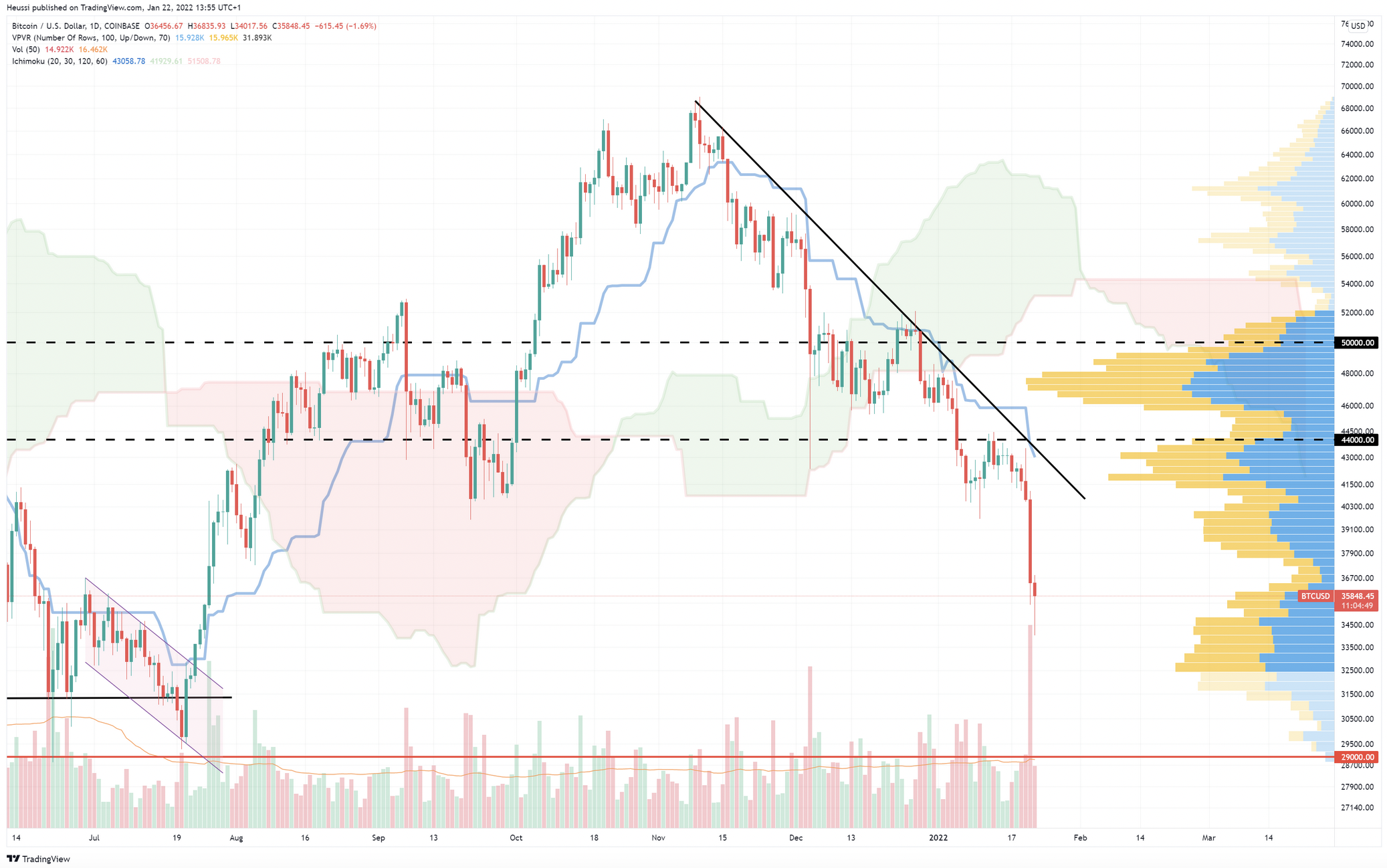
For two months now (last all-time high for bitcoin), we have been grinding lower steadily. The trend line for BTC is nearly at a 45-degree angle. Volumes spiked on December 4, 2021, and January 21, 2022. Looking a bit further back, in February and May of 2021, we saw days with bigger volumes than on January 21, 2022. However, one should not underestimate the shift of CEX to DEX volume. Therefore, my guess is that last week's sell-off (in terms of the combined CEX and DEX volume) was probably the largest we have ever seen. This is something that is totally reasonable when we factor in that the crypto market has attracted additional capital over the past 12 months.
Current catalysts
Now, let us focus on the potential drivers of the lower crypto prices. In general, it followed suit with traditional risk assets (equities mainly). Especially during down days or in times of dramatic shifts in equity prices, crypto tends to follow correspondingly. Equities are driven by a major shift in the G10 yield curves. Rates are on the rise due to higher inflation, which funnily enough does not seem to be transitory, but rather sticky and a touch out of control (i.e. check some energy and commodity price charts). Geopolitical tensions are also not helping, with Russia sending a very large number of troops to the Ukraine border. Incidentally, Friday was one of those days when we saw some behaviour similar to the time of the GFC in 2008 when a proper “risk-off” day occurred. Even the USD currency lost big time on that day versus so-called safe-haven currencies (e.g. CHF and JPY).
In addition, the news that Russia will ban all crypto activities, incl. mining and cryptocurrency payments has not helped the already ailing crypto market. The reaction was similar to what we saw when China imposed bans: large spot selling activity, which probably came from mining operations, but clearly also from private individuals.
Risk management in crypto
Since most of us are not able to influence global rates or political leaders, we need to focus on our risk management to safeguard our investments and trading positions. First and foremost, if you are not only dealing in the spot (cash market), you must keep your leverage in check. Additionally, if you play around in DeFi, you need to take many more additional risk factors into account. Here is a list of the ones that are the most crucial:
- Liquidity buffer (collateral on the side)
- Infrastructure risk (congested chains, overloaded platforms)
- Inter platform dependencies (yield faults are a good example)
- Inter protocol dependencies (bridges)
The liquidity buffer is actually an easy one, but you have to be consistent. If you store stablecoins as your so-called “dry powder”, that capital must be in a hardware wallet. You need to be able to access it quickly and not have to depend on any service provider (e.g. a CEX). How many times when markets are volatile have we seen delays in CEX withdrawals and deposits? Sometimes, they are even completely locked up, and you are put in a waiting loop with no ETA. Additionally, do not put your stables in a yield farm if you intend to use it as your liquidity buffer capital. If you do, you might experience the same fate as most of the banks did during the GFC in 2008. The vault or yield farm you put your stables into might not be accessible during market stress (like the liquidity buffers of the banks being invested into ABS and MBS).


Other risks to keep in mind
When it comes to infrastructure risk, my approach is simple. Since I am not a very technically savvy person, my pragmatic precaution is simply to “always be two steps ahead”. I add collateral or stablecoins to my leveraged positions earlier than I should. As with the liquidity buffer approach above, this comes with a price tag attached to it (the cost of not being able to put that capital to work when a new opportunity comes along). I know that I preach the “get your hands dirty” approach – in order to learn how platforms and vaults work – but it is still very necessary to read up on the technical setups and what the vault or platform is doing with your coins. This is especially true when the vault is interacting with other vaults or platforms (just think of the Alpha Homora, Cream, and Iron Bank fiasco).
If you spread your invested capital across different ecosystems, you have probably come across “bridges” (e.g. wormhole, terra-bridge, multichain, or allbridge). Bridging your tokens during normal market conditions is risky enough as it is (and some of the risk still persists when the bridging has taken place). But bridging in a hurry during volatile market conditions is like driving a Formula 1 car while texting your spouse to let them know that you’ll be late for dinner. I try to mitigate this risk by placing my liquidity buffers in different ecosystems (chains). Of course, the same price is paid here as well: the price of missing out on a new opportunity for your idle capital.
But don’t forget – after days like these there are many opportunities! But only if your dry powder is ready to deploy.
Happy trading!
All intellectual property, proprietary and other rights and interests in this publication and the subject matter hereof are owned by Crypto Broker AG including, without limitation, all registered design, copyright, trademark and service mark rights.
Disclaimer
This publication provided by Crypto Broker AG, a corporate entity registered under Swiss law, is published for information purposes only. This publication shall not constitute any investment advice respectively does not constitute an offer, solicitation or recommendation to acquire or dispose of any investment or to engage in any other transaction. This publication is not intended for solicitation purposes but only for use as general information. All descriptions, examples and calculations contained in this publication are for illustrative purposes only. While reasonable care has been taken in the preparation of this publication to provide details that are accurate and not misleading at the time of publication, Crypto Broker AG (a) does not make any representations or warranties regarding the information contained herein, whether express or implied, including without limitation any implied warranty of merchantability or fitness for a particular purpose or any warranty with respect to the accuracy, correctness, quality, completeness or timeliness of such information, and (b) shall not be responsible or liable for any third party’s use of any information contained herein under any circumstances, including, without limitation, in connection with actual trading or otherwise or for any errors or omissions contained in this publication.
Risk disclosure
Investments in virtual currencies are high-risk investments with the risk of total loss of the investment and you should not invest in virtual currencies unless you understand and can bear the risks involved with such investments. No information provided in this publication shall constitute investment advice. Crypto Broker AG excludes its liability for any losses arising from the use of, or reliance on, information provided in this publication.