
Bitcoin has reclaimed a key long-term support level as ETF flows stabilise. At the same time, DTCC, Visa and Stripe are bringing tokenised assets and stablecoins closer to the traditional financial system.
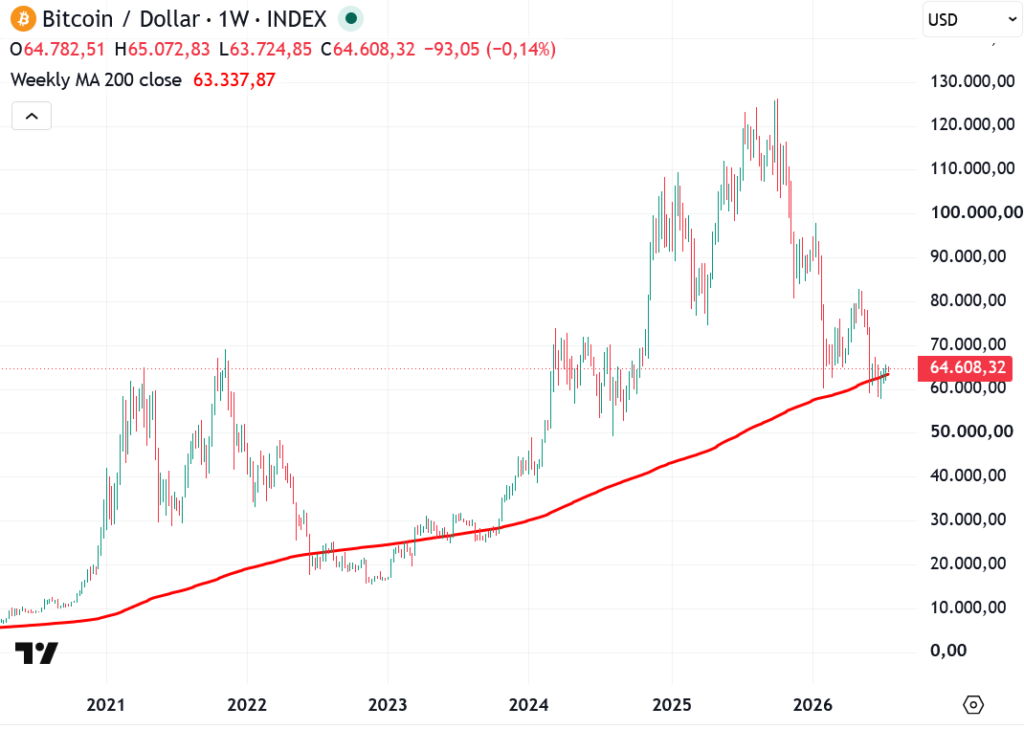
After the weakest month of the current crypto cycle, Bitcoin is showing early signs of stabilisation. Having fallen to just below USD 58,000, the price recovered to around USD 64,600. This puts Bitcoin back above its 200-week moving average, currently in the USD 62,000 to USD 63,000 range. The long-term trend line has repeatedly served as an important support zone in previous market cycles, although it does not guarantee that a definitive bottom is in place.
Capital flows into US spot Bitcoin ETFs have also improved. After net outflows of around USD 425 million on 13 July, four consecutive positive trading days brought inflows of roughly USD 500 million. This is not yet enough to confirm a trend reversal, but it points to easing selling pressure and a cautious return of institutional demand.
While Bitcoin continues to search for a sustainable bottom, the institutional build-out of blockchain infrastructure is advancing independently of short-term price movements. This is particularly evident in tokenised securities and stablecoins.
DTCC moves tokenisation into production
On 15 July, the Depository Trust & Clearing Corporation, or DTCC, converted securities from its existing custody system into digital tokens for the first time and used them in live production transactions. More than 30 companies from traditional finance and the digital asset industry took part, including BlackRock, Goldman Sachs, JPMorgan, Vanguard, Nasdaq, the New York Stock Exchange and CME Group.
The use cases went well beyond a technical demonstration. They included collateralised transactions, securities lending, repo trades involving US Treasuries, equity transfers and the posting of collateral with central counterparties. The tokenised securities retained the same ownership rights and claims as the assets traditionally held in custody by DTCC.
The scale is significant. DTCC’s depository subsidiary holds securities worth around USD 114 trillion. The full launch of the tokenisation service is scheduled for October. Investors and financial institutions will then be able to convert securities between traditional and tokenised form and use them across a range of digital applications.
The transactions were conducted on DTCC’s private network and on Canton, a public blockchain network designed for institutional use. DTCC is also pursuing a multi-chain strategy and plans to connect to the public Stellar network from 2027.
The development shows that blockchain is increasingly emerging as the preferred technological foundation for digital ownership rights, collateral and programmable settlement processes. This does not mean, however, that the financial industry is embracing the open DeFi model. For now, institutions are prioritising controlled access, data privacy and networks embedded within existing regulatory frameworks. Their willingness to use fully open and permissionless blockchain systems remains limited.
Visa and Stripe are building the stablecoin stack
A similar development is taking place in payments. In mid-July, Visa unveiled its new stablecoin platform. It allows financial institutions, fintech companies and payment providers to mint, hold, transfer and redeem stablecoins through infrastructure provided by Visa. The platform will launch with Open USD and connect wallets and stablecoin transactions directly to Visa’s existing payment, treasury, risk and fraud prevention systems.
At the same time, Stripe and private equity firm Advent International have offered more than USD 53 billion for PayPal, equivalent to USD 60.50 per share. According to media reports, PayPal’s board considers the offer too low. Whether a transaction will ultimately take place remains uncertain.
From a blockchain perspective, the strategic combination is particularly compelling. Through Bridge, Stripe already owns a comprehensive infrastructure for stablecoin payments. Bridge enables companies to issue stablecoins, manage reserves and move funds between bank accounts, currencies and different blockchains. With Privy, Stripe also controls infrastructure for digital accounts and embedded wallets.
Stripe is increasingly linking these capabilities with stablecoin accounts, cards and on- and off-ramps into traditional currencies. Companies can issue their own stablecoins, accept payments in digital dollars and use stablecoin balances through cards within the existing payment system. Its technological infrastructure therefore already covers large parts of the value chain.
A natural synergy
What Stripe still lacks is a comparable direct relationship with consumers. PayPal would add more than 430 million customer accounts, Venmo and a globally established digital wallet. It would also bring PayPal USD, its own stablecoin that can be held and transferred through PayPal, Venmo and public blockchains.
The PayPal offer should therefore not primarily be viewed as a crypto acquisition. It would, however, add the crucial element of distribution to Stripe’s stablecoin strategy. Bridge provides the issuance and payments infrastructure, Privy the wallet technology and PayPal potentially the user base. Together, they could connect stablecoins directly with one of the world’s largest existing consumer payment platforms.
In the stablecoin market, success is therefore no longer determined solely by the technical quality of a blockchain. Increasingly, it depends on who controls wallets, merchant relationships, liquidity and regulated access. Reuters also noted that an acquisition could significantly accelerate Stripe’s stablecoin ambitions by giving it access to PayPal’s large consumer base.



Price cycle and infrastructure cycle
Recent developments point to two different speeds within the market. Bitcoin and exchange-traded crypto assets remain in a phase of bottom formation. The improved technical picture and renewed positive ETF flows are constructive, but not yet sufficient to signal a sustained recovery.
At the same time, the underlying infrastructure is moving from pilot projects into live production. Tokenised securities are being used as collateral, banks are testing blockchain-based repo and margin processes, and payment companies are integrating stablecoins directly into their existing networks.
This will not automatically benefit every cryptocurrency or public blockchain. A large share of institutional adoption is likely to take place within controlled systems at first. Nevertheless, the boundary between traditional and blockchain-based financial infrastructure is becoming increasingly blurred.
For investors, the distinction between the price cycle and the infrastructure cycle therefore remains crucial. While the former is still searching for stability, the latter has already gained considerable momentum.