
Close Menu
Crypto Valley Journal
    Facebook X (Twitter) Instagram
    Crypto Valley Journal
    • Hot Topics
      • News
      • Minds
    • Focus
      • Background
      • Blockchain
      • Legal & Compliance
      • Non-Fungible Token (NFTs)
    • Investing
      • Markets
      • Financial Products
      • Decentralized Finance (DeFi)
      • Exchange overview
    • Education
      • Basics
      • Glossary
      • Politicians on crypto
    • Statistics
      • Bitcoin-ETF-Flows
      • Ethereum-ETF-Flows
      • Crypto market data
      • On-chain data
    • Academy
      • Overview
      • Part 1: Blockchain
      • Part 2: Money
      • Part 3: Bitcoin
      • Part 4: Cryptocurrencies
      • Part 5: Decentralized Finance
      • Part 6: Investing
    • English
      • Deutsch
    Crypto Valley Journal
    You are at:Home » Markets » Market Review » Market commentary, 28.02.2022
    market commentary

    Market commentary, 28.02.2022

    By Patrick Heusser on 28. February 2022 Market Review

    Recurring market commentary on what’s happening in the crypto markets, summarized by the Crypto Broker team at Crypto Finance AG.

    Market commentary

    Good Morning!

    The crypto market has started to recover a bit, but is still very vulnerable as all eyes have been on the Ukraine over the weekend. There is plenty of news and materials covering the different aspects and views involved in the critical situation within the Ukraine. It is impossible to foresee or predict the outcome. Russia is heavily sanctioned by being cut off from the SWIFT system, but seems to be unimpressed by the rising pressure on them by NATO.
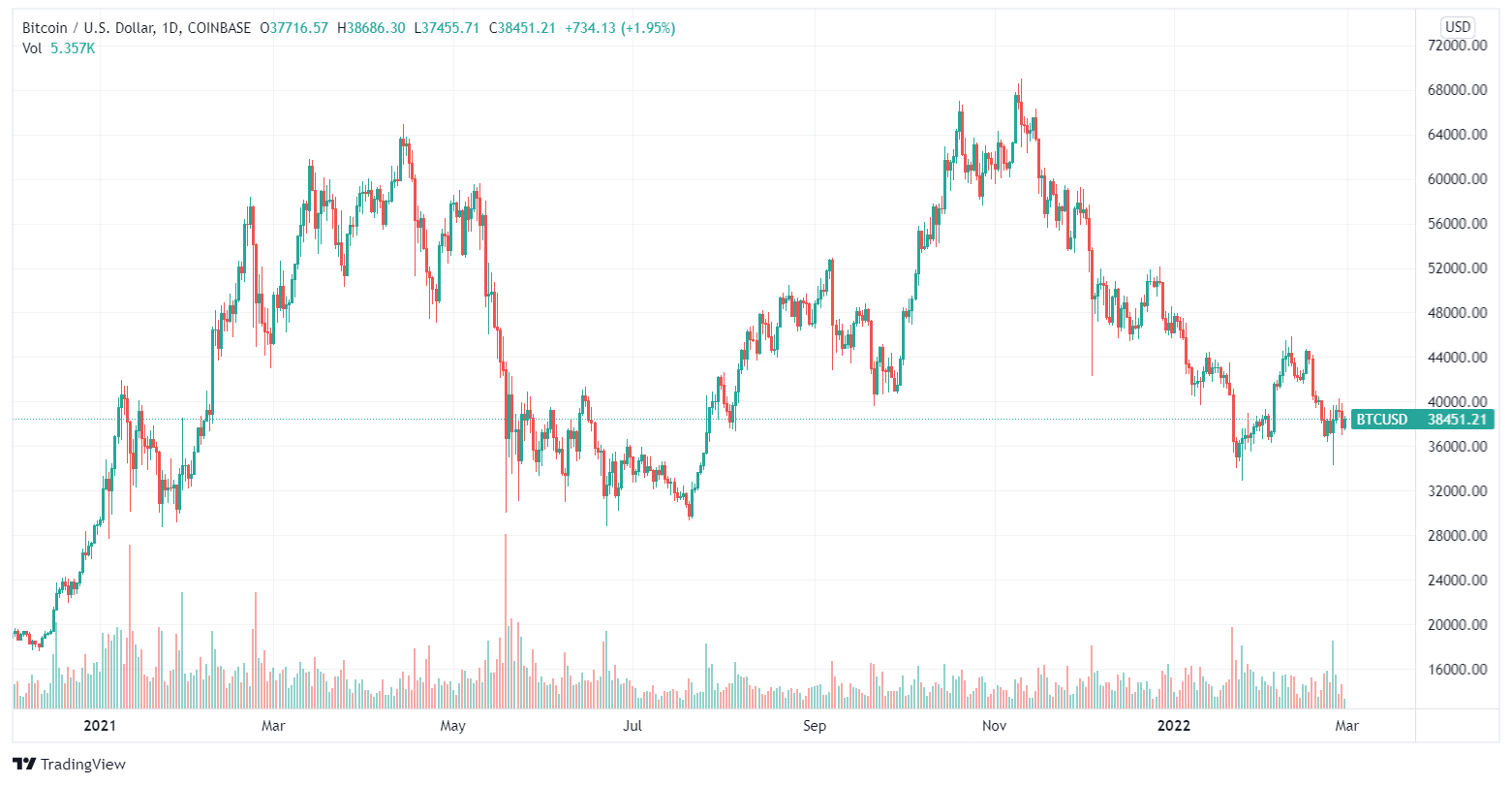
    Bitcoin BTC/USD (daily) / Charts: Tradingview

    Conflict in the Ukraine

    As mentioned previously, the current situation requires a great deal of background information in order to make any well-balanced statements at all. The history of Russia runs deep, having its beginnings in the North (Novograd) in 862. In 882, Kiev (the capital city of the Ukraine) was seized for uniting the northern and southern lands of the Eastern Slavs under one authority. Going into intricate details this far back in history goes beyond the scope of this commentary, so let me instead touch on the dissolution of the Soviet Union, which occurred between 1988 and 1991.

    There were many factors that led to the collapse of the Soviet Union, including political policies, economics, defense spending, and the nuclear accident in Chernobyl in 1986. While it is, for all practical purposes, impossible to pinpoint a single cause for an event as complex and as far reaching as the dissolution of a global superpower, a number of internal and external factors were certainly at play in the collapse of the U.S.S.R.


    Crypto market consolidation continues as Bitcoin holds $59,000-$63,000 and Ethereum near $1,600, while institutional demand sets a floor. Market Review

    Crypto market consolidation: Macro fears meet institutional floors

    Six Swiss crypto service providers secured MiCA authorization. AMINA was the world's first; Sygnum and Bitcoin Suisse followed later. Legal & Compliance

    Swiss crypto service providers secure MiCA licenses

    Robinhood Perpetual Futures in Europe now cover commodities and currencies, and the broker plans a crypto launch in the United Kingdom. Financial Products

    Robinhood Perpetual Futures expand to commodities in Europe

    Robinhood Perpetual Futures in Europe now cover commodities and currencies, and the broker plans a crypto launch in the United Kingdom. Financial Products

    Robinhood Perpetual Futures expand to commodities in Europe

    Economic problems in the Soviet Union

    The primary domestic goals of soviet leader Mikhail Gorbachev were to jump start the moribund Soviet economy and to streamline the cumbersome government bureaucracy. When his initial attempts at reform failed to yield significant results, he instituted the policies of “glasnost" (openness) and "perestroika "(restructuring). In the end, Gorbachev’s reforms and his abandonment of the “Brezhnev Doctrine” hastened the demise of the Soviet empire.

    In 1990, the Soviet economy was the world’s second largest, but shortages in consumer goods were routine, and hoarding was commonplace. Economic stagnation had hobbled the country for years and the “perestroika” reforms only served to excacerbate the problem. It was a widely held belief that Soviet defense spending accelerated dramatically in response to the presidency of US president, Ronald Reagan, and proposals such as the strategic defense initiative. In fact, the Soviet military budget had been trending upward since at least the early 1970s.

    Cold war era

    In addition to budgetary matters, Soviet involvement in Afghanistan was a key military factor in the break of the U.S.S.R. McDonald's opened its first restaurant in Moscow in January 1990, and it seemed like a triumph of Western capitalism as customers lined up around the block for their first taste of a Big Mac. Throughout the Cold War, the Soviet Union and the United States teetered on the edge of mutual nuclear destruction.

    Gorbachev had been in power for just over a year when in April 1986 the Unit 4 reactor at the Chernobyl power station in Pryp’yat (now in the Ukraine) exploded. On December 25, 1991 the Soviet hammer and sickle flag was lowered for the last time over the Kremlin, thereafter to be replaced by the Russian tricolour. Mikhail Gorbachev resigned his post as president of the Soviet Union, leaving Boris Yeltsin as president of the new independent Russian state.

    Ukraine's independence

    In the 1994 Budapest memorandum, the United States, Russia, and Britain committed to respect the independences, sovereignty, and the existing boards of the Ukraine, and to refrain from the threat or use of force against the country. Those assurances played a key role in persuading the Ukrainian government in Kiev to give up what amounted to the world's third largest nuclear arsenal. The US administration attached highest priority to ensuring that this would not lead to an increase in the number of nuclear weapons states. Before agreeing to give up the nuclear arsenal, Kiev sought three assurances:
    1. Compensation for the value of the highly enriched uranium in the nuclear warheads, which could be blended down for use as fuel for nuclear reactors. Russia agreed to provide that.
    2. Eliminating nuclear missile silos and bombers. The cost was covered by the United States.
    3. The Ukraine wanted guarantees or assurances of its security once it got rid of the nuclear arms.

    All of these points are in the Budapest Memorandum! Unfortunately, Russia has broken virtually every commitment it undertook in that document. It used military force to seize and then illegally annex Ukraine's Crimean peninsula in early 2014. Russian forces have also waged war for several years in the eastern Ukrainian region of Donbase. US officials told their Ukrainian counterparts that were Russia to violate them, the United States would take a strong interest and respond accordingly. Boris Yeltsin respected Ukraine's independence and territorial integrity, but Vladimir Putin as we can definitively see now does not.

    We wish all of you a good week!


    Copyright © 2021 | Crypto Broker AG | All rights reserved.
    All intellectual property, proprietary and other rights and interests in this publication and the subject matter hereof are owned by Crypto Broker AG including, without limitation, all registered design, copyright, trademark and service mark rights.

    Disclaimer
    This publication provided by Crypto Broker AG, a corporate entity registered under Swiss law, is published for information purposes only. This publication shall not constitute any investment  advice respectively does not constitute an offer, solicitation or recommendation to acquire or dispose of any investment or to engage in any other transaction. This publication is not intended for solicitation purposes but only for use as general information. All descriptions, examples and calculations contained in this publication are for illustrative purposes only. While reasonable care has been taken in the preparation of this publication to provide details that are accurate and not misleading at the time of publication, Crypto Broker AG (a) does not make any representations or warranties regarding the information contained herein, whether express or implied, including without limitation any implied warranty of merchantability or fitness for a particular purpose or any warranty with respect to the accuracy, correctness, quality, completeness or timeliness of such information, and (b) shall not be responsible or liable for any third party’s use of any information contained herein under any circumstances, including, without limitation, in connection with actual trading or otherwise or for any errors or omissions contained in this publication.

    Risk disclosure
    Investments in virtual currencies are high-risk investments with the risk of total loss of the investment and you should not invest in virtual currencies unless you understand and can bear the risks involved with such investments. No information provided in this publication shall constitute investment advice. Crypto Broker AG excludes its liability for any losses arising from the use of, or reliance on, information provided in this publication.

    Share. Facebook Twitter LinkedIn Email Telegram WhatsApp

    About the author

    Patrick Heusser

      Patrick Heusser is Head of Trading at Crypto Broker AG. Prior to joining the company, Patrick worked as an Interest Rate Trader at UBS and held various positions in the IRCC (interest rate, commodity and foreign exchange trading) in London, New York, Singapore and Zurich. Patrick is an expert in trading and risk management. He also gained experience in other areas, such as building start-up companies. Patrick has a degree in banking from a business school. He has also taken various courses in technical chart analysis.

      Related Articles

      Crypto market consolidation continues as Bitcoin holds $59,000-$63,000 and Ethereum near $1,600, while institutional demand sets a floor.

      Crypto market consolidation: Macro fears meet institutional floors

      The Bitcoin price falls below USD 60,000 to its lowest level since October 2024 as Strategy, ETF buyers and retail all retreat at once.

      Crypto winter: Bitcoin price breaks below USD 60,000 again

      Bitcoin rally: US-Iran peace deal pushes Bitcoin above USD 65,000

      CVJ weekly review
      4. July 2026

      Weekly review: Clarity Act gets delayed until 2027

      PMorgan warns of Strategy's new Bitcoin sales policy: the bank sees an avoidable two-way risk for the entire Bitcoin market.
      3. July 2026

      JPMorgan flags Strategy’s Bitcoin sales as a market risk

      Ethereum Institutional launches as a non-profit from Bitmine, Sharplink, and Joe Lubin, a new point of contact for banks and asset managers.
      3. July 2026

      Ethereum Institutional becomes Wall Street’s point of contact

      twitter image button instagram image button linkedin image button youtube image button

      About Crypto Valley Journal
      About Crypto Valley Journal

      On the pulse of the movement

      • Academy
      • Contact
      • Advertising
      • About us
      • Partner
      • Imprint
      • Privacy
      • Disclaimer
      Search

      Type above and press Enter to search. Press Esc to cancel.