
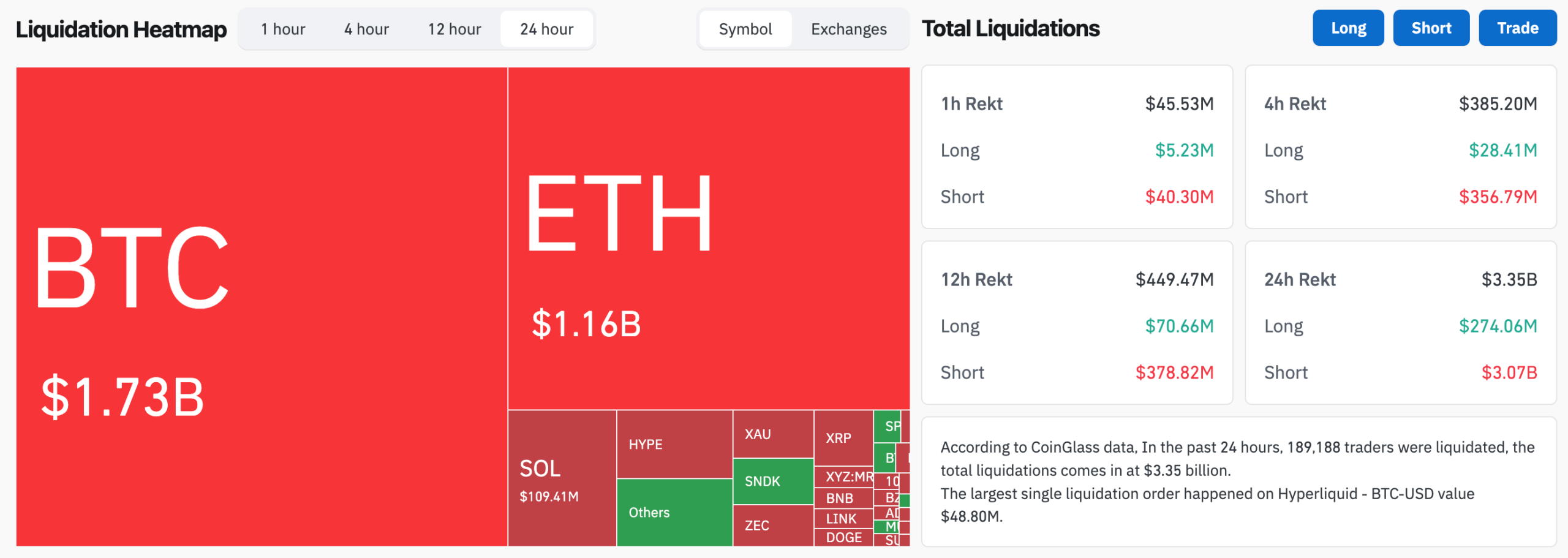
A Bitcoin short squeeze liquidated crypto short positions worth USD 3.3 billion within 24 hours. It is the highest reading since Coinglass records began in 2021; the price jumped 8% to almost USD 70,000.
With a short position, a trader bets on falling prices and sells borrowed coins to do so. If the price rises instead, the trader has to cover at a loss. That buying then pushes the price up further. Traders call this forced covering short covering. Previously, mostly bearish positioning had shaped the market for months. Money flowed out in May and June, and demand stayed uneven until mid-August. Bitcoin briefly fell into the low 60,000s. Overall, the liquidation wave hit 172,108 traders.
Bitcoin short squeeze was more one-sided than the 2025 crash
According to Coinglass, that USD 3.3 billion is the highest daily figure since records began in 2021. Long positions, by comparison, reached only USD 270 million in the same window. Shorts therefore accounted for around 92% of all liquidations, a ratio of more than 10:1. The speed stands out most. Exchanges closed out more than USD 1 billion in short positions within roughly an hour. Such cascades emerge when liquidations trigger further liquidations. Every forced closure is also a purchase, so it lifts the price into the next cluster of leveraged positions.
A look at the crypto crash of 10 October 2025 puts that into perspective. Back then, total liquidations added up to around USD 19 billion, more than five times the recent event. Short liquidations, however, came to just USD 2.47 billion. The current squeeze was therefore far more one-sided, even though the overall volume was smaller. Records of this kind still come with caveats. Binance has sharply limited its liquidation reports since April 2021. Coinglass also captures only one report per second per exchange, by its own account. Historical and current totals therefore probably understate the real volume.
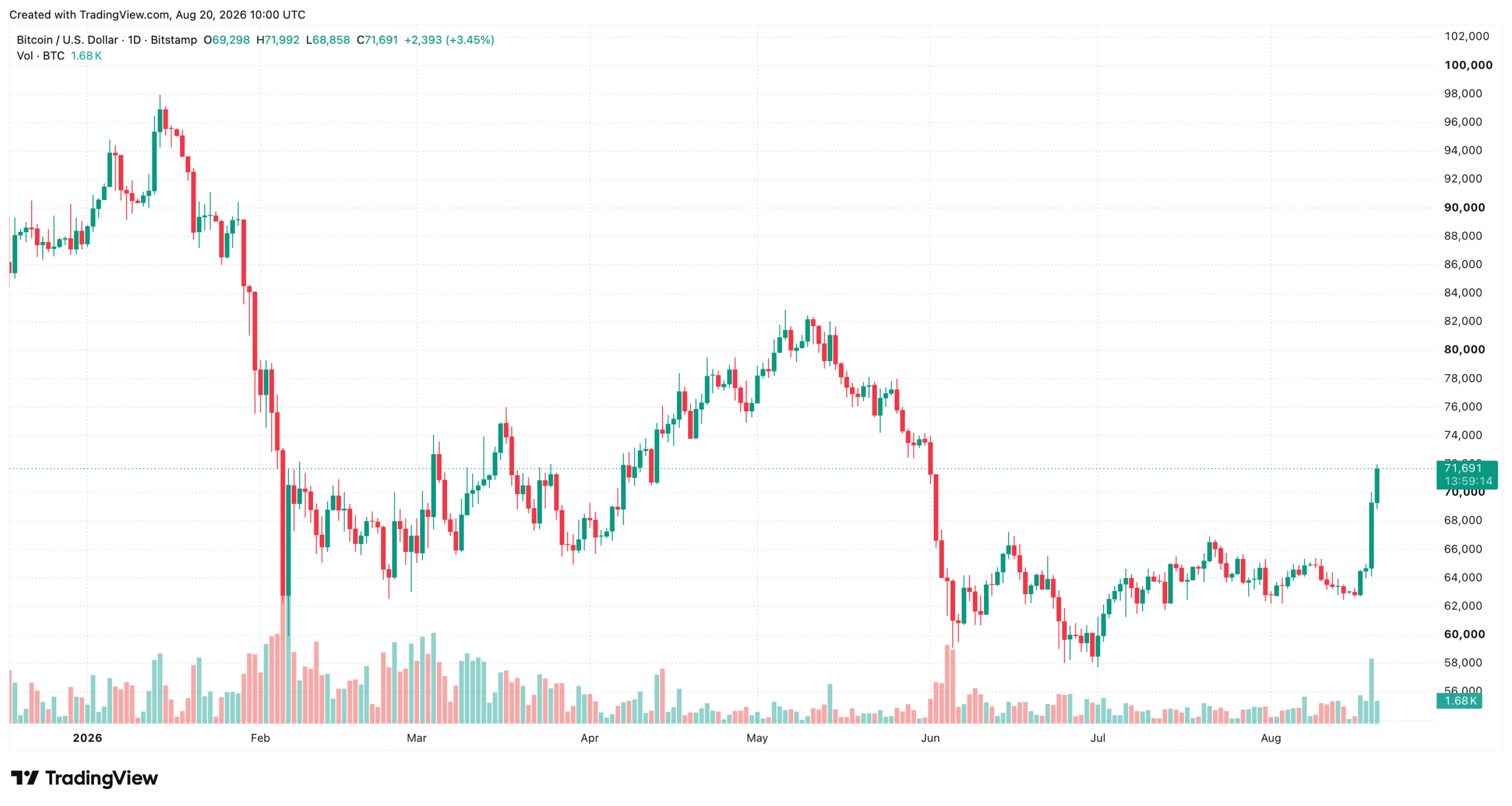
Bitcoin climbs eight percent to above USD 70,000
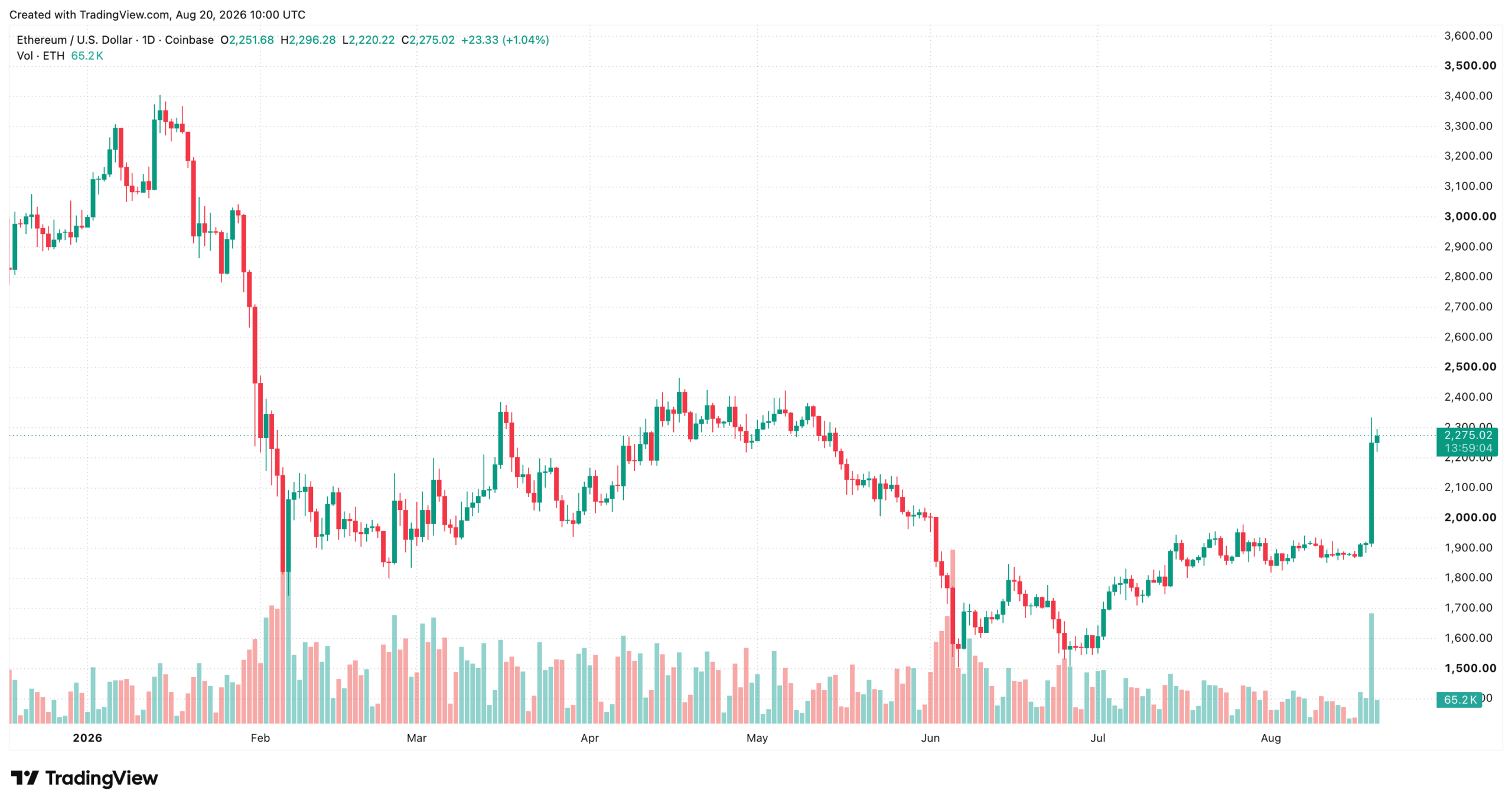
On Wednesday morning, Bitcoin still opened at around USD 64,681 and slipped to a daily low near USD 64,100. Within a few hours, however, the price turned and broke through USD 70,000. Ether gained even more sharply, by roughly 18%. The second-largest cryptocurrency topped the USD 2,000 mark for the first time in weeks. It had opened at about USD 1,916, and the range now extends to USD 2,275.
The move did not stop at the derivatives market, however. US spot Bitcoin ETFs recorded net inflows of USD 517.19 million on the same day. That is the highest daily figure since 4 May 2026. It is therefore the strongest reading in three and a half months. Such funds track Bitcoin directly. As a result, they serve as an access route for regulated investors who prefer not to hold coins themselves. The spot market thus confirmed the move in derivatives. Altogether, eight of the twelve funds reported inflows. BlackRock's IBIT led with USD 284.7 million. ARKB from Ark & 21Shares followed with USD 77.7 million, ahead of Fidelity's FBTC with USD 62.4 million.




Treasury buybacks of government bonds push yields lower
A macroeconomic trigger landed the same morning. The US Treasury doubled the cap per buyback operation for longer-dated nominal coupon bonds. That raises the ceiling from USD 2 billion to at least USD 4 billion. Specifically, the rule covers the 10-to-20-year and 20-to-30-year maturity segments. The window then runs from 9 September to 4 November 2026. In addition, the number of operations at the long end rises from two to four per quarter. At that pace, the Treasury could therefore buy back around USD 128 billion per year in the affected maturities.
The timing was notable. Only a day earlier, the yield on 30-year US Treasuries had hit a 19-year high of 5.33%. After the announcement, it eased by about 9 basis points to 5.196%. The ten-year yield also fell, by roughly 6 basis points to 4.647%. Worries about the US fiscal position drive those yields, alongside geopolitical risks such as the Iran conflict. The measure does not target crypto, however, but the functioning of the bond market. Lower yields and a softer dollar generally support risk appetite.
SEC proposes exemptions from securities registration
The SEC had published its "Regulation Crypto Assets" proposal a day before the squeeze. That paper sets out two new exemptions from the registration requirement for securities. A first variant covers issuances of up to USD 5 million over a four-year period. The second allows up to USD 75 million per twelve-month period. Furthermore, the larger exemption would require financial statements and ongoing reporting duties. The agency cites easier capital raising for companies in the start-up and financing phase as the purpose. Finally, the public comment period runs for 60 days from publication in the Federal Register.
A day later, US President Donald Trump received industry representatives at the Eisenhower Executive Office Building. Attendees included Coinbase CEO Brian Armstrong, Kraken co-CEO Arjun Sethi as well as representatives of Gemini and Robinhood. SEC Chair Paul Atkins and CFTC Chair Michael Selig also sat at the table. Trump pressed Congress to pass the market structure bill known as the Clarity Act. The president added that Selig is working to bring Hyperliquid into the US. The perpetual futures exchange would then enter the US legally and fully compliant. Hyperliquid's HYPE token subsequently rose 23.23%.
The SEC proposal meanwhile fits into a series of regulatory moves in 2026. In Congress, the Clarity Act has stalled. The executive branch and regulators are therefore trying to create clarity through rulemaking. The proposal is not yet in force; nevertheless, the market read it as a directional signal. For investors, though, direction mattered more than the legal detail that Wednesday. Fiscal and regulatory signals thus met one-sided positioning.