Memecoins on Robinhood Chain have pulled tokenized stock prices far from the exchange. One pool temporarily locked more than half of all tokenized Hims & Hers shares. It drove their on-chain price to 4.5 times the exchange price. However, that reflects no demand signal, but a gap in the tokenization mechanics.
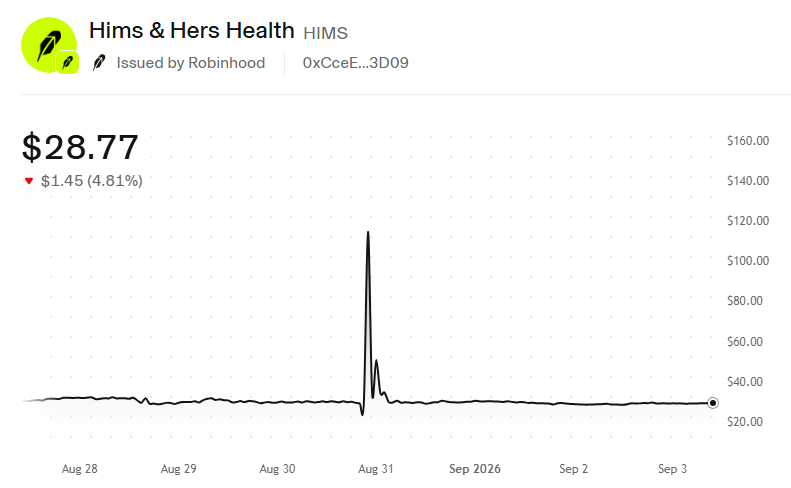
Robinhood Chain is an Ethereum layer 2 that the US broker Robinhood operates. Alongside cryptocurrencies, it also hosts stock tokens, wrappers that track a real share one to one. But new units come from a single authorized participant only, and only during US trading hours. The mainnet launch came in July 2026 with around 95 tokenized names in more than 120 countries. Robinhood excluded US persons from the start. Later, volume picked up sharply. In late August, the chain recorded USD 945 million in DEX volume in a single day, a record since launch. At the same time, the pool of the memecoin BONER locked up much of the thin HIMS float. On Sunday, with the NYSE closed, the token reached USD 132.64, after a Friday close of USD 28.84. The real share, however, did not follow.
How a memecoin pool drained the tokenized HIMS float
BONER is a memecoin whose main trading pool runs directly against tokenized HIMS. Anyone who buys BONER first acquires tokenized HIMS, which the pool then locks up. Each purchase therefore tightens the freely tradable float. So the more capital flows into the memecoin, the fewer wrappers remain for the rest of the market. At times, the pool held 31,198 of the 58,714 HIMS tokens in existence, roughly 53% of the entire on-chain float.
On Friday, the share closed at USD 28.84 on the NYSE. Yet over the weekend the token float stood still, because new units only arise while the exchange trades. Demand for BONER thus met a supply that could not grow for two days. On Sunday, the on-chain price climbed to a high of USD 132.64, 4.5 times the closing price. Ondo's competing HIMS wrapper, by contrast, had an 18 times larger float. Its price never left the level of around USD 29 in the same period.
Finally, on Monday, the authorized participant BBVI minted around 4,000 new HIMS tokens within an hour. As a result of that issuance, the on-chain price fell back to around USD 29. The real share remained untouched. It traded at USD 29.41 on Monday afternoon, roughly 2% above the Friday close. Its market capitalization stood at USD 6.9 billion. The four-and-a-half-fold on-chain price consequently produced no additional buying wave on the exchange. A slide in the share during the squeeze did not happen either.
The pattern repeats with MSTR, AMC and NVDA wrappers
The HIMS case was not an isolated one. Instead, several tokens on the chain follow the same blueprint. The memecoin uses the wrapper of a well-known share as the counter asset in its pool. Thus it benefits from that wrapper's thin float. Moreover, the pattern covers the wrappers of MSTR, AMC and NVDA. An analysis by the portal Memeburn cites 32.4% of the tokenized MSTR float for SAYLORMOON. For CINEMA, it puts the share of the AMC equivalent at 45.3%. The pool of Artificial Inu likewise held around 7,166 tokenized NVDA units, according to the same source.
The market values of these tokens now run into the hundreds of millions. By volume, the pattern still dominates trading in stock tokens. Among the largest pairs were SPACEHOOD against tokenized SPCX and MOO against tokenized MU. Their daily volumes stood at around USD 18.4 million and USD 19.3 million respectively. Overall, memecoin pairs account for more than half of all stock token volume. The tokenized share thus serves less as an investment product than as a trading vehicle. As a result, the chain attracts activity that has only an indirect link to equity exposure.



Why memecoins on Robinhood Chain send no demand signal
The flaw sits in the issuance mechanics. New stock tokens arise only when BBVI deposits real shares during US trading hours. Outside those windows, the float does not move. Meanwhile, trading on the chain continues around the clock. A pool that locks up a large part of that float can therefore pull the price far from the exchange. But once the exchange opens, arbitrage closes the gap again, as the minting in the HIMS case showed. Consequently, such spikes stay short-lived.
For the company itself, the episode carries no weight. FINRA reported short interest of 58,674,597 HIMS shares in mid-August, with 4.49 days to cover. Notably, all existing tokenized HIMS units amount to roughly 0.1% of that. So this channel cannot trigger a short squeeze on the exchange. The tokenized float is simply too small next to regular trading. Furthermore, the on-chain price is unsuitable as a sentiment indicator, because it reflects only capital inflows into a single memecoin.
The comparison with a meme stock like GameStop does not hold either. There, investors trade the real share, including voting rights and a direct link to the short position. A memecoin tied to a share, by contrast, is a separate asset with no claim on the company. Instead, the distortion hits the wrapper alone, in the observed case only for the length of a weekend. Anyone who buys the token near its high pays a multiple of the fair price. Arbitrage restores that price after the exchange opens. In addition, buyers carry two risks at once: that of the memecoin and that of the wrapper.
Tokenized shares remain debt securities in legal terms
Legally, stock tokens are not shares. According to Robinhood's product documentation, they are tokenized debt securities of Robinhood Assets (Jersey) Limited. Holders acquire neither legal nor economic rights in the underlying company, only economic exposure to the price. So no voting rights or dividend claims arise. The wrapper tracks the price, nothing more. Robinhood also issues the tokens as standard ERC-20 tokens. That makes them freely composable in DeFi, for example as collateral or as a pool asset. Exactly this composability makes the float squeeze possible in the first place.
In January 2026, the SEC confirmed the applicable legal position in a joint statement from three divisions. Still, a distributed ledger as a book-entry mechanism changes nothing about the application of US securities law. So no new exemptions exist for tokenized securities. Robinhood CEO Vlad Tenev had said on CNBC in early July 2026 that assets without utility are not sustainable. Six days later, he wrote on X about his own chain:
While we’re building robinhood chain to be the best chain for RWA … it works great for memes too
— Vlad Tenev (@vladtenev) July 8, 2026
In early September, he responded to a post about memecoins on Robinhood with an emoji, without announcing anything. Before that, he had described how developers built pools out of memecoins, cryptocurrencies and stock tokens. Robinhood itself had never designed those combinations. Meanwhile, competition over tokenized shares is intensifying. Coinbase launched its own stock tokens on its Base network in late August, among them Apple, Nvidia, Meta and Alphabet. The structure runs through a special purpose vehicle in Abu Dhabi, with 1:1 backing at Alpaca Securities. It is likewise available only outside the US. On Robinhood Chain, the memecoins still determine which wrapper sees any liquidity at all.