Dragonfly Capital has closed its fourth venture fund at $650 million. The original target was $500 million. This $150 million oversubscription signals sustained LP confidence in a market that has weeded out many crypto venture firms.
The fund matches the exact size of Fund III from 2022. Dragonfly is one of the few crypto VCs that has continuously raised new capital since 2018. The firm filed the SEC filing for Fund IV back in November 2024. By September of that year, it had gathered $250 million of the original target, as Fortune first reported.
Consolidation in the crypto VC market
The industry is going through a structural shakeout. The number of active US venture firms dropped by more than 25 percent between 2021 and 2024, from roughly 8,300 to about 6,200. At the same time, crypto deals in 2025 fell by around 60 percent year over year. Specifically, the count shrank from over 2,900 transactions to approximately 1,200. Total invested volume, though, rose to $18.9 billion, up from $13.8 billion in 2024.
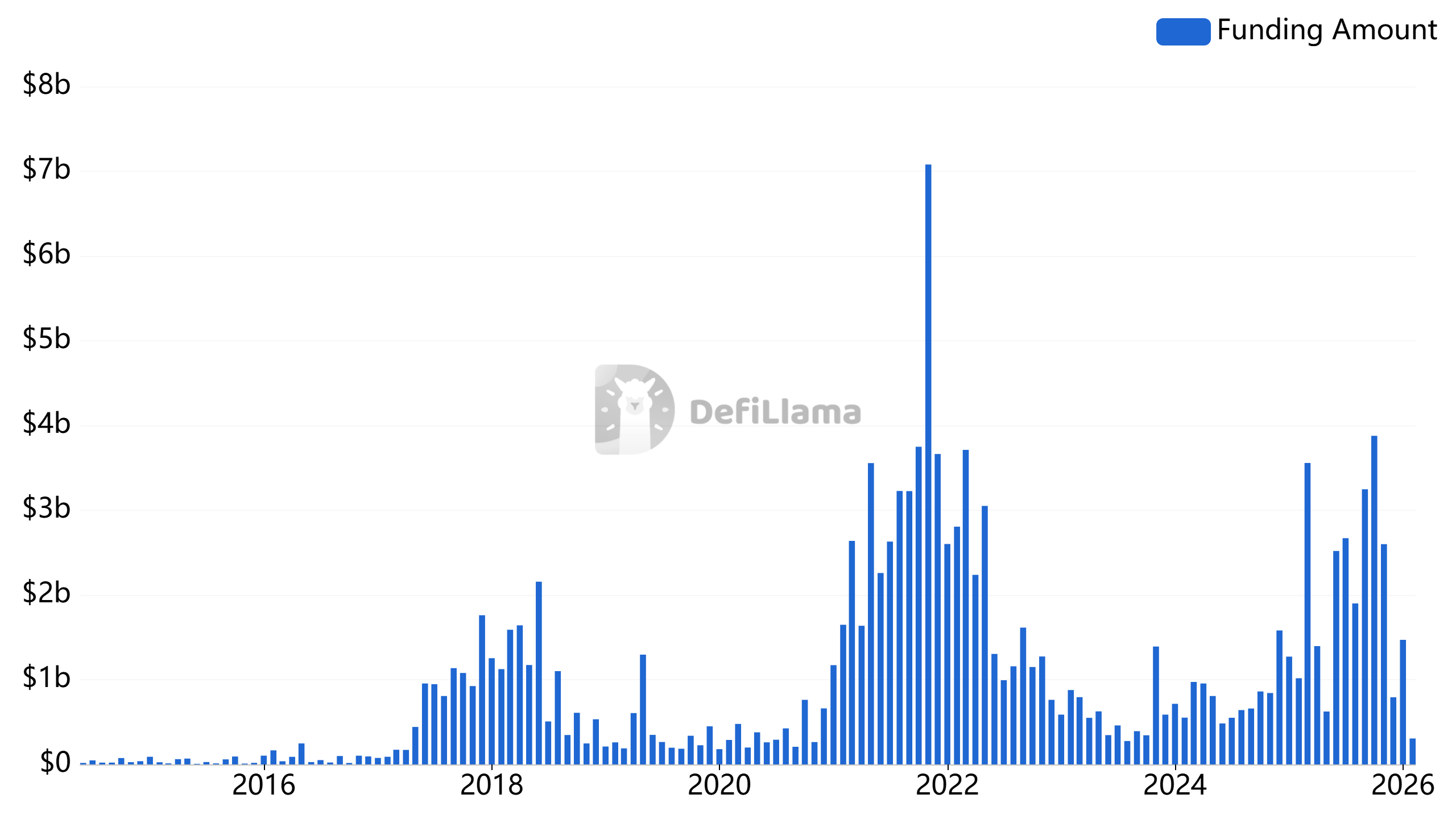
Capital is concentrating in fewer deals with larger rounds and IPOs. Rob Hadick, General Partner at Dragonfly, describes the situation plainly.
"Many crypto venture firms are approaching the end of their runway from earlier funds and are struggling to raise new capital." - Rob Hadick, General Partner, Dragonfly Capital
Seed financing also fell 18 percent in 2025. Series B rounds, on the other hand, increased by 90 percent. The trend is clear: capital flows into later stages and toward firms with a proven track record. Meanwhile, Dragonfly positions itself as a mid-sized, focused fund. For comparison, a16z manages over $7.6 billion in crypto AUM, and Paradigm runs a $2.5 billion flagship fund.
From Beijing to San Francisco
Alex Pack and Bo Feng founded Dragonfly in 2018 as an East-West bridge fund. Their first fund comprised $100 million, backed by leading Asian tech investors. This original edge lay in bridging Western and Chinese crypto markets.
China's crypto ban in 2020 forced a pivot. The firm relocated first to Singapore, then to San Francisco. Alex Pack left Dragonfly after Fund II to found Hack VC. Haseeb Qureshi then took over leadership. Previously, Qureshi was a professional poker player and software engineer at Airbnb. Today he hosts the podcast "Chopping Block" and teaches Web3 entrepreneurship at UC Berkeley.
Fund II closed in 2021 at $225 million. Fund III followed in 2022 at $650 million. Rob Hadick joined the team in April 2022 after working at the GoldenTree hedge fund. Since 2019, Dragonfly has also managed over $1 billion in liquidity through its own trading team. This provides the fund with real-time market data for primary investment decisions.



Portfolio: Ethena as flagship investment
Dragonfly led Ethena's $6 million seed round. At the time, other investors rejected the model as too risky. Ethena's stablecoin USDe has since reached a market capitalization of roughly $6.3 billion. Subsequently, Ethena closed a $100 million round with Franklin Templeton and Fidelity's venture arm.
The Polymarket story played out differently. Dragonfly came close to investing in the seed round in 2020. But the firm ultimately decided against making a counter-offer to Polychain's better term sheet. Qureshi acknowledges:
"It was obviously a huge mistake on our part, but we had the right idea." - Haseeb Qureshi, Managing Partner, Dragonfly Capital
Dragonfly later joined the Series B anyway and completed two investment rounds in Polymarket in total (2024 and 2025). Overall, the portfolio now counts 19 unicorns, including Polymarket, Rain, Monad Labs, and Ethena. Over eight years, the fund has financed 162 companies. In 2025 alone, it made 14 new investments. Other portfolio companies include Avalanche, Amber Group, MegaETH, Pendle, Kaito, and Bitget.
Investment philosophy against the hype
Dragonfly's approach differs from many crypto VCs, according to the firm. Its central question is whether a project will still be relevant in five to ten years. Rather than tokenomics and narrative cycles, the focus is on real revenue and institutional clients. This explains the willingness to invest early in unconventional projects like Ethena while the broader market balked.
"We speak openly and say what we think. In a space that is just completely flooded with bullshit and hypocrites and self-promoters, I think that has actually been our superpower." - Haseeb Qureshi
The trading team complements the venture strategy. Over $1 billion in managed liquidity delivers data on market movements in real time. As a result, the team can make investment decisions based on actual trading activity, not just pitch decks and projections.