
Pi Network is one of the most well-known mobile-based blockchain projects worldwide. Since its launch in March 2019, over 70 million users have registered. The promise sounds tempting: crypto mining via a smartphone app, no expensive hardware, no high electricity costs. A single daily tap in the app is all it takes.
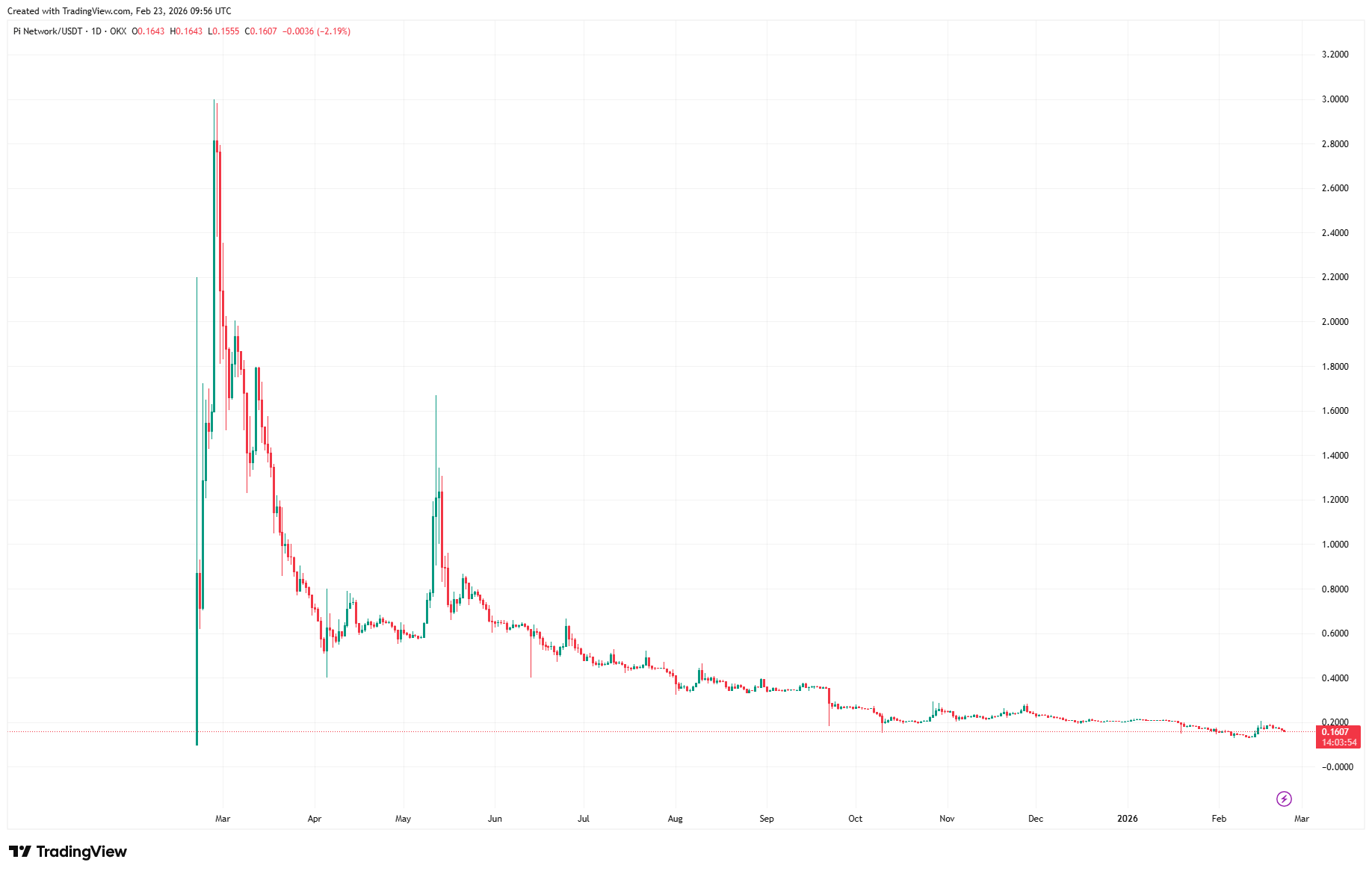
But the reality behind the numbers is sobering. Since its all-time high of 2.99 USD in late February 2025, the PI token has lost around 93 percent of its value. In early 2026, the price fluctuates between 0.15 and 0.26 USD. The estimated market capitalization sits at 1.6 to 1.7 billion USD. Industry figures like Bybit CEO Ben Zhou have publicly called the project a scam. Chinese authorities categorized Pi Network as a pyramid scheme back in 2023.
How Pi Network works
Dr. Nicolas Kokkalis and Dr. Chengdiao Fan founded Pi Network on March 14, 2019. Kokkalis brings expertise in distributed systems and taught Stanford's first blockchain course in 2018. Fan has a background in human-computer interaction. The third co-founder, Vincent McPhillip, left the project as early as February 2021.
Technically, Pi is based on a variant of the Stellar Consensus Protocol using Federated Byzantine Agreement. Instead of computing power, the system uses "Security Circles," networks of trusted contacts, to validate transactions. The mining rate depends on account status and the size of one's personal network. Users who invite more verified participants receive higher rewards. Transaction fees are just 0.01 PI.
The tokenomics model sets a maximum supply of 100 billion PI. 65 percent goes to community rewards, 20 percent to the core team. Another 10 percent flows into the foundation, and 5 percent into liquidity. As of February 2026, over 9 billion PI are in circulation.
From closed network to open mainnet
Pi Network went through several development phases. After the beta phase starting in 2019, the testnet followed in March 2020. The Enclosed Mainnet went live in December 2021, though behind a firewall without external connectivity. Only on February 20, 2025, at 08:00 UTC did the team remove the firewall and activate the open network.
PI opened trading at 1.47 USD and reached a peak of 2.10 USD on the same day. The price then briefly climbed to an all-time high of 2.99 USD in late February 2025. In May 2025, rumors of a Binance listing drove the price above 1.70 USD. They turned out to be false. By early October 2025, PI had fallen to 0.172 USD, a loss of around 95 percent.
For comparison: Bitcoin and Ethereum typically lost 70 to 80 percent in previous bear markets. Pi Network's crash of over 90 percent in just eight months is extraordinary even by volatile crypto market standards.
Centralization and scam allegations
The project faces fundamental criticism. According to a CNN report from January 2025, the Pi Core Team centrally operates all active validators. Community nodes exist but have no influence on consensus. Analysts accordingly describe Pi as a "permissioned blockchain" rather than a genuinely decentralized network.
"A gray area. Accessible, fascinating, and experimental, but loaded with red flags." - OKX Research
The referral system is also under scrutiny. Early users earn disproportionately more PI through invitations. This makes the growth model resemble a multi-level marketing structure. In July 2023, authorities in Hengyang City, China, officially categorized Pi Network as a pyramid scheme. Bybit CEO Ben Zhou publicly refused to list the token, stating that Pi is a scam.
Another incident shook confidence in May 2025. 12 million PI tokens flowed out of a wallet allegedly linked to the core team. The price subsequently crashed by over 50 percent. Beyond the insider trading suspicions, there are also privacy concerns. KYC verification is mandatory for access to the open mainnet. This data is stored on centralized servers, yet no policy on data retention or deletion exists.




Ecosystem and user base
Of the 70 million registered users, around 16 million had completed the mainnet migration by early 2026. The gap between registrations and actually migrated accounts is significant. Over 15.8 million Pioneers are active on the mainnet according to project data.
The ecosystem is growing nonetheless. By early 2026, Pi counts over 215 active decentralized applications, including marketplaces like Piketplace and collaboration tools like Brainstorm. That January, the team launched a developer SDK allowing third-party developers to integrate PI payments in under ten minutes. Alongside this, Pi App Studio launched in 2025 with AI-powered app development. Pi Network Ventures, a 100 million USD investment fund, made its first investment in OpenMind.
Still, use cases for the token remain limited. While 27,000 merchants are said to accept PI, the figure is barely verifiable according to OKX analysis. No fiat on- and off-ramps exist within the Pi ecosystem. Liquidity on exchanges remains thin, with spreads between 0.05 and 0.52 percent. PI is currently tradable on OKX, Gate.io, MEXC, BitMart, XT.com, and Bitget. Daily trading volume reached around 30 million USD on Gate.io after the launch.
Governance without transparency
The governance structure also raises questions. Pi Network operates with a semi-DAO model in which the core team retains veto power. Public records of governance proposals or voting results are absent. Token holders have no explicit voting rights tied to their coin holdings. And the team has repeatedly postponed its decentralization roadmap.
Basic transparency standards are also missing. There is neither a comprehensive whitepaper nor public smart contract audits. Bitget's Chinese platform removed Pi content entirely. In February 2026, mandatory protocol upgrades from version 19 to 23 are pending. Their impact on users and the ecosystem remains unclear.