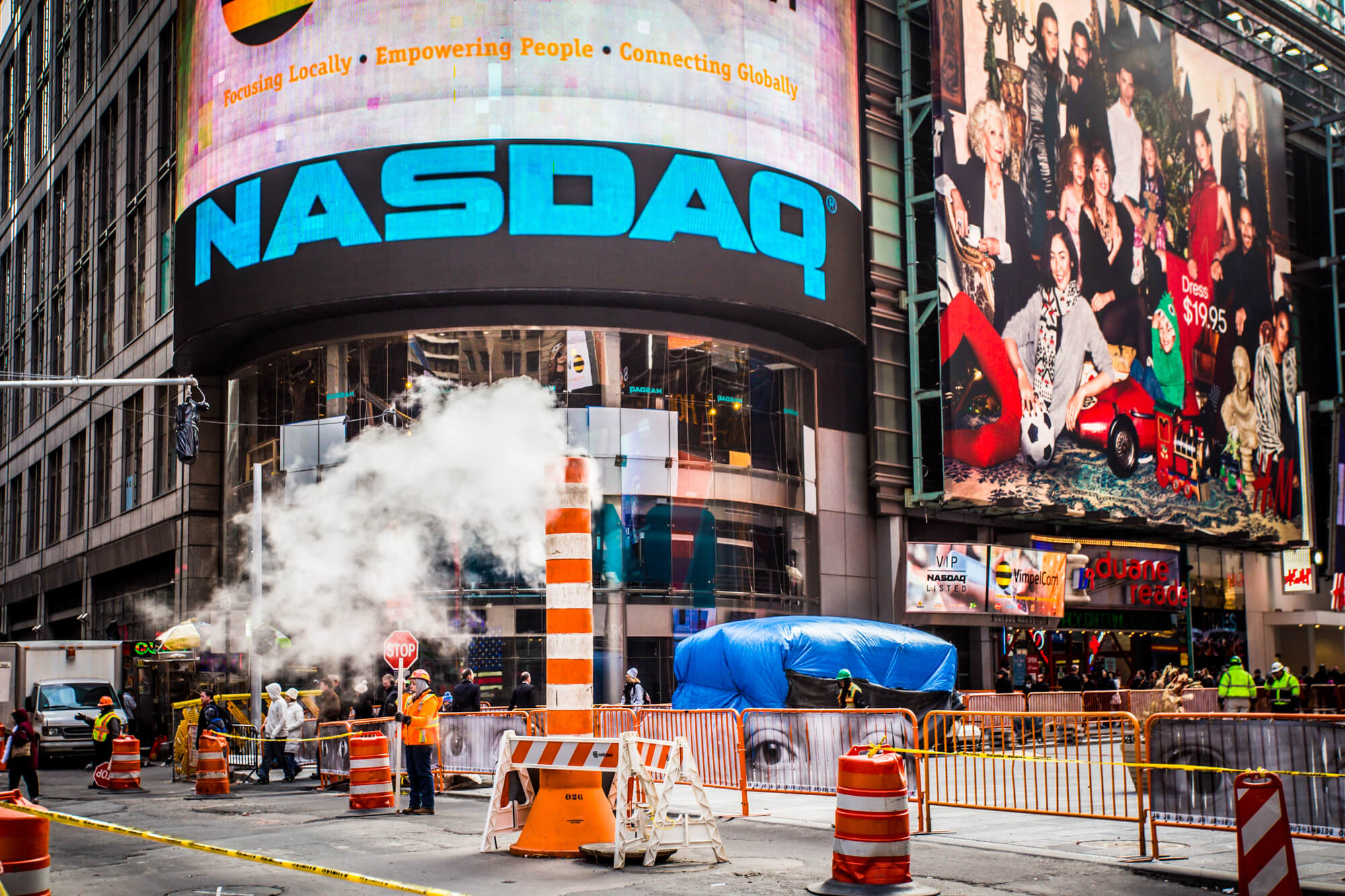
Nasdaq has filed a rule change application with the US Securities and Exchange Commission (SEC) to offer so-called "outcome-related options" on the Nasdaq 100 Index and the Nasdaq 100 Micro Index. These products follow the principle of prediction markets.
Traders buy and sell contracts priced between $0.01 and $1.00. Each price reflects the market's expectation that a specific event will occur. Those who predict correctly receive the full payout of $1.00. Incorrect predictions, however, result in a complete loss of the stake. This move marks the first formal engagement by a major US exchange operator in this segment.
Prediction markets have grown into a multi-billion-dollar market over the past two years. Kalshi and Polymarket, the two dominant platforms, recorded a combined monthly volume of roughly $18.4 billion in February 2026. It was the sixth consecutive monthly record. Meanwhile, the Nasdaq 100 tracks the 100 largest non-financial companies listed on Nasdaq, including Apple, Nvidia, and Intel. Its corresponding Micro Index represents one hundredth of that value.
Binary options under SEC oversight instead of CFTC
A key detail of the Nasdaq application concerns the regulatory classification. The exchange plans to list the new contracts as securities options under SEC oversight. This fundamentally distinguishes them from event contracts on platforms like Kalshi or Polymarket, which typically fall under CFTC jurisdiction.
Such a distinction has far-reaching implications. As SEC-regulated securities options, Nasdaq's products would be directly accessible to institutional investors and regulated retail brokers. Prediction market platforms have so far primarily served retail investors. Nasdaq can therefore leverage existing infrastructure for clearing, settlement, and broker connectivity.
SEC Chair Paul Atkins addressed the delineation between the two agencies before the Senate Banking Committee in February. He described prediction markets as a field with potentially overlapping jurisdictions. Atkins specifically named contracts on corporate earnings, M&A activity, product announcements, and index movements as areas potentially relevant to the SEC. Both agencies hold weekly coordination meetings and are working on modernizing crypto rules as part of the joint initiative "Project Crypto."
"Prediction markets are exactly an area where jurisdictions potentially overlap. This is a major topic we are focused on." - Paul Atkins, SEC Chair, before the Senate Banking Committee
Cboe as a competitor with its own push
Nasdaq is not alone. Cboe Global Markets announced in February 2026 that it would reactivate "all-or-nothing" binary options on financial indices such as the S&P 500. It would be the second attempt. Cboe first listed binary options in 2008 but later pulled them from the market due to lack of demand.
Since then, the market environment has fundamentally changed. Rob Hocking, Cboe's Global Head of Derivatives, described the new products as simple, event-based contracts for retail investors. They are intended to serve as an entry point into more complex options products. In an interview with the Wall Street Journal, JJ Kinahan, Head of Retail Expansion at Cboe, also emphasized the regulatory requirements.
"We will be very thorough with the legal and compliance requirements before we list new contracts." - JJ Kinahan, Head of Retail Expansion, Cboe Global Markets
Still, Cboe has not yet filed a formal SEC application. According to the exchange operator, discussions with brokers and market makers are ongoing. Nasdaq has taken a concrete step forward with its filing. Meanwhile, the CME Group is expanding access to crypto derivatives, driven by growing demand for 24/7 trading.



A $70 billion market attracts Wall Street
The interest from traditional exchanges is backed by impressive numbers. In February 2026, the total prediction market reached a nominal volume of $127.5 billion. Actual trading volume stood at just under $70 billion. Around 2.5 million users actively trade on the platforms. Total open interest exceeds $1 billion.
Kalshi and Polymarket dominate the sector with a combined market share of roughly 79 percent. Kalshi generated over $43 billion in total volume in 2025. Polymarket closed the year at $33.4 billion. According to industry reports, the combined valuation of both platforms stands at approximately $20 billion. Super Bowl 60 alone generated about $1.25 billion in prediction market volume. During Super Bowl week, the two platforms together reached a weekly volume of $6.3 billion.
Established financial firms are also increasingly positioning themselves in this segment. Gemini received CFTC approval as a Designated Contract Market for regulated prediction markets in December 2025. Coinbase then introduced prediction markets for US customers through Kalshi. At the same time, Nadex, a long-standing US provider of binary options, stopped onboarding new retail customers in December 2025 and transitioned to Crypto.com. This withdrawal of a veteran alongside the market entry of new players underscores the sector's dynamics.
A troubled history, a new market environment
Nasdaq's move carries a historical dimension. Binary options had a poor reputation in the US for years. During the 2010s, numerous fraud cases on unregulated offshore platforms made headlines. As early as 2013, the SEC explicitly warned retail investors against such offerings. Selling offshore binary options to US citizens remains illegal to this day. Consequently, binary options in the US may only be traded on regulated exchanges under SEC or CFTC oversight.
Now, the decisive difference from back then lies in the regulatory structure and market demand. Nasdaq's contracts would run on a licensed exchange under SEC oversight. Kalshi and Polymarket have demonstrated that investors intuitively understand the concept of fixed payouts of $0 or $1. As a result, the demand that was absent during Cboe's first attempt in 2008 now exists. This structural similarity to the prediction market format significantly lowers the barrier to entry for retail investors.
The central question therefore shifts from market acceptance to regulation. Atkins put it precisely: a security remains a security, regardless of its form. For prediction markets, the classification depends on the specific wording of the contracts. In Nasdaq's case, the SEC must decide whether outcome-related options fit within the existing regulatory framework for securities options. No specific decision date has been set yet.