
Close Menu
Crypto Valley Journal
    Facebook X (Twitter) Instagram
    Crypto Valley Journal
    • Hot Topics
      • News
      • Minds
    • Focus
      • Background
      • Blockchain
      • Legal & Compliance
      • Non-Fungible Token (NFTs)
    • Investing
      • Markets
      • Financial Products
      • Decentralized Finance (DeFi)
      • Exchange overview
    • Education
      • Basics
      • Glossary
      • Politicians on crypto
    • Statistics
      • Bitcoin-ETF-Flows
      • Ethereum-ETF-Flows
      • Crypto market data
      • On-chain data
    • Academy
      • Overview
      • Part 1: Blockchain
      • Part 2: Money
      • Part 3: Bitcoin
      • Part 4: Cryptocurrencies
      • Part 5: Decentralized Finance
      • Part 6: Investing
    • English
      • Deutsch
    Crypto Valley Journal
    You are at:Home » Focus » Blockchain » Polymarket: How crypto betting went mainstream
    Kalshi raises over 1 billion USD and reaches a valuation of 22 billion USD. Meanwhile, criminal charges loom from Arizona.

    Polymarket: How crypto betting went mainstream

    By Editorial Office CVJ.CH on 9. October 2025 Blockchain

    Amid the US presidential elections, one crypto app has managed to capture the prediction market: Polymarket. The protocol allows users to bet on the outcome of elections, competitions, or general events. But how did Polymarket break into the mainstream?

    Prediction markets are exchange-based platforms where participants trade contracts based on the outcome of future events such as elections or economic trends. The prices of these contracts reflect the collective probability of an event occurring. Traders profit directly if their prediction aligns with the actual result. This simple concept gains particular importance during the US election cycles every four years, as highlighted by the rapid rise of the betting platform Polymarket.

    Subscribe to our newsletter

    The best articles of the week, directly delivered into your mailbox.

    Over USD 2.5bn in trading volume for US elections

    Markets for future events have long existed in the traditional world. Polymarket, however, aimed to bring this business onto the blockchain. The decentralized protocol launched in 2020 on the Polygon network - hence the name Polymarket. The founders promised greater transparency, lower fees, and censorship resistance. But it would take four years for the app to break into the mainstream. The controversies surrounding the current US presidential elections revealed the ideal product-market fit.

    Users could bet on the platform about who would become the next president of the United States, who would win the popular vote, and which party would control the two chambers of Congress. On traditional betting exchanges, additional hurdles need to be overcome. Polymarket makes it easy to trade using cryptocurrencies or credit card deposits.
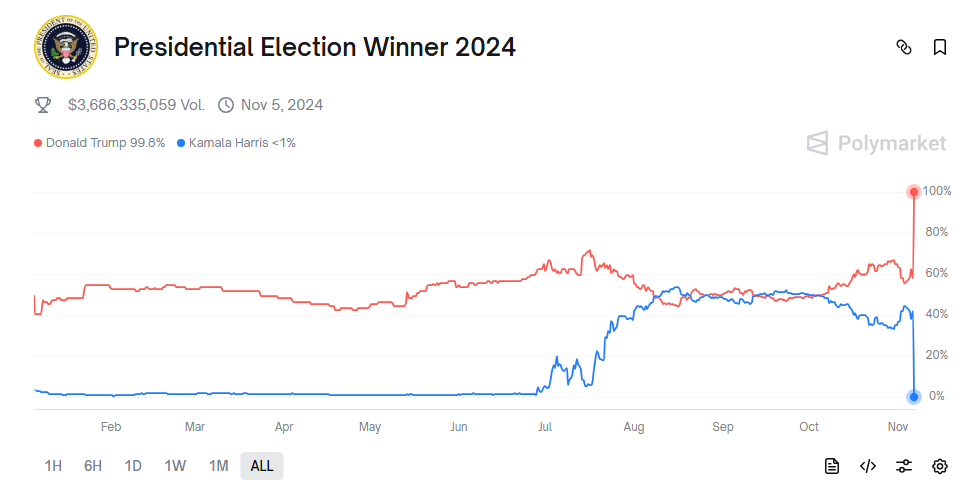
    Polymarket bets on past US presidential elections / Source: Polymarket

    By the end of the elections, users had wagered over USD 4bn on the various outcomes of the US elections. Traders put USD 3.6bn of this volume into the race between Kamala Harris and Donald Trump. Thanks to these impressive numbers, mainstream media outlets such as Bloomberg have since used the crypto app as a primary indicator of election probabilities.


    Ray Dalio’s Bridgewater Associates Minds

    Star investor Ray Dalio considers Bitcoin inferior to gold

    Strategy and BitMine are deep in the red: around USD 21 billion in unrealized losses. The Digital Asset Treasury (DAT) sector is wobbling. Background

    Strategy and BitMine underwater: USD 21 billion unrealized loss

    VanEck lists VBNB, the first US spot BNB ETF on Nasdaq. Sponsor fee 0.39%, custody at Anchorage Digital, no staking at launch. Financial Products

    VanEck launches first US BNB ETF (VBNB) on Nasdaq

    Digital finance transparency relies on Proof of Reserves, Merkle trees, MPC custody and 24/7 monitoring to verify solvency and user assets. Basics

    Transparency as the foundation of security in digital finance

    Ray Dalio’s Bridgewater Associates Minds

    Star investor Ray Dalio considers Bitcoin inferior to gold

    Strategy and BitMine are deep in the red: around USD 21 billion in unrealized losses. The Digital Asset Treasury (DAT) sector is wobbling. Background

    Strategy and BitMine underwater: USD 21 billion unrealized loss

    Volume remains above average

    Polymarket also has its critics. On one side, prediction markets occupy a regulatory gray area. Depending on legal interpretation, authorities may classify betting on real-world events as gambling. Polymarket would not meet the strict requirements of the gambling industry; users do not even undergo an identification process. In a settlement with the Commodity Futures Trading Commission (CFTC), the platform therefore had to pay a fine of USD 1.4m in 2022 . Since then, Polymarket claims to have built “an exceptional compliance team and robust internal practices and procedures” as a result of the investigation.

    Observers further criticize the strong focus on volume rather than “open interest.” Open interest refers to the total value of active, unsettled contracts in a prediction market. After all, volume can be easily inflated with low fees. Open interest, on the other hand, makes it clear how much money is actually at stake. This figure cannot be determined directly via the platform itself. According to on-chain data, the total value wagered on Polymarket amounts to around USD 211m. Before the parabolic rise due to the elections, this figure was around USD 20m.

    Total value locked on the prediction platform Polymarket / Source: DeFi Llama

    While the platform has not been able to increase activity since the US elections, it has managed to maintain a remarkable volume. Competitor Augur lost nearly 80% of its total value locked (TVL) after the vote on the new president in 2020. Currently, almost 100,000 unique wallet addresses trade on the platform per month. Many of them are likely unaware that blockchain technology processes all bets in the background.

    Latest development: NYSE parent ICE plans multi-billion investment in Polymarket

    The Intercontinental Exchange (ICE), parent company of the New York Stock Exchange (NYSE), has announced an investment of up to USD 2 billion in Polymarket. The funding is intended to fuel further growth and institutionalize the platform’s data infrastructure, with ICE set to distribute prediction market data directly. The stake represents the most significant alignment to date between traditional finance and the decentralized Web3 economy.


    Share. Facebook Twitter LinkedIn Email Telegram WhatsApp

    About the author

    Editorial Office CVJ.CH
    • Website
    • Twitter
    • LinkedIn

    Since 2018, the editorial team at Crypto Valley Journal has been reporting from Zug - the heart of Switzerland’s Crypto Valley - on Bitcoin, cryptocurrency, blockchain, and regulatory developments in digital assets. Behind the publication’s collective editorial voice is a team of writers with backgrounds in financial markets, law, and technology.

    Related Articles

    JPMorgan, Citi, Bank of America and Wells Fargo plan a network for tokenized deposits from 2027, operated by The Clearing House.

    JPMorgan, Citi, BoA and Wells Fargo plan network for tokenized deposits

    Strategy's first Bitcoin sale since 2022 sparks a USD 60M Polymarket UMA dispute and puts the token-voting oracle to the test.

    Polymarket UMA dispute over Strategy’s Bitcoin sale puts UMA to the test

    China expands the digital yuan: interest on balances, double the operator banks, and mBridge settling over $55 billion cross-border.

    China advances the digital yuan (e-CNY) on a broad front

    CVJ Weekly review
    6. June 2026

    Weekly review: Strategy sells Bitcoin and shakes up the market

    Strategy and BitMine are deep in the red: around USD 21 billion in unrealized losses. The Digital Asset Treasury (DAT) sector is wobbling.
    5. June 2026

    Strategy and BitMine underwater: USD 21 billion unrealized loss

    JPMorgan, Citi, Bank of America and Wells Fargo plan a network for tokenized deposits from 2027, operated by The Clearing House.
    5. June 2026

    JPMorgan, Citi, BoA and Wells Fargo plan network for tokenized deposits

    twitter image button instagram image button linkedin image button youtube image button

    About Crypto Valley Journal
    About Crypto Valley Journal

    On the pulse of the movement

    • Academy
    • Contact
    • Advertising
    • About us
    • Partner
    • Imprint
    • Privacy
    • Disclaimer
    Search

    Type above and press Enter to search. Press Esc to cancel.