![S&P Dow Jones Indices licenses the S&P 500 to Trade[XYZ] for the first officially licensed S&P 500 perpetual contract on Hyperliquid.](https://cryptovalleyjournal.com/wp-content/uploads/2026/03/CVJ.CH-SP-Dow-Jones-SP-500-Hyperliquid.jpg "S&P Dow Jones Indices licenses S&P 500 for perpetual contracts on Hyperliquid")
S&P Dow Jones Indices (S&P DJI) has licensed the S&P 500 to Trade[XYZ]. This creates the first officially licensed S&P 500 perpetual contract on a decentralized trading platform. As a result, the contract is available on Hyperliquid starting today, tradable around the clock, 365 days a year.
Globally, over $1 trillion in positions tied to the S&P 500 are traded daily. These include futures, options, ETFs, and structured products. Indeed, the index is widely regarded as the most closely watched equity benchmark in the world. Notably, the new perpetual contract uses institutional S&P DJI index data directly, not merely a proxy price. It is available exclusively to eligible non-US investors.
How the S&P 500 perpetual on Hyperliquid works
Perpetual contracts are derivatives without a fixed expiration date. Unlike traditional futures, traders do not need to roll their positions periodically. On Hyperliquid, the S&P 500 perpetual runs on the HIP-3 protocol. This protocol enables trading of tokenized real-world assets. USDC serves as collateral, while the oracle price is denominated in USDT. Together, this creates a quanto contract structure.
The decisive advantage over traditional exchanges lies in 24/7 trading. Consequently, investors can open or close positions on weekends and holidays. During periods of geopolitical tension or macroeconomic shocks, this provides an information edge. Traditional futures markets do not open until Sunday evening (US time). By then, market participants on Hyperliquid have already reacted.
Trade[XYZ] is the largest provider of real-world asset markets on Hyperliquid. Since October 2025, the platform has reached a cumulative trading volume of over $100 billion. Accordingly, the annualized run rate exceeds $600 billion. In the HIP-3 market, Trade[XYZ] dominates with roughly 90 percent of total open interest.
S&P DJI deepens engagement in digital markets
The licensing to Trade[XYZ] is not an isolated step. Rather, S&P DJI has been moving systematically toward digital assets since 2021. That year, the index provider launched its first cryptocurrency index series, the S&P Digital Market Indices. In July 2025, it followed with licensing the S&P 500 to Centrifuge for tokenized fund shares. Two months later, SPXA went live as the first licensed S&P 500 Index Fund Token.
In October 2025, S&P added the Digital Markets 50 Index, combining cryptocurrencies and crypto-adjacent equities. Following that, S&P Global Ratings published the first rating of a structured finance deal backed by Bitcoin collateral in February 2026. The perpetual contract on Hyperliquid thus fits into a clear strategic trajectory.
"This collaboration extends the reach and utility of our flagship benchmarks into digital trading environments. We believe digital-native investors should expect the institutional quality standards that define our indices, and we are very excited to work with Trade[XYZ] to deliver on that." - Cameron Drinkwater, Chief Product & Operations Officer, S&P Dow Jones Indices



Hyperliquid dominates the decentralized derivatives market
Hyperliquid controls over 70 percent of total open interest in the decentralized perpetual futures market. Daily trading volume exceeds $45 billion. The platform runs on its own Layer-1 blockchain with the HyperBFT consensus mechanism. At the end of 2025, Hyperliquid ranked as the fourth-largest platform by revenue across the entire crypto ecosystem, with earnings exceeding $650 million.
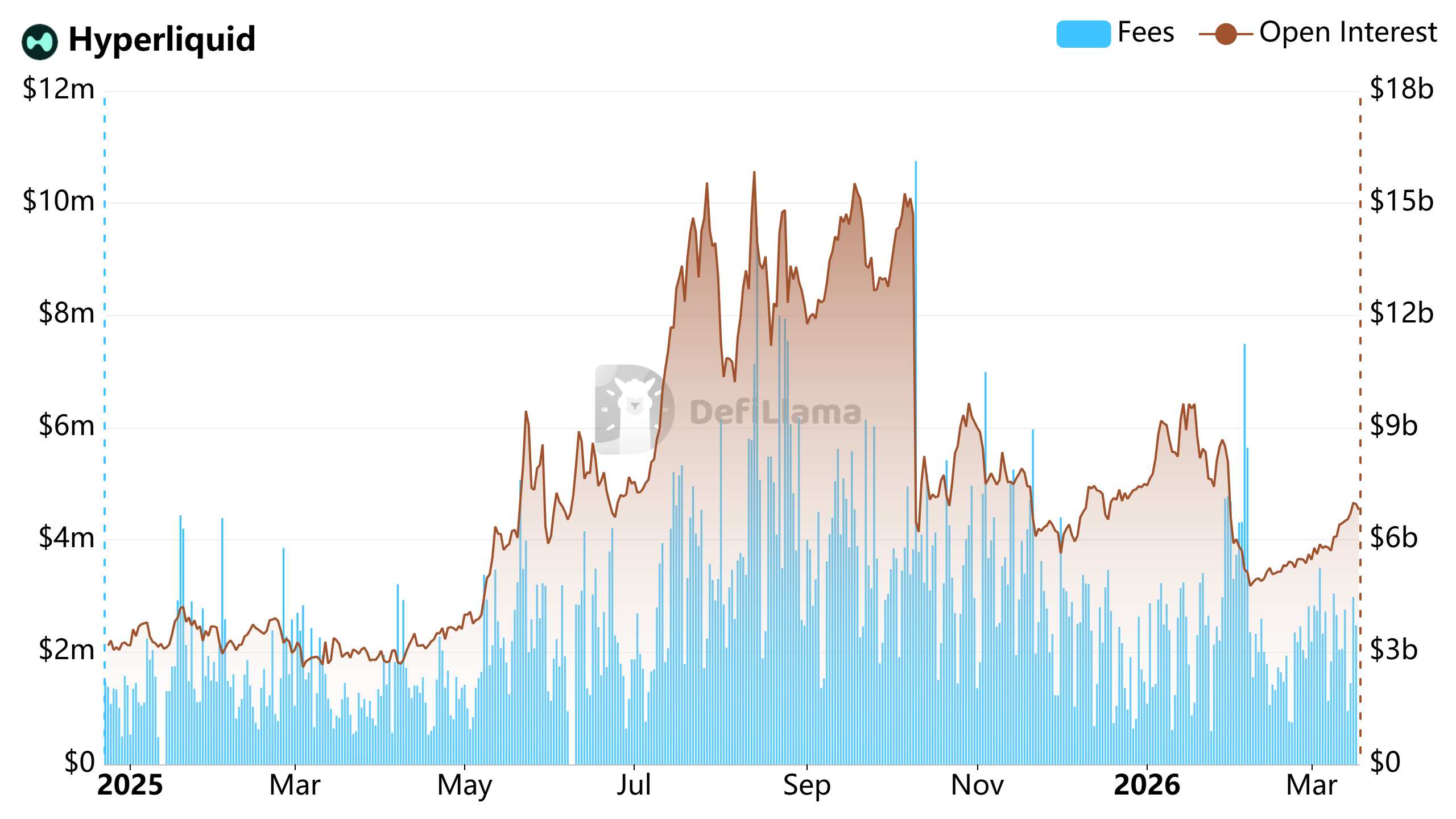
Crypto trading alone no longer explains this growth. Of the 30 largest markets on Trade[XYZ], only seven are crypto pairs. The remaining 23 comprise tokenized equity futures, individual stocks, gold, silver, and crude oil. Leading in open interest, the XYZ100-USDC contract -- a tokenized equity index -- stands at $213 million. Crude oil (CL-USDC) follows at $169.8 million. In total, open interest in the HIP-3 market recently reached $1.43 billion. Collins Belton, COO and General Counsel of Trade[XYZ]'s parent company, states the ambition clearly:
"We built XYZ with the vision of bringing the world's most important markets onto the blockchain. The S&P 500 is a natural starting point. It represents the most closely watched equity index in the world and has been the definitive benchmark for global equities for decades." - Collins Belton, COO and General Counsel, Trade[XYZ] parent company
Decentralized derivatives grow into the mainstream
The market share of decentralized perpetual exchanges in the total futures market rose from 2.7 percent in 2023 to 26 percent by the end of 2025. At the same time, monthly trading volume for decentralized perpetual futures exceeded $1.2 trillion, according to Coinbase Institutional. Meanwhile, on-chain derivatives market capitalization grew 654 percent in 2025 to $18.9 billion, according to CoinGecko. Of that, $17.9 billion was attributable to perpetuals.
For traditional index providers like S&P DJI, this opens a new distribution channel. Licensing revenue from DeFi products complements the existing business with ETF providers and futures exchanges. Still, the regulatory landscape remains complex. The exclusion of US investors from the Trade[XYZ] product points to deliberate risk avoidance. Specifically, SEC oversight of S&P 500 derivatives and CFTC jurisdiction over futures contracts likely play a role.
S&P DJI lends its name and data to a product on a decentralized platform. This signals normalization. Increasingly, institutional brand owners license to DeFi protocols, provided the compliance structure is sound. The boundary between traditional financial markets and decentralized infrastructure is becoming progressively more permeable.