A summarizing review of what has been happening at the crypto markets of the past week. A look at trending sectors, liquidity, volatility, spreads and more. The weekly report in cooperation with market data provider Kaiko.
The last 7 days in cryptocurrency markets:
- Price Movements: ETH is down 25% on the week despite the successful completion of the Merge.
- Market Liquidity: The U.S. dollar remains the dominant fiat currency in crypto, possessing 70% of total fiat trade volume.
- Derivatives: ETH funding rates have returned to neutral after dipping to all time lows of less than -0.4%.
- Macro Trends: August core inflation data exceeded expectations, causing both crypto and equity markets to tumble.
Post-Merge sell-off sweeps markets
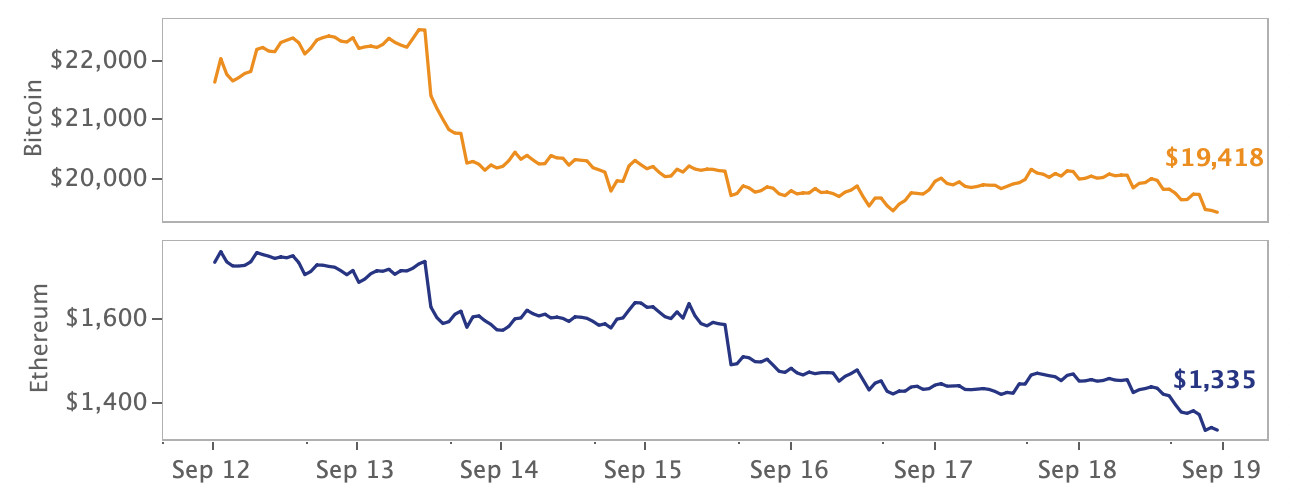
In what many expected to be a positive week for the price of ether, a successful Merge ended up preceding a significant sell off of roughly 25% on the week. ETHW and ETC were also some of the week's worst performers in a sign that old Ethereum miners will struggle to remain profitable. In broader industry news, a South Korean court issued an arrest warrant against Terra founder Do Kwon, the Blockchain Association formed an industry PAC, and Wall Street firms Charles Schwab, Citadel Securities, and Fidelity Digital Assets announced the launch of a new cryptocurrency exchange, EDX Markets.
Staked ETH discount narrows to lowest level since May
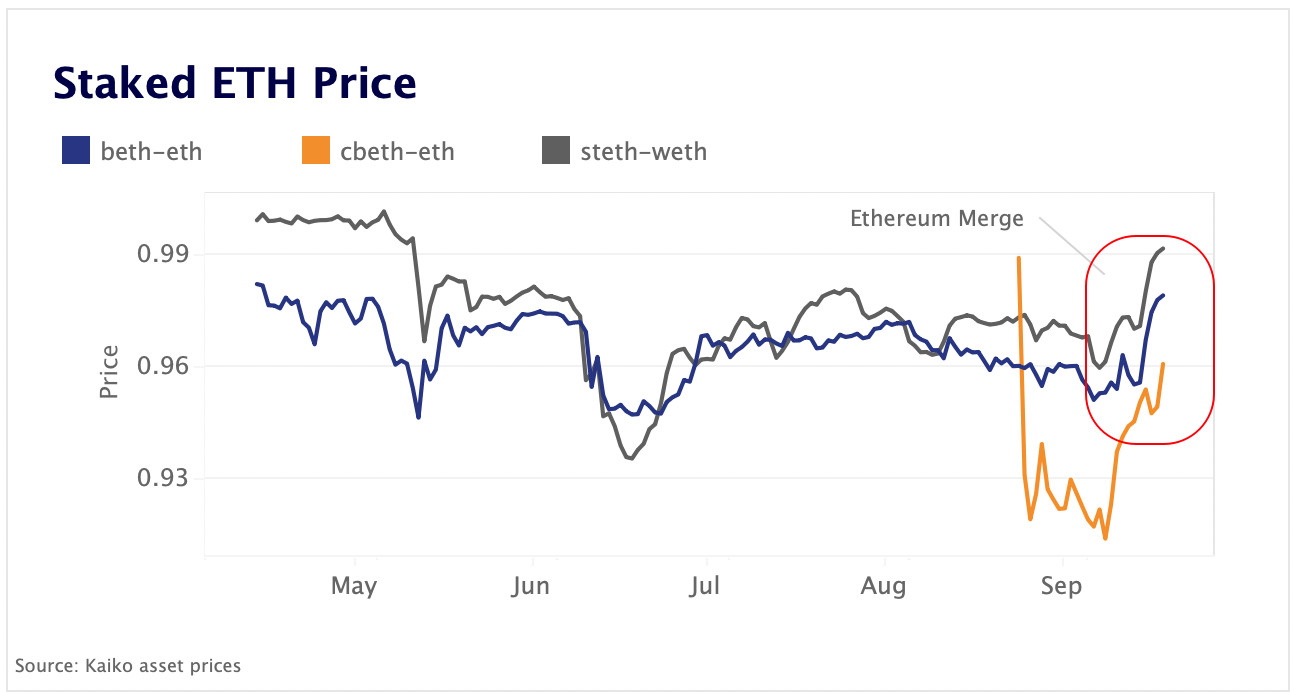
The discount on staked ETH tokens relative to spot ETH has narrowed to its lowest levels since May, a trend which first emerged in the hours after the Ethereum network's successful transition to proof-of-stake. Liquid staking derivative tokens such as Coinbase’s cbETH, Binance’s bETH and Lido’s stETH are wrapped versions of ether staked on Ethereum’s consensus layer - the Beacon chain. They are not pegged to Ethereum (ETH) and their market price takes into account a number of regulatory and smart contract risks. For example, if a staker is "slashed", which happens in the event of validator failure, a portion of staked ether could be at risk.
The sharp narrowing of Lido’s stETH discount from 4% to just 1% was supported by increasing liquidity in Curve's stETH pool, which is the largest secondary market for staked ether. cbETH and bETH markets also saw strong buy pressure immediately after the Merge (we discuss the post-Merge market reaction here). While the trend suggests some risk premium has been taken off the table, the staked ETH discount will likely persist until the next Ethereum upgrade enables staking withdrawals sometime next year. However, the opportunity costs of holding ETH has now increased (as staking offers additional rewards) which could provide some tailwinds for staked ETH markets.
The U.S. Dollar remains the dominant fiat currency in crypto
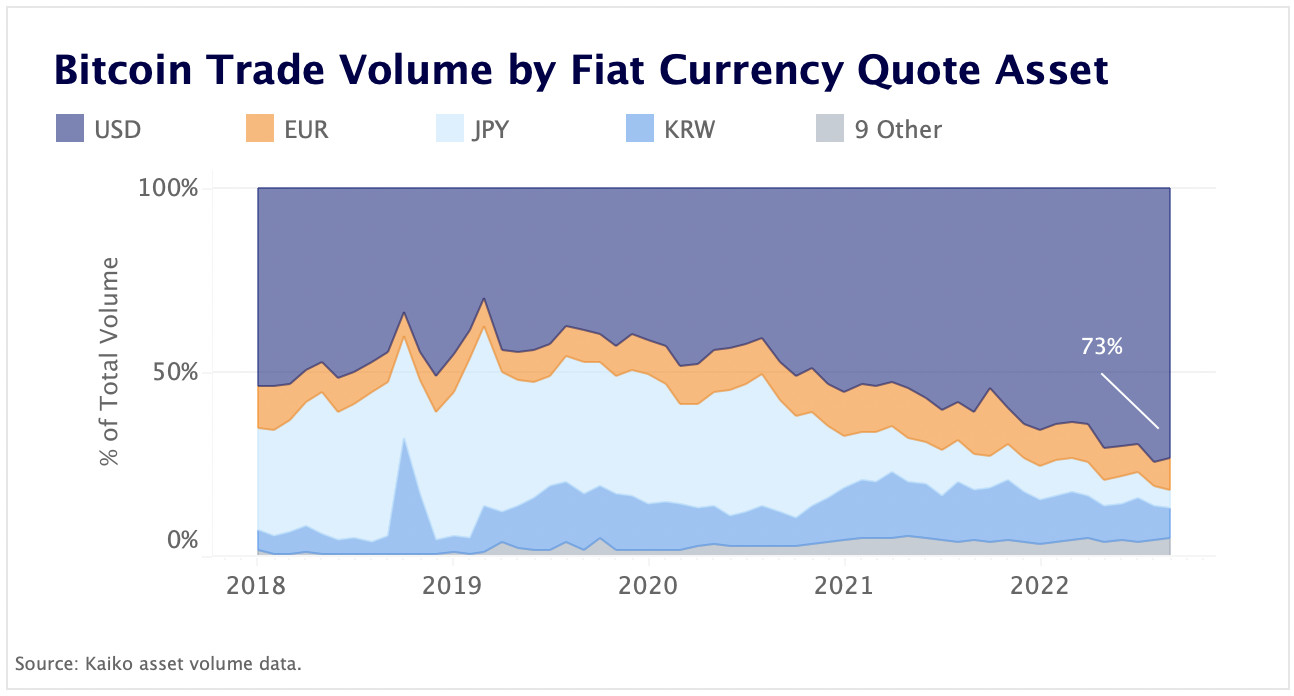
While the majority of cryptocurrency transactions are conducted today using stablecoins, fiat currencies still serve as a critical on and off-ramp to markets. Historically, the U.S. dollar has been the most important fiat currency in crypto, but how has its role changed over time? The share of bitcoin (BTC) traded against the U.S. Dollar has increased significantly since 2018 and currently exceeds 70% of total bitcoin-fiat trading volumes.
The trend could be explained by rising institutionalization of the market, as large investors typically prefer transacting in dollars. However, a closer look at the breakdown by fiat currency suggests that local regulations could have also played a role. Notably, BTC volumes on Japanese markets have declined sharply with Japanese-based exchange Liquid registering a five-fold drop in annual trade volumes between 2018 and 2021 after suffering a $97mn hack and stricter Japanese regulations. For context, the amount of BTC traded on USD markets rose by 30% over the same period.
Fiat market share will likely continue to evolve as regulatory regimes become clearer around the world. For example, Japan is reportedly considering loosening its screening rules for new assets. For now, the dollar still reigns supreme.
ETH market share hits all time high during post-Merge sell-off
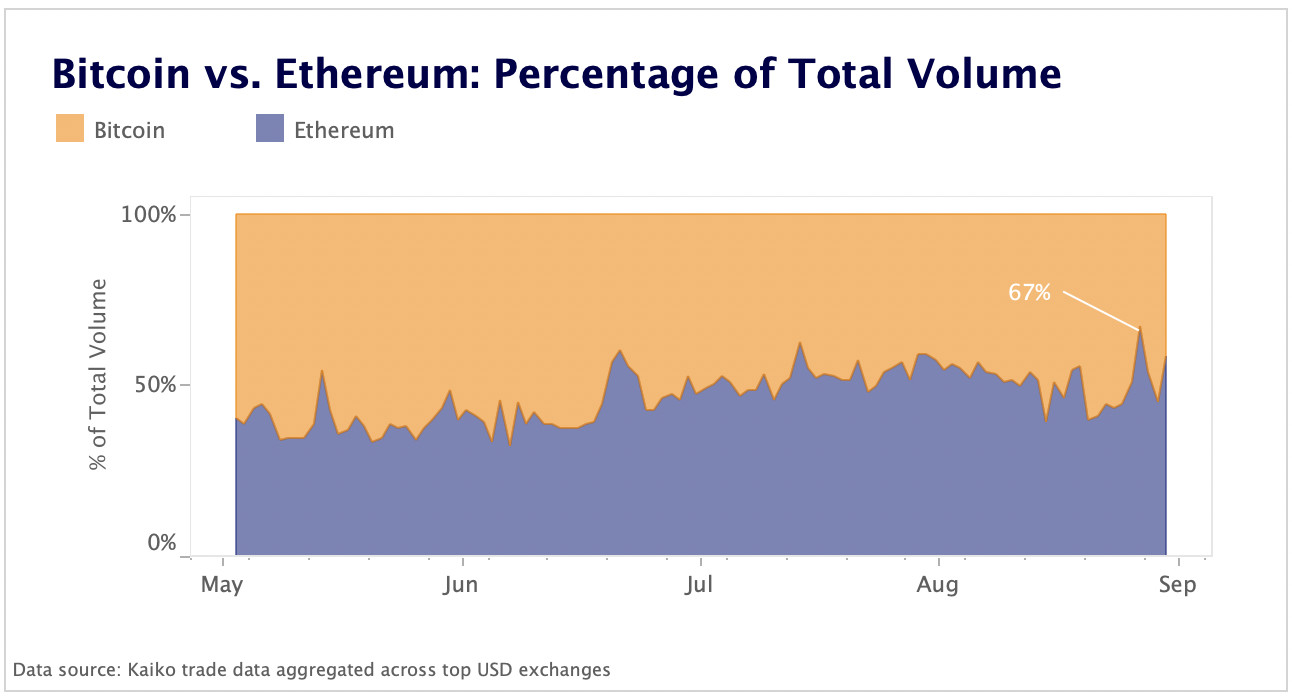
Ether’s market share of trade volume hit an all-time high of nearly 70% relative to bitcoin’s during the post-Merge selloff last week. Large liquidations of leveraged long positions across derivatives markets exacerbated the drop in spot prices, causing spot volumes to surge. Overall, ETH's market share has more than tripled since 2020, suggesting a durable shift in market structure away from BTC.
As volumes surged, liquidity evaporated for ETH spot markets, as measured by the quantity of bids and asks within 2% of the mid price on ETH-USD(T) order books. This suggests market makers were apprehensive and removed liquidity to avoid being caught in Merge-related volatility. Liquidity was quickly re-added in the aftermath, and now sits just slightly above the levels we saw pre-Merge.
Binance bucks trade volume trend
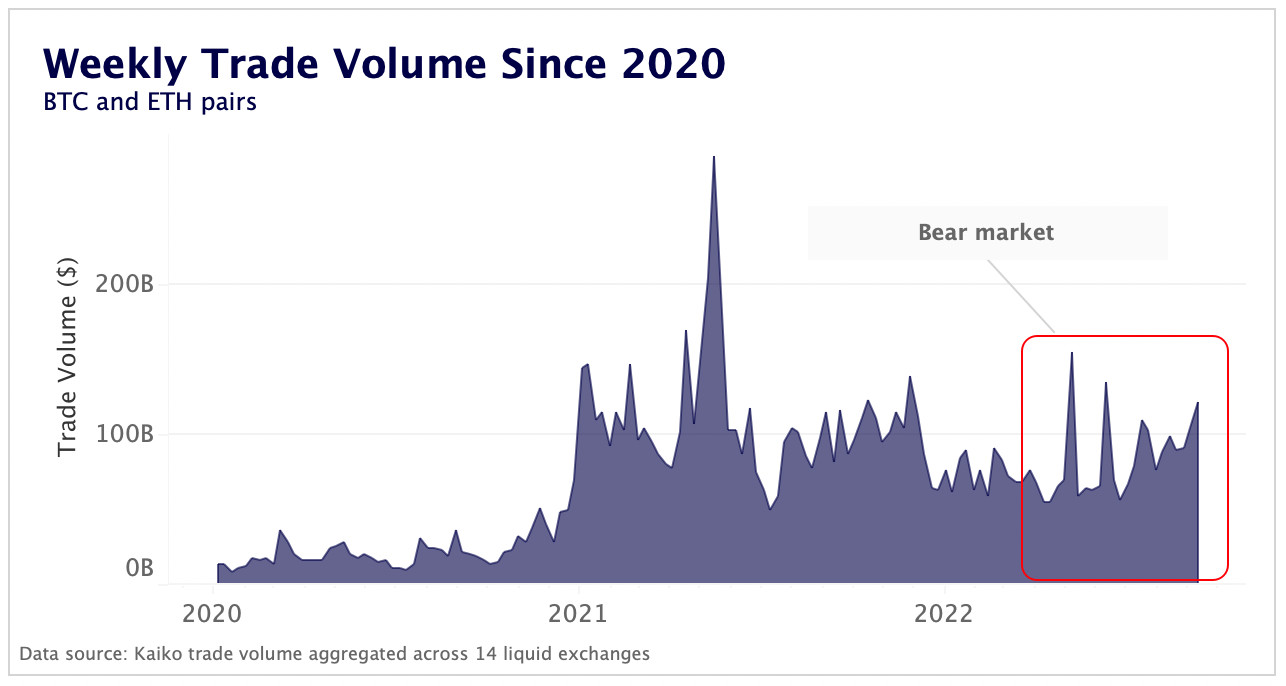
Trade volume is one of the best indicators of a prolonged bear market. An initial price slump is typically accompanied by a surge in trade volume as traders take advantage of (or suffer) from volatility. However, as days turn into weeks turn into months of depressed prices, volumes start to drop off across most exchanges. Yet, when looking at aggregated volume for the most liquid BTC and ETH pairs, we can observe no such trend since the start of the bear market in May. While weekly volumes remain well below all time highs, there has actually been a slight up-tick in activity over the past few months.
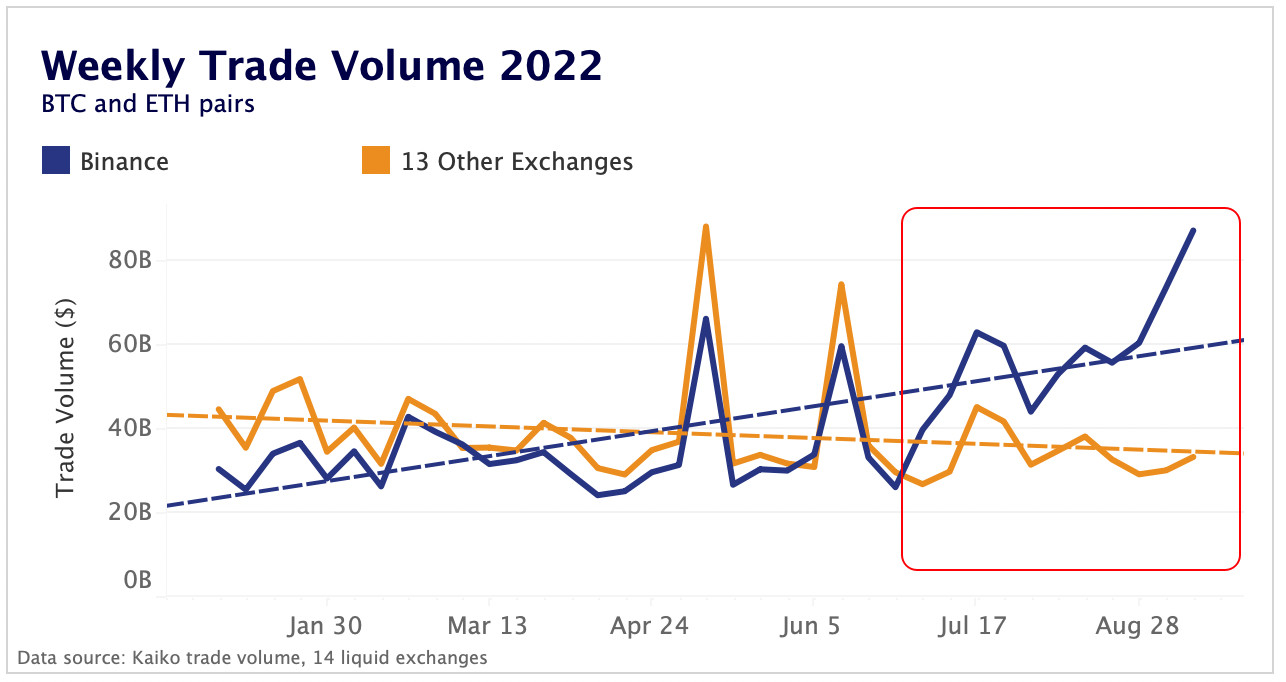
Unfortunately, aggregated data can obfuscate exchange-level trends. When separating Binance from this aggregated dataset, we can a strong divergence in activity between the world's largest exchange and 13 other exchanges. Ever since Binance removed trading fees for BTC/ETH pairs, they've experienced a massive surge in volume. For the first time, Binance market share has climbed well beyond aggregated volumes for 13 other exchanges (including Coinbase, FTX, Huobi, Okex, etc.). Since the start of 2022, volumes have actually trended down on all exchanges except Binance, matching what we would expect of a bear market.




ETH funding rates stage dramatic recovery
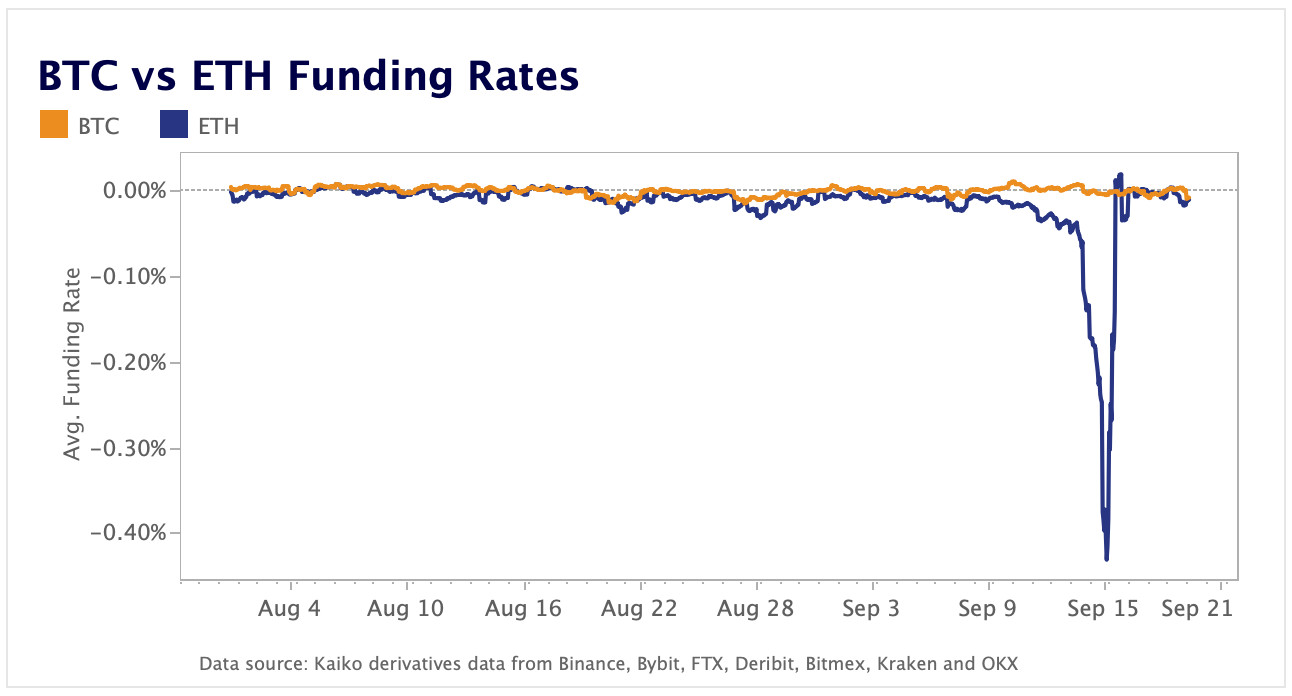
ETH funding rates moved sharply off their all time lows post-Merge as the ETHW airdrops began and futures prices no longer needed to account for a potential arbitrage. Investors were taking advantage of the ETHW airdrop by combining their long ETH spot positions with short ETH futures, eliminating price risk while still being able to collect the ETHW airdrop. Were futures prices not discounted to reflect this strategy, this strategy would have also profited on the short futures side of the trade. Once the Merge was successfully completed and the airdrop of ETHW took place, futures returned closer to spot prices and thus the funding rates moved sharply towards neutral again
Hotter than expected U.S. inflation boosts Fed hike bets
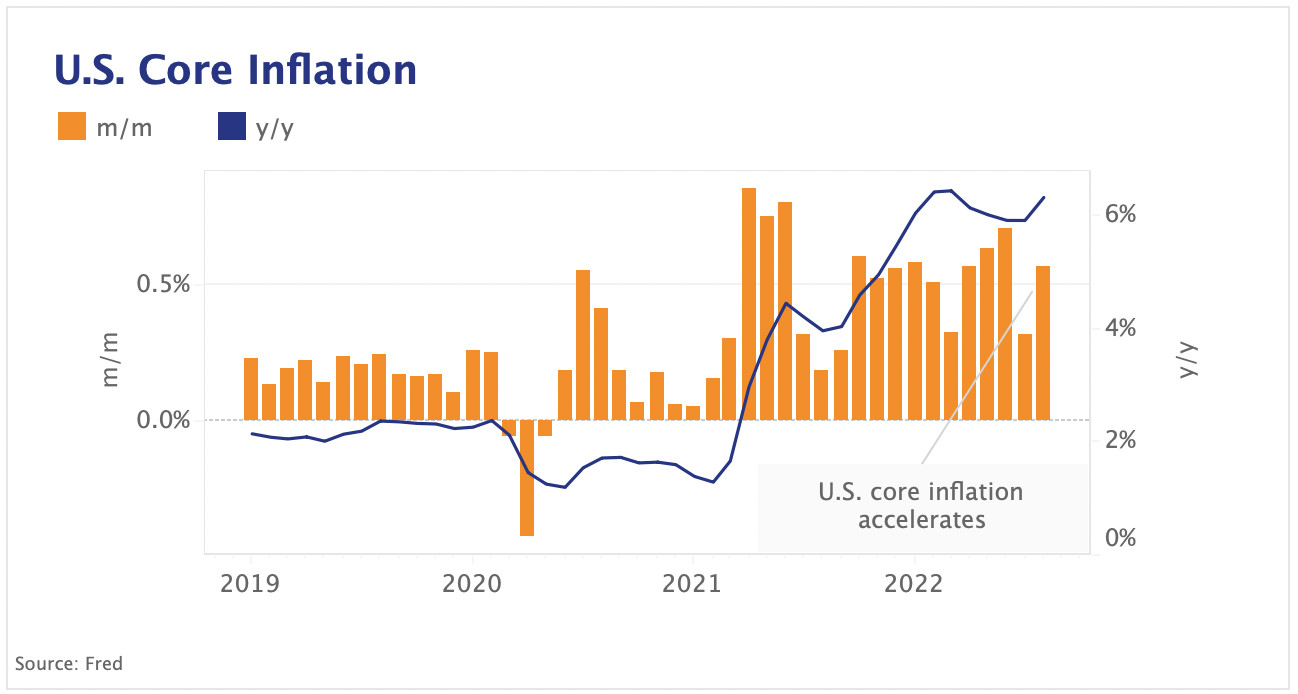
Macro headwinds continue to weigh on financial markets after a hotter than expected monthly US inflation print for August caused both crypto and equities to crash. Headline inflation came at 8.3% year-over-year, slightly lower relative to July’s numbers. However, the monthly core inflation went up by .6%, almost double the estimates. The core inflation excludes volatile food and energy prices and is considered stickier and costlier to hedge than headline or energy inflation. Fears that bringing down inflation will be a slower and more painful process than anticipated boosted an aggressive repricing in the Fed peak rate which is now seen above 4%. Markets are widely expecting another large 75bps rate hike at this week’s Fed meeting while bets for a super-sized full percentage move are on the rise.
Bitcoin’s correlation with bonds and equities rises in September
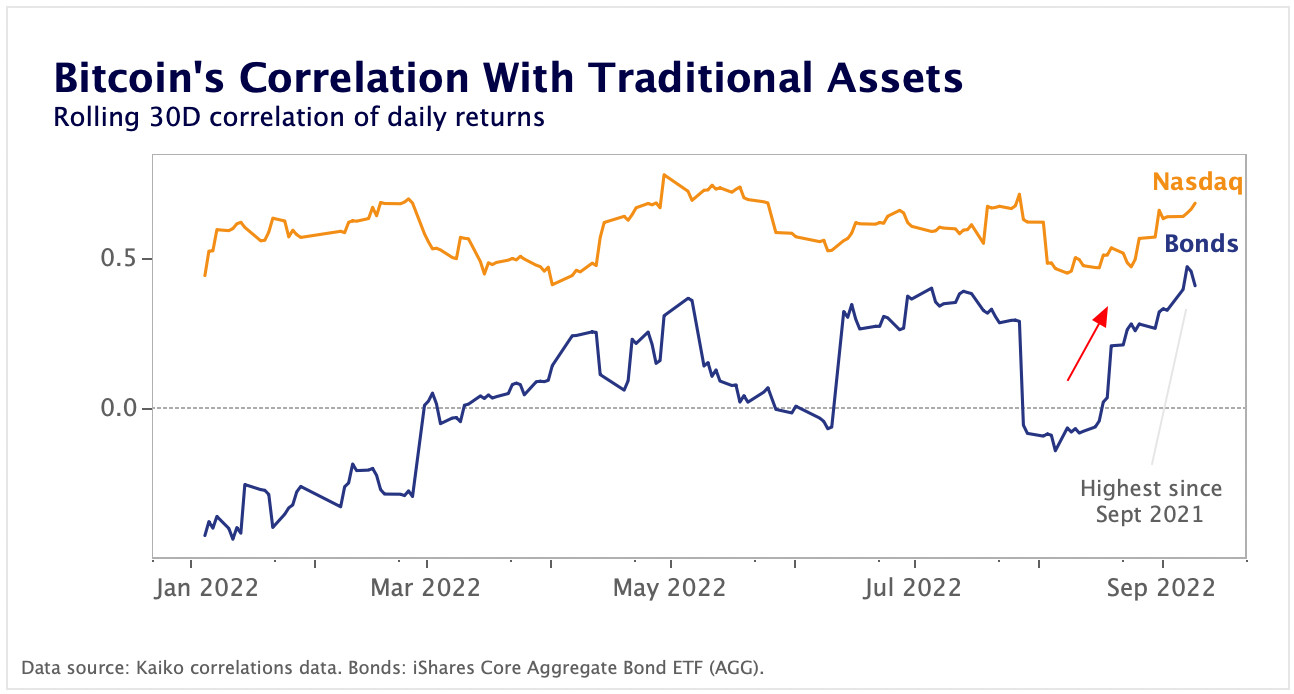
Bitcoin’s correlation with both bonds and equities has resumed its increase in September after declining over the summer. Inflation uncertainty coupled with Fed tightening has resulted in a historical decline in both risk and fixed-income assets, challenging traditional asset allocation approaches. The iShares Aggregate Bonds ETF, which tracks the U.S. investment-grade bond market, declined by 12% YTD, the Nasdaq 100 lost 28% of its value while Bitcoin is down over 50%. Recent research shows that persistently high and more volatile core inflation could be among the explanations for the positive correlation between bonds and risk assets over the past months, as inflation negatively impacts all asset classes.