
BitMine Immersion Technologies recently filed its 10-Q for the second fiscal quarter, reporting a net loss of USD 3.818 billion. Almost the entire shortfall for the quarter ended 28 February 2026 stems from unrealised writedowns on the company's Ethereum holdings.
Roughly 99 percent of the quarterly loss, or precisely USD 3.775 billion, resulted from the revaluation of digital assets. Over the first six months of the fiscal year, unrealised losses therefore total USD 9.023 billion. Under mark-to-market accounting, such price movements flow directly into the income statement. At the same time, the company led by Tom Lee continued to expand its ETH position. As of 13 April 2026, BitMine holds roughly 4.87 million ETH, controlling 4.04 percent of the circulating Ethereum supply.
Accounting losses alongside a growing balance sheet
The balance sheet as of 28 February 2026 reveals a significant gap between cost basis and market value. On the reporting date, 4,473,459 ETH sat on the books at a fair value of USD 8.793 billion, against a cumulative cost basis of USD 16.973 billion. As a result, the average entry price works out to roughly USD 3,793 per ETH. In addition, the company held 195 BTC worth USD 13.072 million and cash of USD 879.577 million.
At quarter-end, total assets amount to USD 9.894 billion, with equity of USD 9.858 billion. The bulk of this stems from an aggressive capital-raising programme. Through the at-the-market offering, the company received net proceeds of USD 10.069 billion. Accordingly, shares outstanding rose to 537,628,819 as of the filing date.
Operationally, however, BitMine remains comparatively small. Revenue in the second quarter came to USD 11.041 million, of which USD 10.201 million came from staking rewards. Self-mining contributed only USD 219,000, while consulting and leasing together added roughly USD 621,000. Compared with the prior-year quarter at USD 1.517 million in revenue, the top line has increased sevenfold. Relative to the balance sheet, however, it remains marginal.
Tom Lee defends the treasury strategy
Back in February, Chairman and Fundstrat founder Tom Lee responded to the interim paper losses. When ETH fell below USD 2,000 and cumulative unrealised losses grew to USD 8 billion, Lee pointed to the purely accounting nature of the writedowns. Under mark-to-market rules, price movements feed directly into the income statement. Yet nothing is actually sold.
"Crypto is in a downturn, so of course ETH is declining. BMNR will record unrealised losses on our ETH holdings." - Tom Lee, Chairman BitMine Immersion Technologies
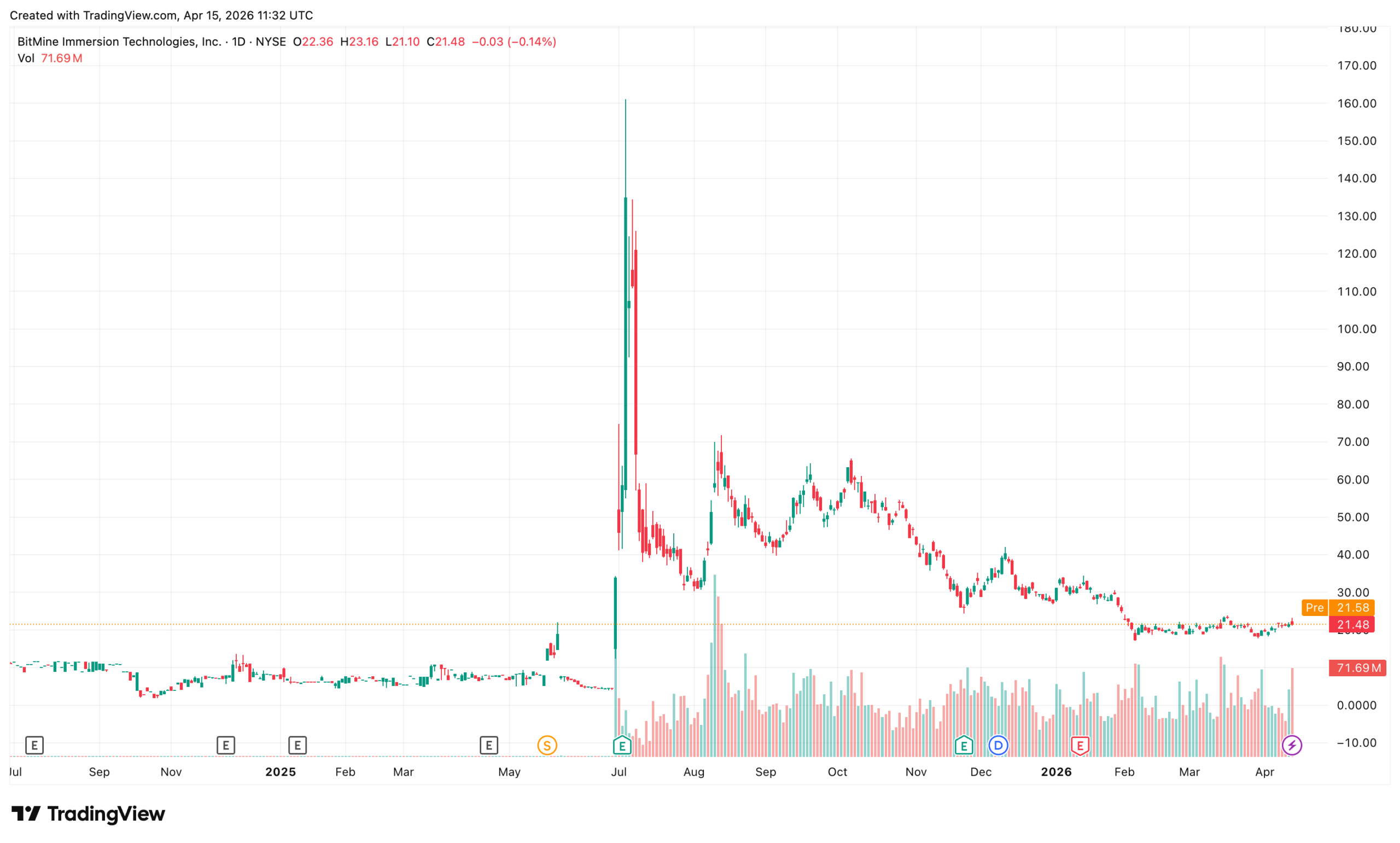
In parallel, shareholders approved a massive increase in authorised shares from 500 million to 50 billion. This hundredfold expansion is intended to enable further ATM issuance and therefore additional ETH purchases. BMNR shares initially reacted to the dilution announcement with a 6.4 percent decline. As of 14 April 2026, the stock traded at USD 21.48. In the annual report, the operating model now rests explicitly on the ETH treasury strategy as well as capital-light ecosystem services.



ETH treasury as a mirror of the Strategy blueprint
BitMine's approach follows the model of Strategy, formerly MicroStrategy. Since 2020, that firm has held Bitcoin as its primary balance-sheet asset and now ties up USD 55 billion in BTC. The mechanism is identical: raise capital in the equity market, convert proceeds into crypto reserves, and present the stock as leverage on the underlying asset. In one decisive respect, however, the ETH variant differs. Staked ETH generates ongoing yield of roughly 3 percent per year, whereas BTC treasuries remain passive.
Currently, BitMine has 3,334,637 ETH, or 68 percent of its holdings, in staking, which produces annualised income of roughly USD 212 million. On 9 April 2026, the company launched MAVAN, an institutional Ethereum staking platform for its own and external investors. At the same time, BitMine completed the uplist from NYSE American to the NYSE main exchange. Both steps address institutional perception as an ETH infrastructure vehicle, rather than a pure mining operation.
The stated target is 5 percent of the circulating ETH supply, referred to internally as the "alchemy of 5%". At 4.04 percent in mid-April, BitMine is closing in on that goal. Moreover, the company already sits well ahead of the next-largest ETH treasury holder, SharpLink Gaming, with 859,853 ETH. The concentration is striking. Should BitMine reach the 5 percent mark, a single listed company would control more ETH than all currently regulated Ethereum spot ETFs combined. The next earnings release, covering the third fiscal quarter, is scheduled for 29 April 2026.