
One of the most important building blocks for connecting billions of people to blockchain infrastructure is scaling solutions that enable a seamless user experience. There are different types of platforms, of which so-called zkEVM blockchains are considered the holy grail of scaling.
The name zkEVM can be broken down into two parts: 1) zk means zero-knowledge, a proof system allowing a person to prove the veracity of information to another party without revealing any data thanks to mathematics. 2) EVM stands for Ethereum Virtual Machine, the execution environment for the Ethereum network. In other words, zkEVM is a scaling solution compatible with Ethereum. Using zero-knowledge proofs, ZK-Rollup can achieve better scalability, security, and faster finality as a scaling solution for Ethereum. A concrete example is the bundling of transactions happening within a certain period and settling the proof of a block of transactions on the Ethereum network instead of the full list of transactions that may congest the network.
EVM compatibility is central
However, the existing scaling solutions like zkSync Lite, Loopring, and Starknet are not EVM-compatible. As a result, users and developers need to use or build new smart contracts, wallets, and developer tools in order to have applications interact with Ethereum. The best analogy would be an application available over the Internet (Ethereum) vs. an intranet (a non-compatible environment) Therefore, Optimistic rollups like Arbitrum and Optimism have been more popular among users due to their EVM compatibility.
To overcome the limitation, developers have proposed a new type of ZK-Rollup, zkEVM. Not only can zkEVM leverage the upside of zero-knowledge proofs, but it also provides developers and users with the existing toolings and applications. Thus, zkEVMs are often referred to as the “Holy Grail” for scaling Ethereum to thousands, if not hundreds of thousands of transactions per second. With the launch of the first zkEVMs, zkSync Era and Polygon zkEVM, we analyze the bridging activities from Ethereum to these 2 networks to provide an overview of the adoption of zkEVMs.
Deposited assets on the zkEVMs
zkSync Era has higher bridge activities ($125M) than Polygon zkEVM ($2.59M). The mainnet launch for zkSync Era and Polygon zkEVM is on 24 March and 27 March respectively. While Polygon zkEVM has a more diversified bridged asset, zkSync Era is leading in TVL ($125M) and the number of depositing addresses (285.2K).
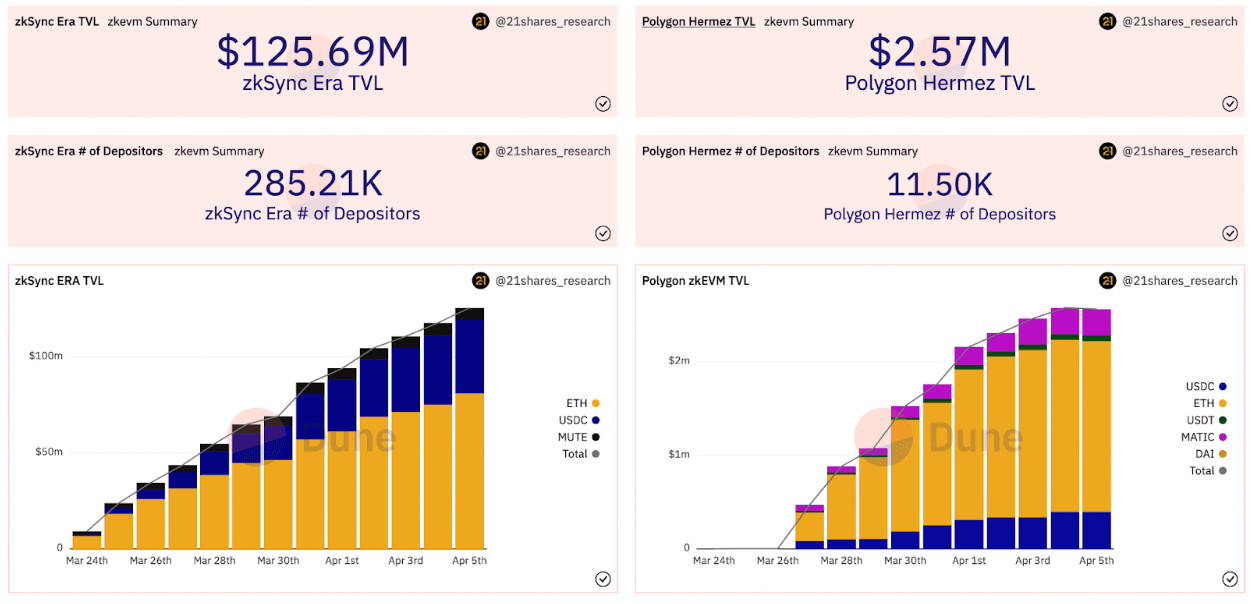
One of the potential catalysts for zkSync Era’s success could be the speculation of a token airdrop. According to Nansen, the average allocation of the Arbitrum airdrop is 1,859 ARB tokens, which amounts to ~ $2,230 as of 5 April. Therefore, speculators might be bridging their assets to zkSync Era in a bid to secure a potential airdrop. On the other hand, since Polygon already has an existing token, MATIC, and will not have a separate token for Polygon zkEVM in the future. As a result, speculators are less incentivized to bridge to Polygon zkEVM than zkSync Era.
Sybil addresses
Sybil addresses are wallets funded by the same wallet, with similar on-chain activities, aiming to get a token airdrop. Even though the activities of sybil addresses could increase the network activities, awarding them with token airdrops contradict the goal of decentralizing the network via a DAO model. As such, over 17,000 and 15,000 sybil addresses were disqualified in Optimism and Arbitrum’s airdrops.
zkSync Era has more potential Sybil addresses based on the depositing addresses’ wallet age and usage on Ethereum/Layer 2 networks. In other words, traders bet on an upcoming zkSync token as Polygon already has MATIC. In doing so, they create new addresses and attempt to be eligible for potentially an airdrop.
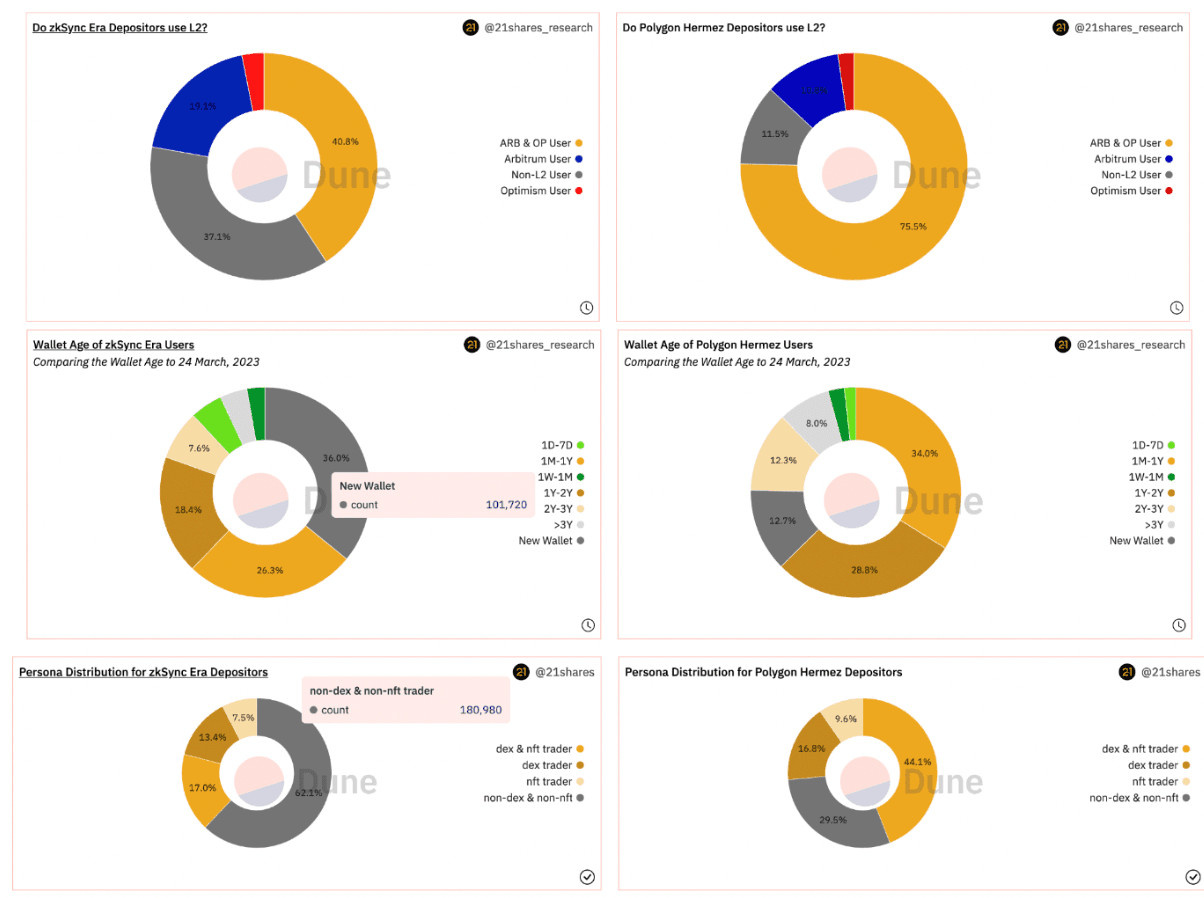
By looking at the persona and usage of the depositing addresses, we believe that could help identify sybils. First, we compared the percentage of depositors that have used the existing layer 2 solutions, Arbitrum and Optimism. For zkSync Era, over 37% of the addresses have not used Arbitrum and Optimism, while only 12.5% of depositing addresses on Polygon zkEVM have yet to use Arbitrum and Optimism. Secondly, over 36% of the depositing addresses are new wallets on zkSync Era. However, only 12.7% of the depositing addresses on Polygon zkEVM are new wallets. With the above comparison, zkSync Era likely has a higher sybil rate than Polygon zkEVM, as Polygon already has a token.




Average Gas Cost
The transaction cost on zkEVMs ($0.25 - $2) is still relatively high compared to Optimistic Rollups like Arbitrum and Optimism ($0.13 - $0.45)
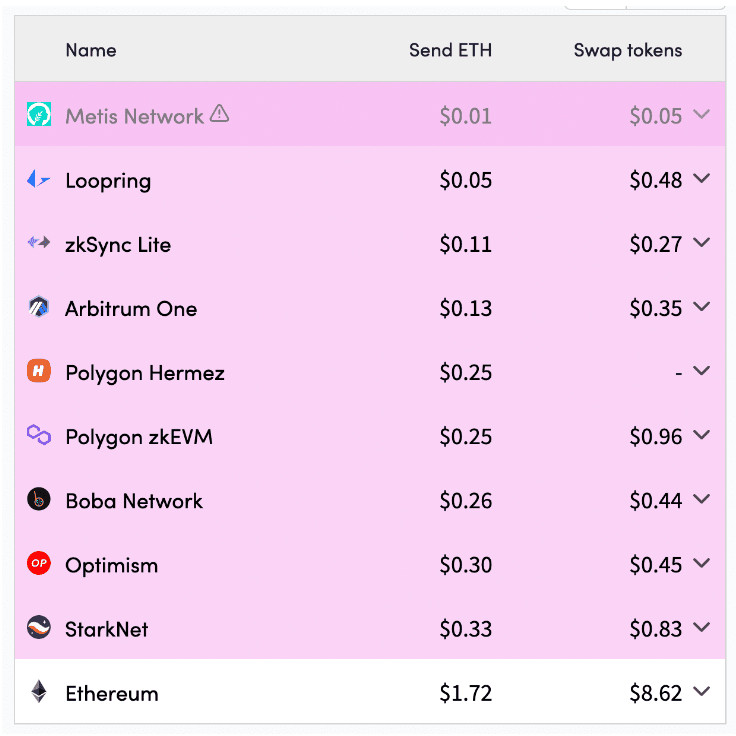
Despite an 88.8% gas reduction in swapping tokens, zkEVMs are still 50% more expensive than Arbitrum and Optimism. The key reason is the low usage of the network. Optimistic rollups and ZK-Rollups have a fixed gas cost per batch. For Optimistic rollups, it is around 40,000 gas, and 500,000 gas for ZK-Rollups. Given the high fixed cost for ZK-Rollups, it will require more network transactions to share the overall cost and lower the gas fee for individual users.
Closing thoughts on zkEVMs
The launch of zkEVM marks a huge milestone for Ethereum. Yet, it is essential to note the technology is still in its infancy and will require battle testing before gaining wider adoption. In the meantime, Polygon zkEVM and zkSync Era will continue providing a better user experience and infrastructure, including decentralizing the sequencer and Security Council.
There will also be more scaling solutions, such as Scroll and Linea. Feel free to check out our real-time dashboard and analyze the on-chain activity. We will keep adding new zkEVMs once they launch going forward.