Tezos (XTZ) is a Layer 1 smart contract blockchain network that powers a range of applications including decentralized finance (DeFi), non-fungible tokens (NFTs) and gaming.
Tezos was founded by Arthur Breitman (former research engineer at GoogleX and quantitative analyst at Goldman Sachs and Morgan Stanley) along with his wife Kathleen Breitman (who holds a Bachelor’s degree in Economics from Cornell University). At the time of writing, Tezos is ranked #81 with a market capitalisation of $1.07 billion according to CoinMarketCap. The project enjoys a strong community with over 444K followers on Twitter, 8K members in its official Telegram group and more than 72.3K members on Reddit.
History
In 2015, the Breitmans established a company called Dynamic Ledger Solutions (DLS), which was responsible for writing the initial code for Tezos. DLS held the intellectual property rights to the Tezos codebase prior to the network’s launch. As part of the Tezos project, DLS agreed to transfer these rights to the Tezos Foundation in exchange for a percentage of the total initial token supply. This agreement allowed the Tezos Foundation to oversee the blockchain’s further development while ensuring that DLS was rewarded for its contribution to the project.
Token generation
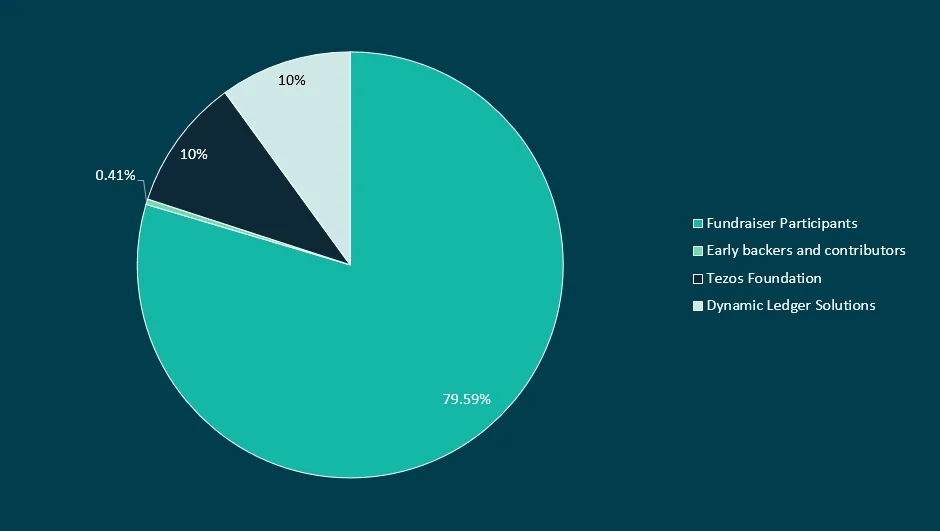
Tezos raised $232 million in its fundraiser with key contributors including Polychain Capital, Draper Associates, Winklevoss Capital, Boost VC, TrustVC and Hashchain Capital. Of the initial token supply, 79.59% was allocated to ICO participants, 0.41% to early backers and contributors, 10% to the Tezos Foundation, and 10% to Dynamic Ledger Solutions. The total initial supply of XTZ during the fundraiser was approximately 763 million tokens.
Staking and security
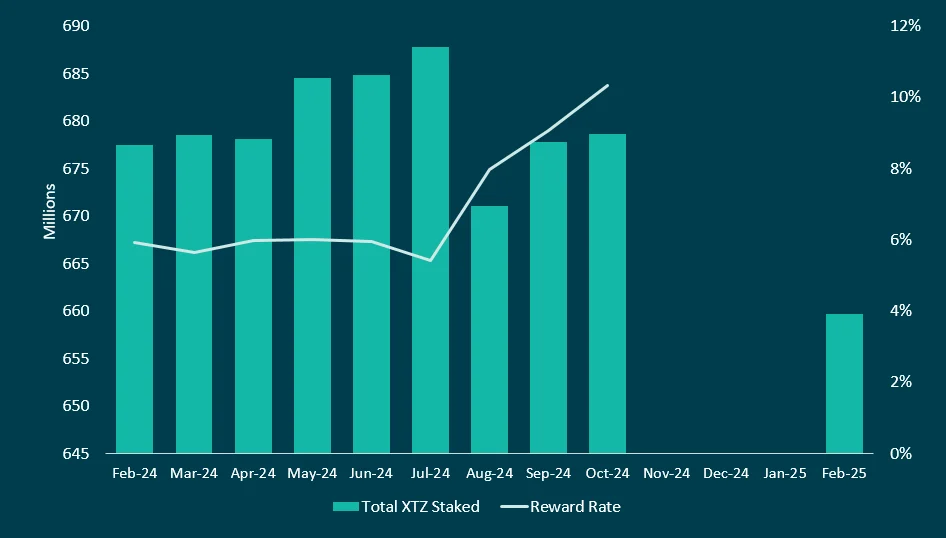
The network currently has 288 active validators and 167.8K delegators, securing over 659 million XTZ in total value staked which translates to $566.55 million in total economic security at current prices. It has a staking market cap ratio of 66.26% and is ranked #26 by staking market cap according to Staking Rewards. At the time of writing, Tezos validators are earning an annualised reward rate of 16.2% on their stake. The annual inflation rate for XTZ is currently 5.82%. The real yield earned by validators is therefore equal to 10.38%.
Architecture and previous upgrades
Tezos operates using a Proof-of-Stake (PoS) consensus mechanism. In Tezos, validators are known as “bakers” and are responsible for validating transactions and creating new blocks. To become a baker, a participant needs to hold a minimum of 6,000 XTZ. Bakers are selected to validate blocks based on the size of their stake – either their own or those delegated to them. Delegation allows token holders who do not wish to bake themselves to assign their XTZ to a baker without transferring ownership, giving them a share of the rewards. This liquid delegation system is flexible because participants can easily re-delegate their tokens to other bakers if they wish, promoting decentralization and encouraging active participation in securing the network. (The consensus is therefore also referred to as Liquid Proof-of-Stake.)
Bakers are rewarded with new XTZ for successfully creating blocks but they are also penalized through slashing if they act maliciously. This mechanism creates incentives for bakers to maintain the network’s integrity.




Tezos shell and protocol architecture
Tezos’ architecture is divided into two key components: the Shell and the Protocol.
- Shell: The Shell is the intermediary layer between the blockchain and the protocol. It is responsible for managing communication between network nodes, updating the chain state and determining the head block based on consensus. The head block is the most recent block that has been validated and added to the blockchain. It represents the current state of the ledger, including all confirmed transactions up to that point. It manages the blockchain’s self-amendment process by determining which version of the protocol to apply when upgrades are proposed and voted upon.
- Protocol: The Protocol layer consists of the blockchain’s rules and logic. Tezos is designed to be self-amending, meaning that upgrades can be proposed, voted on and implemented on-chain through governance without needing a hard fork. The self-amendment process reduces the likelihood of contentious splits in the community and ensures smooth transitions as the network evolves (on-chain governance unlike some projects that do it off-chain).
XTZ holders vote on proposals in a four-stage process: proposal, exploration vote, testing, and promotion vote. This governance model allows Tezos to adapt and upgrade over time in a decentralized way, which is key to its long-term sustainability.
Client/server architecture
Tezos operates on a decentralized client-server architecture where different types of nodes contribute to maintaining the network. The architecture is composed of:
- Full nodes: These nodes store the entire blockchain history, validate new transactions, and propagate them across the network. Full nodes are crucial for decentralization and security, as they participate in validating the correctness of the blockchain.
- Light clients: Light clients only store a portion of the blockchain data and rely on full nodes for the verification of transactions. They are optimized for users who do not need full access to the entire chain, like developers working on dApps or users with hardware constraints.
This architecture ensures that different applications can interact with the Tezos blockchain securely and efficiently.
Smart rollups
Tezos Layer 1 features its own native rollups, analogous to optimistic rollups such as OP Mainnet and Arbitrum built atop Ethereum. The rollups on Tezos currently operate under an optimistic model, where any party can submit a commitment to the outcome of a computation to the Layer 1 blockchain. These commitments are deemed valid unless they are disputed within a predefined time frame – approximately two weeks on Tezos rollups. The state of the network can be challenged by providing fraud proofs. If fraud is confirmed, the challenger receives a reward and the fraudulent party loses their staked tokens. Essentially, all transactions are considered valid unless challenged. To maintain the integrity of an optimistic rollup, only a single honest node is required to confirm the validity of the state.
Tezos supports both public and private Smart Rollups. Public rollups are permissionless, allowing any participant to become an operator and contribute to verifying the rollup’s security. In contrast, private rollups are permissioned, meaning the owner of the rollup can restrict the set of operators who are authorized to verify the state and help secure the rollup. Data from these rollups is subsequently committed to the Tezos Layer 1 blockchain (similar to the process of posting Ethereum Layer 2 data onto the Ethereum Mainnet).
The Data Availability Layer (DAL)
This is a blockchain designed to enhance the data bandwidth available to Smart Rollups. The Data Availability Layer (DAL) operates through a network of nodes that distribute data via a peer-to-peer system. Layer 1 bakers are responsible for verifying the availability of the data. Once the bakers confirm data availability, the DAL nodes deliver the data to the Smart Rollups for further processing.
Etherlink
Etherlink is an EVM-compatible smart rollup. It enables integration with existing Ethereum tools, including wallets (like MetaMask), indexers and facilitates asset transfers to and from other EVM-compatible chains. It provides Tezos with the ability to tap into Ethereum-based assets.
Etherlink supports a range of tools including the following:
- LayerZero: Interoperability protocol that allows asset and message transfers between different blockchains
- Pyth Network: Oracle network to provide data feeds for blockchains
- Transak: On and off ramp services between fiat and crypto
- Thirdweb: Provides a suite of tools for web 3 projects to build, launch and maintain their presence onchain
Major upgrades
Tezos undergoes regular upgrades via its governance mechanism. Here are details of three major protocol upgrades from the past:
(February 2024) Oxford 2 Upgrade:
- Introduced private Smart Rollups, enabling developers to deploy permissioned L2s. This is significant for Tezos’ ability to attract builders to develop enterprise solutions on its network.
- The price of the XTZ token rose 3.35% immediately following the upgrade.
(June 2024) Paris Upgrade:
- Introduced Adaptive Issuance – a mechanism that adjusts staking rewards to maintain network security with minimal inflation. This targets a 50% staking ratio of the total Tezos supply, adjusting rewards to encourage more or less staking as needed.
- Reduced gas costs, enabling more complex dApp interactions at lower costs. It also laid the foundation for future zk-SNARK implementations, which will bring privacy-preserving transactions to Tezos, enhancing its appeal for privacy-focused applications.
- The price of the XTZ token rose 2.7% following the upgrade.
(June 2024) Mumbai Upgrade:
- Introduced smart rollups
- Adjusted block time to 15 seconds and reduced block rewards to 20 XTZ to maintain the token’s annual inflation rate.
- Added ephemeral accounts which streamline user interactions by allowing temporary accounts that can execute transactions without the need for full account creation.
- The price of the XTZ token rose 3.8% soon after the upgrade.
Financials and onchain activity
Total value locked (TVL) on the Tezos network currently stands at $39.93 million and is ranked #62 by TVL according to DeFi Llama. As of this writing, Youves, a decentralized synthetic assets application, is the largest protocol on the network, securing $27.37 million in assets. It is followed by Sirius, a decentralized exchange (DEX) protocol, with a TVL of $7.55 million. Although USD-denominated DeFi TVL saw a decline of 26% from Q2 to Q3 2024, XTZ-denominated TVL rose 27% during the time. This shows that the decline was driven by lower asset values and not by withdrawals.
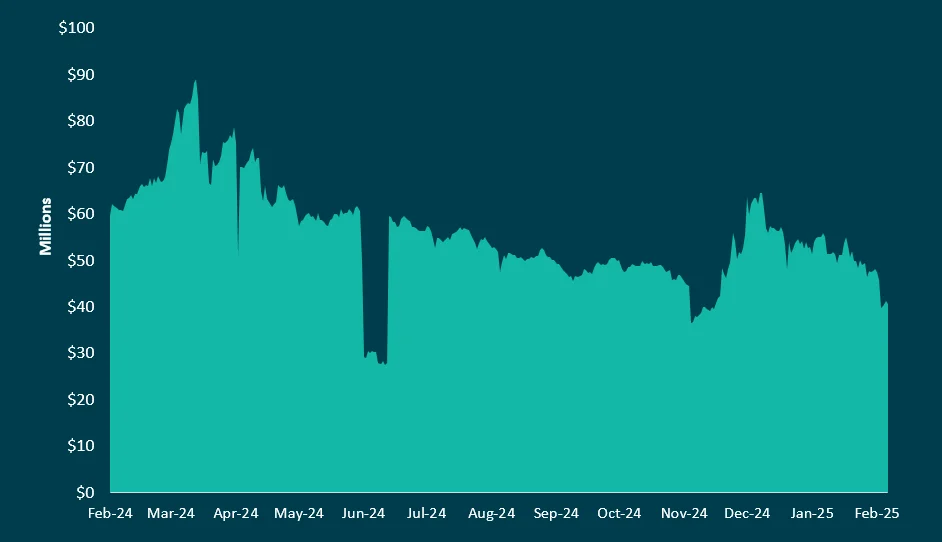
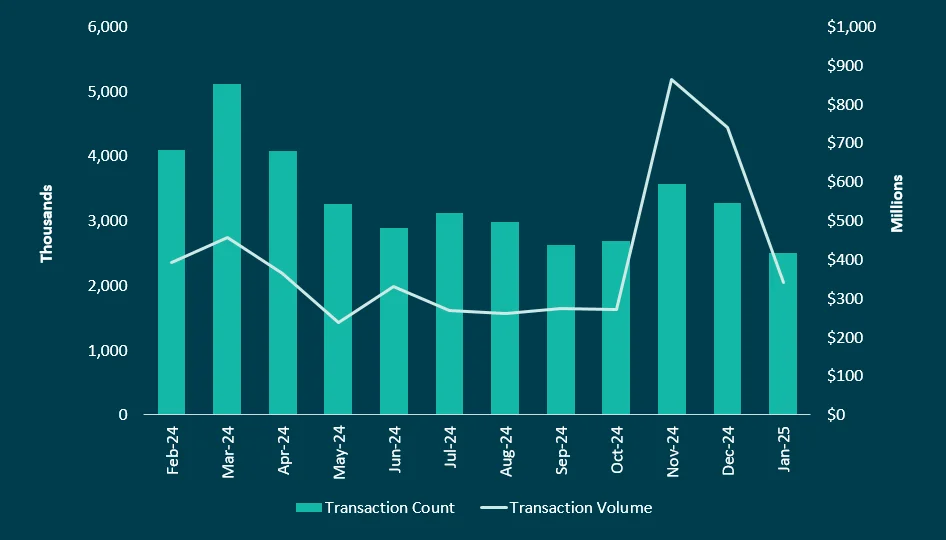
The effect of low asset prices also led to a drop in total fees (denominated in XTZ) earned by the protocol alongside a similar trend in the broader crypto ecosystem. Other metrics, such as transaction count and volume, have mirrored this trend. It is important to note that this drop in activity has occurred across most blockchains during this period and has not specifically impacted the price of XTZ.
Currently, the majority of Total Value Locked (TVL) in the crypto space resides on EVM-compatible networks. With the introduction of Etherlink, developers now have the ability to deploy EVM-compatible protocols on Tezos, creating opportunities to engage with the Tezos ecosystem. Etherlink’s launch strengthens Tezos by attracting users and developers from other EVM-compatible networks, increasing its visibility and participation in the largest sector of decentralized finance (DeFi) activities. We expect this progression to lead to a significant jump in TVL, fees earned and other onchain activity metrics for Tezos.
With the upcoming mainnet launch of Etherlink, we expect significant liquidity and development to flow into Tezos, driven by the Ethereum developer and user community – one of the largest in crypto. The Tezos X roadmap also outlines several key future developments. These include MEV protection for smart rollups and the introduction of Michelson rollups which will allow for the seamless re-deployment of existing applications from Tezos Layer 1 to run in parallel with Etherlink. Additionally, there will be support for mainstream programming languages such as JavaScript, TypeScript, Python and Java through Turnkey Smart Rollup solutions.