
During the Q1 earnings call, Michael Saylor openly stated for the first time that Strategy could sell Bitcoin to service dividend obligations. With this, the Executive Chairman breaks a viral promise he had repeated in dozens of interviews since January 2022: "Never sell."
The share price reacted in after-hours trading with a 4.33 percent decline to 178.80 USD. As of May 11, 2026, Strategy holds 818,334 BTC with a market value of 66.1 billion USD. This equals roughly 3.9 percent of the entire issuable Bitcoin supply. Three days after the earnings call, Saylor partially walked back his remarks in a Fortune interview. He said the statements were tactically aimed at short sellers. Nevertheless, the rhetorical door is now open, and the market has taken note. On Polymarket, the probability that Strategy will actually sell Bitcoin by year-end stands between 42 and 48 percent.
How the flywheel works and where it breaks
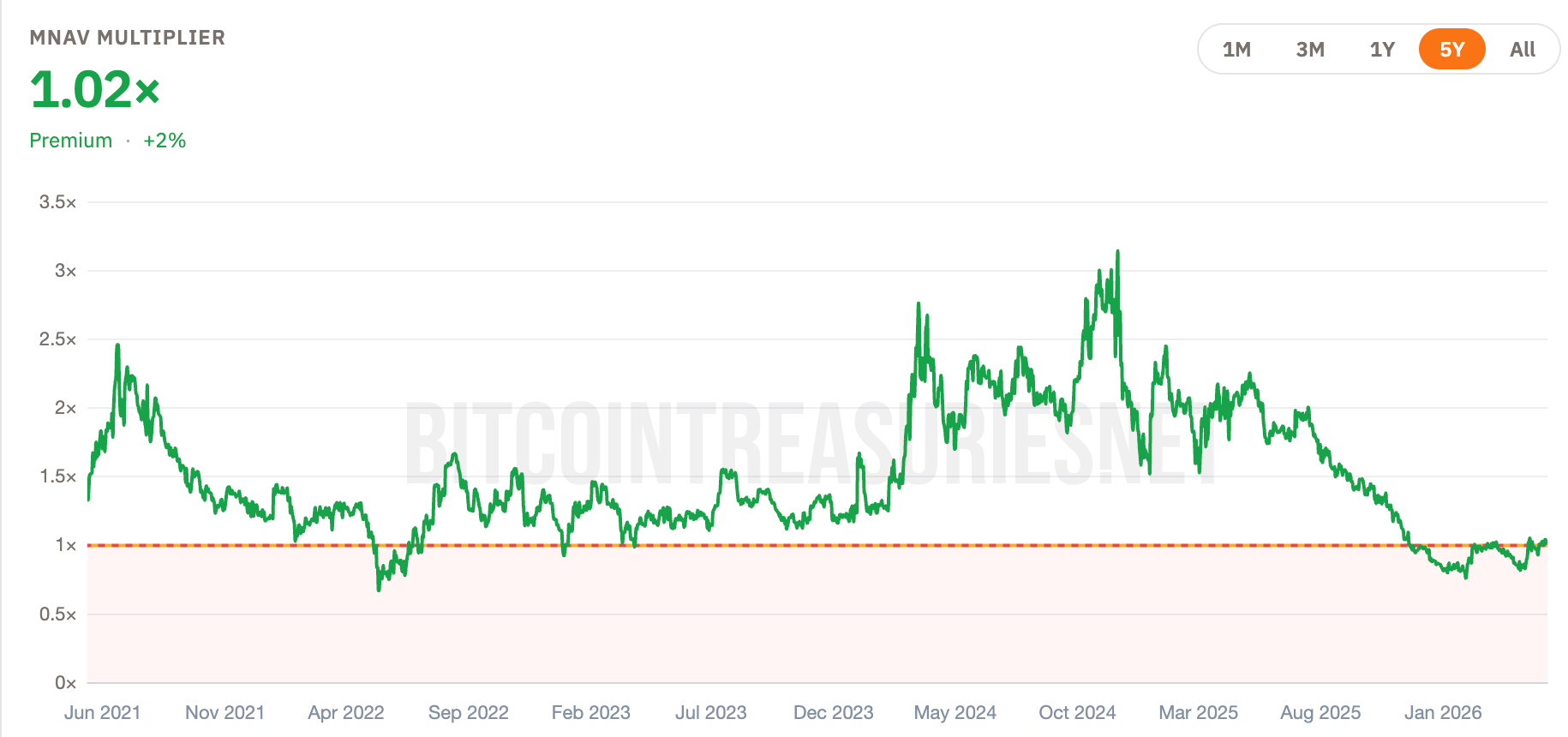
Since MicroStrategy's rebranding in 2025, Strategy has explicitly positioned itself as a "Bitcoin Treasury Company". The mechanism behind this is often referred to as the "flywheel" and rests on a single metric: the mNAV, meaning the ratio of market capitalization to Bitcoin holdings. As long as MSTR trades at a premium to NAV, the company can issue new shares through so-called ATM (At-the-Market) programs at a higher price than the underlying BTC value per share. Importantly, the capital raised flows directly into further Bitcoin purchases.
As a result, a self-reinforcing cycle emerges. More BTC per share means a higher NAV, which implies lower credit risk and allows Strategy to issue convertible bonds and preferred shares on more favorable terms. Saylor himself described it during the earnings call as follows: the more credit gets sold, the higher the mNAV, the more credit can be sold, and the more Bitcoin can be acquired.
However, the weakness is mathematically inevitable. Once the mNAV falls below 1.0x, the logic reverses. A share issuance then dilutes the BTC holdings per share rather than increasing them. This is exactly what happened again in November 2025, when market capitalization at 63.2 billion USD landed below the then-current BTC value of 65.1 billion USD. The mNAV currently stands at 1.01x. This is just above the tipping point.
STRC and the dividend burden as a concrete sales trigger
The real issue lies not in the Bitcoin holdings themselves, but in the cash obligations they carry. In recent quarters, Strategy has built a web of preferred shares: STRK with an 8 percent dividend, STRF and STRD each at 10 percent, and STRE at 10 percent in euros. However, the heaviest burden falls on STRC with a variable 11.5 percent dividend, payable monthly in cash, on an outstanding face value of 8.5 billion USD. This alone results in an annual obligation of roughly 982 million USD, regardless of the Bitcoin price.
As long as the flywheel keeps spinning, this burden can be covered through fresh equity issuances. Yet if the mNAV collapses sustainably, three uncomfortable options remain: additional debt, dilutive share issuances, or the sale of Bitcoin. CFO Andrew Kang provided the sober break-even calculation during the earnings call. Bitcoin must appreciate by at least 2.3 percent per year for the reserve to cover the dividends on its own. If performance falls below that threshold, selling becomes mandatory.
"We're probably going to sell some Bitcoin to fund a dividend, just to inoculate the market and send the message that we did it." - Michael Saylor, Executive Chairman, Strategy
The quarterly loss of 12.54 billion USD in the first quarter of 2026 underscores the balance sheet's sensitivity. Of this, 14.46 billion USD stems from unrealized BTC losses after the Bitcoin price had temporarily dropped to 63,000 USD. It marked the third consecutive quarterly loss. By contrast, total revenue from the operating software business amounted to only 124.3 million USD, an order of magnitude that comes nowhere close to covering the dividend obligations.




From "sell a kidney" to tactical clarification
Saylor's reversal stands in stark contrast to nearly four years of rhetorical campaigning. In January 2022, he had declared on Bloomberg: "We are not sellers. We just buy and hold BTC." In February 2024, he called Bitcoin itself the "exit strategy" on Bloomberg TV. Subsequently, in March 2024, his Yahoo interview went viral, in which he equated the "highest and best use of capital" with holding Bitcoin. In February 2025, he sharpened the tone further: "Sell a kidney if you must, but keep the BTC." Just three months before the current earnings call, he had reiterated on CNBC: "We will not sell."
Notably, Saylor quickly reframed the statement afterward. In a Fortune interview dated May 8, he explained that the sales remark had been a tactical message aimed at short sellers. Anyone wanting to break the strategy, he argued, must show that Bitcoin would, if necessary, be exchanged for shares or sold to service liabilities. On Stocktwits he clarified further: "If I were more precise, I would say: never be a net seller of Bitcoin. That just wouldn't have been as viral or as catchy."
Strategically, the qualification is understandable. However, it comes too late to reverse the market's interpretation. What used to count as a non-negotiable principle is now a conditional policy. As long as Bitcoin grows faster than the dividend load, the company buys; otherwise, it sells. For the credibility of the treasury strategy, this shift is not trivial.
3.9 percent market share and the industry comparison
With 818,334 BTC, Strategy holds nearly twenty times as much as its next-largest competitor. Metaplanet from Japan, now the third-largest listed Bitcoin treasury, held 40,177 BTC at an average price of roughly 97,000 USD as of the end of March 2026. That marks a significantly higher cost basis than Strategy's 75,532 USD. Marathon Digital, after selling 15,000 BTC in March 2026, still holds around 38,700 BTC. Precisely this Marathon sale, which served to redeem convertible bonds, delivered the industry precedent for what Saylor is now hinting at.
The decisive factor is scale. A coordinated sale by Strategy would carry a volume for which there is no comparable actor in the corporate universe. Even a partial sale to service the STRC dividends would imply tens of thousands of BTC. This is in a market that thrives on ETF inflows and institutional buyers but can turn thin under selling pressure.
Officially, Strategy continues to pursue the goal of expanding its holdings to one million Bitcoin. During the earnings call, CEO Phong Le reaffirmed the ambition to double BTC per share within seven years, which corresponds to roughly 10 percent annual growth. In May 2026, this metric stood at 213,371 satoshis per share, compared with 181,030 in the prior year, a gain of about 18 percent. Therefore, the mechanics still function. The open question is how long that will remain true once the mNAV no longer runs on autopilot above 1.0x and the dividend clock keeps ticking monthly.