The US Securities and Exchange Commission plans to publish a so-called Innovation Exemption for tokenized stocks before the end of May 2026. As a result, crypto platforms such as Coinbase could offer tokenized US equities without acquiring full broker-dealer status.
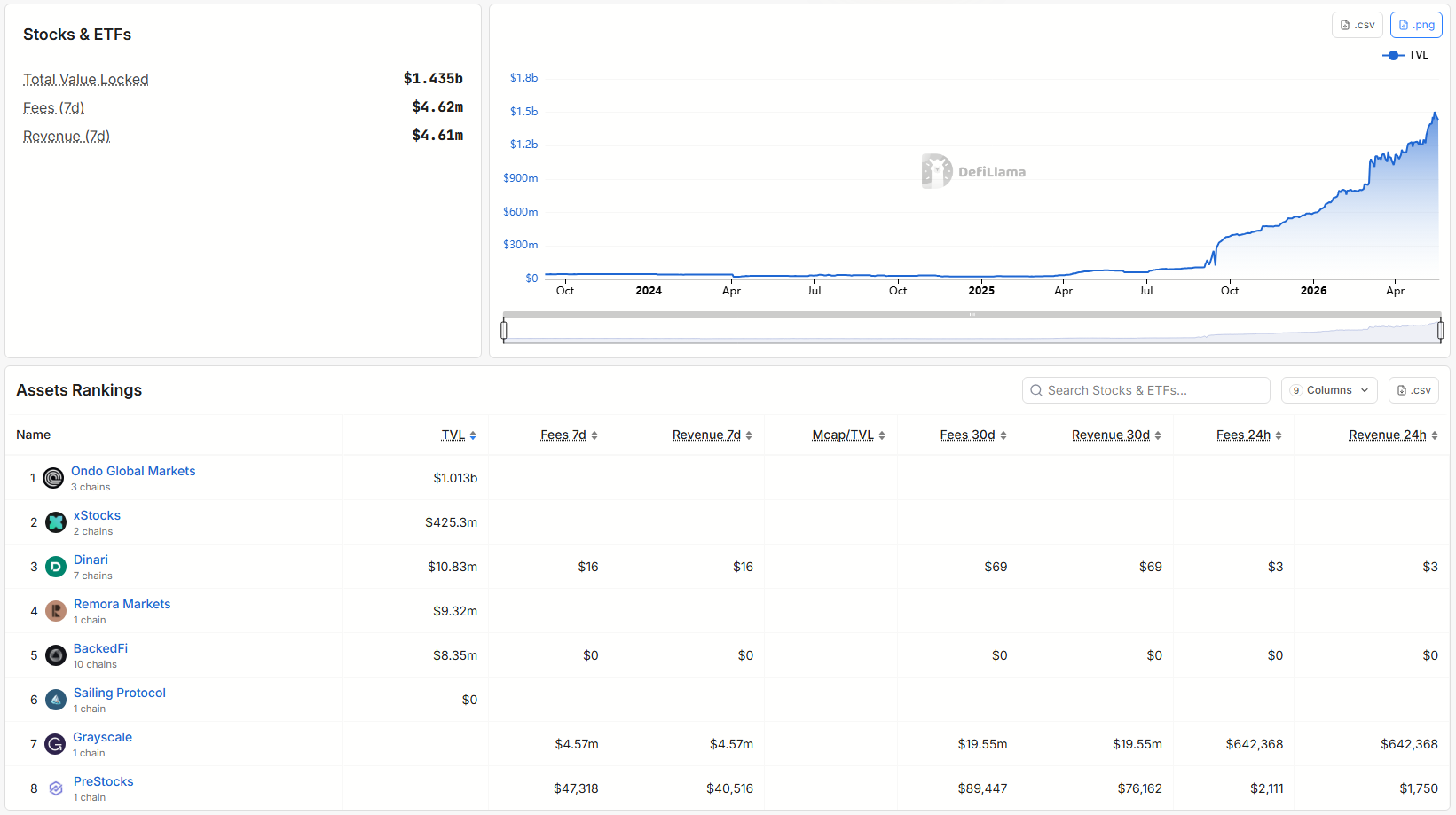
At the same time, traditional Wall Street is accelerating its own tokenization plans for real-world assets. Central securities depository DTCC announced first pilot transactions for July 2026. Moreover, the full launch of its tokenized securities platform follows in October 2026. More than 50 financial institutions are participating, including BlackRock, Goldman Sachs, J.P. Morgan, Circle, Ondo Finance and Ripple Prime. On-chain, the market for tokenized stocks has now reached USD 1.4 billion. Over the past 30 days, it grew by 29.68%.
What the SEC rules for tokenized stocks set out
The initiative largely traces back to SEC Commissioner Hester Peirce. According to the agency, it consulted hundreds of market participants before finalizing the draft. In addition, the exemption is time-limited and contains clear guardrails. These include exposure limits for platforms, disclosure obligations toward investors, and conditions reflecting its pilot character.
At the core of the framework sits a distinction the SEC had already established on 28 January 2026. At that point, the Divisions of Corporation Finance, Investment Management, and Trading and Markets issued a joint statement. Tokenization alone, therefore, does not change the legal classification of a security. Specifically, the regulator differentiates between two models: issuer-sponsored tokens represent direct ownership rights, while third-party tokens function as synthetic exposures or linked securities. Synthetic variants typically grant neither voting rights nor dividend claims against the issuer.
Wall Street and crypto platforms in a race
The Innovation Exemption forms part of a broader shift in direction under SEC Chair Paul Atkins. Through the "Project Crypto" program, Atkins shifted the regulatory approach in mid-2025 from enforcement-driven to rules-based. At a conference on 8 May 2026, he named four areas for new SEC rules. These include on-chain trading systems, broker-dealer definitions, clearing and settlement, and so-called crypto vaults. Furthermore, he signaled that the SEC would need to adjust Reg NMS to enable on-chain trading of tokenized securities.
"It is a new day at the SEC. Regulation will no longer emerge through ad hoc enforcement actions. Instead, the Commission will use its existing rulemaking, interpretive and exemptive authorities to set tailored standards for market participants." - Paul Atkins, Chair, SEC
Traditional banks and exchanges are pushing back against the sandbox-style Innovation Exemption. They point to potential competitive distortions, weakened AML compliance and market fragmentation. However, the same institutions are simultaneously building their own tokenization infrastructure through DTCC. In March 2026, DTCC established the business unit "DTCC Digital Assets Solutions" for this purpose. The depository holds more than USD 114 trillion in assets and therefore forms the backbone of the US securities market. Initially, eligible instruments for the pilot include Russell 1000 stocks, large index ETFs and US Treasuries.




Ondo dominates the tokenized stock market
While the regulation takes shape, an on-chain market structure has already emerged. Currently, 2,246 tokenized stocks circulate on-chain. Monthly transfer volume amounts to USD 3.24 billion. In addition, the number of holders stands at 265,000 and has grown by 25% within 30 days. Ondo Finance clearly leads the market with USD 883 million in market value and a 59.77% share. Second place goes to xStocks with USD 404.5 million and a 27.38% market share. Together, both providers control roughly 82% of the segment.
The regulatory pipeline lays out a clear roadmap. In March 2026, the SEC approved the Nasdaq rules for tokenized stocks. On 17 April 2026, the NYSE rule change SR-NYSE-2026-17 followed with immediate effect. For example, the NYSE rules initially limit tokenization to Russell 1000 stocks and ETFs of major indices such as the S&P 500 and Nasdaq-100. Furthermore, as early as December 2025, the SEC issued DTCC a no-action letter with a three-year term for pilot operations. The DTCC pilot starts in July 2026, while the full service launch follows in October 2026.