
In developing countries, the adoption of cryptocurrencies is growing at a tremendous rate. Young people in Africa, who have only a smartphone instead of access to traditional finance, are driving this development.
Developing countries are in the midst of an economic revolution. And the trend continues: while cryptocurrencies are often dubbed as financial speculation in other parts of the world, there is a clear trend toward everyday commerce in the developing world. Small and medium-sized enterprises, as well as individuals in third-world countries, are responsible for this trend. The example of the African continent impressively shows how developing countries can benefit from cryptocurrencies.
Crypto is a gamechanger
An ever-increasing amount of professionals and entrepreneurs are benefiting developing countries. Young people are drawn to the tech sector, people are looking for new ways to make their money and preserve their wealth. On the African continent, for example, the principle of mobile payment services is already deeply entrenched. Thus, many African countries are well-positioned to benefit from the adoption of cryptocurrencies. Indeed, the perspective on dealing with cryptocurrencies of people from third-world countries is inherently different from Westerners, who can enjoy easier access to banking.
Cryptocurrency specialist Elisha Owusu Akyaw explains that the younger generation is also interested in cryptocurrencies and the blockchain space due to a lack of opportunities for school and university graduates. With the new opportunities for financial freedom, it is also possible for young people to start their own businesses and bring them to the market. In addition, working internationally is possible, as there is suddenly the possibility to earn money across borders and thus build a significantly different standard of living than would have been possible for previous generations.
Avoiding currency instability
Likewise, both hyperinflation and unstable local currencies are doing their part to convince the younger generation in the developing world of the benefits of cryptocurrencies. These offer a realistic alternative to currencies that could fall into a bottomless pit or have repeatedly had a negative impact on trade and personal utility over time. It is also highlighted by some blockchain experts that competing currencies, including digital currencies, can strengthen local money and give it a higher degree of resistance.
"Cryptocurrencies offer a way to escape the crippling effects of hyperinflation, which has plagued several African countries. Zimbabwe experienced one of the most extreme cases of hyperinflation in modern history in the late 2000s. At its peak in November 2008, inflation reached a staggering 89.7 trillion percent (8.97 x 10^22) per month." - Ronghui Gu, CEO Certik in CV VC African Blockchain Report 2022
In many African countries, there are controls and restrictions on the movement of capital, so normal banks are often unable to meet customers' needs. There is a lack of various things: remittances are not possible across borders, exchange rates are extremely poor, and bank fees are usually extremely high. This negatively impacts entrepreneurship and economic growth in African and other third-world countries, while also demonstrating the transformative impact of digital currencies on the continent.
Support for family members
Members of a community, regardless of location or country, also see the benefits of cryptocurrencies. Among other things, these can be used to further support family members in other countries or the former home country. This is because the costs of remittances to developing countries are often so high that they are hardly affordable for normal consumers. This is where cryptocurrencies come in, making remittances across borders possible at almost no cost.

To stick with the African example: In 2019 alone, about $48 billion in remittances were sent to sub-Saharan Africa, of which about 50% went to Nigeria. The Brookings Institute report shows that trade is large both within the African continent and between Africa, Europe, and the United States. Between the continents, however, there are of course not only remittances to Africa but also a large volume of remittances. Especially in the international trade business, cryptocurrencies are becoming increasingly popular. Cryptocurrencies can thus be used for importing and exporting goods abroad and domestically, as well as for domestic payments.
Crypto to fund children's education
Due to local currency instability in many developing countries, cryptocurrencies are giving new impetus to funding the education of subsequent generations. London-based Luno conducted a survey with nearly 7,000 participants from Nigeria, Kenya, South Africa, the United Kingdom, Australia, Indonesia, and Malaysia to determine the reasons that led participants to engage with digital assets. According to the results, most of the countries' residents are financially savvy and invest in meaningful and long-term goals, with 69% of them engaging in cryptocurrencies to provide a better life for their families.
Taking a closer look, 48% would invest their salaries in digital assets to pay for their children's future education costs. In comparison, 43% would do the same to build a fund to pass on to their relatives. Only 3% said they did not have a specific plan when making their investment decisions.
Marius Reitz - Luno's General Manager for Africa - described this situation as a "crypto revolution," adding that the potential that lies dormant in developing countries is enormous. However, a large portion of African locals lack basic knowledge about cryptocurrencies, which is why they would not invest in them, he said. 55% of Nigerians said they knew nothing about the asset class, while the percentage in South Africa and Kenya was 56% and 64%, respectively. This once again shows the potential that can be unleashed if more people in developing countries are exposed to digital assets.
Crypto venture capital flows to Africa
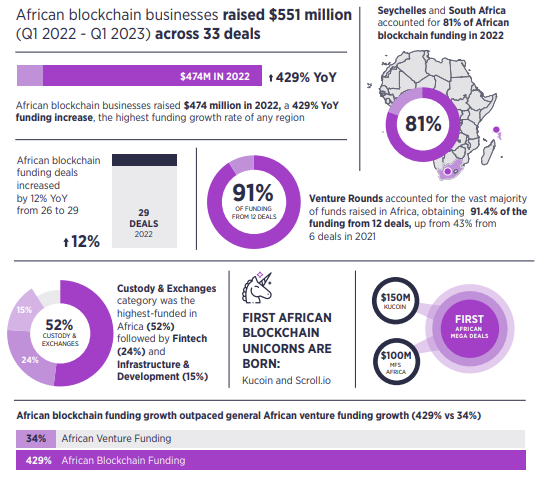
Globally, blockchain venture funding is on the rise and has reached a 6.5% share of total venture funding, according to the African Blockchain Report 2022 by Swiss venture capitalist CV VC. In Africa, blockchain funding reached a record 15% of all non-sector venture capital raised, which is more than double the global average. This shows that Africa has become a major investment destination for blockchain-based startups. Despite economic and socio-political challenges, the global blockchain industry set a record in 2022 with a total of 1,828 deals, an increase of nearly 30% from the previous year.
Among global regions, Africa proved to be the most dynamic with the highest funding rate for blockchain companies. African blockchain startups raised an impressive $474 million in 2022, representing a 429% year-over-year increase in venture funding. This indicates that investors are gaining confidence in African blockchain startups as they raise larger checks. In addition, Africa is the only region globally to show an increase in all deal sizes, although blockchain deals have historically increased the least globally.
What does the future hold for Bitcoin in Africa?
There seems to be no doubt anymore that third-world countries are on their way to becoming true crypto states. Developing countries around the world, meanwhile, are busy adapting laws and legal regulations to a future with cryptocurrencies. Africa's largest economy, Nigeria, for example, legalized cryptocurrencies and issued guidelines for digital currencies and businesses. Following the successful implementation of Bitcoin in El Salvador, the Central African Republic (CAR) also followed suit by designating the cryptocurrency as legal tender.