For years, Switzerland could pride itself on having internationally unique rules for crypto assets and blockchain technologies. However, industry representatives warn that the lead over other countries is shrinking. Still, Swiss policymakers remain relaxed.
Switzerland positioned itself early on as a leading crypto jurisdiction by creating a regulatory environment that balanced innovation and investor protection while leveraging its reputation for financial stability and data privacy. FINMA’s comprehensive ICO guidelines in 2018 were internationally unique. Likewise, the introduction of distributed ledger technology (DLT) legislation in 2021 was a milestone – providing legal clarity for blockchain-based assets for the first time worldwide. This proactive approach established Switzerland’s “Crypto Valley” in Zug as a hub for blockchain innovation.
Countries in Asia and the Middle East, however, are catching up quickly and are increasingly offering attractive conditions for blockchain companies – the sharp policy shift by the Trump administration acted as a signal. In Switzerland, by contrast, the political will has been waning since the above-mentioned milestones, industry associations warn. A new overview of statements from members of the Swiss Parliament supports this thesis.
Years of pioneering work in Crypto Valley
In the early years, the blockchain industry managed to win over prominent politicians for its mission. As early as 2013, coinciding with the founding of Bitcoin Suisse as the cornerstone of Crypto Valley, politicians were open to dialogue. Representatives at all levels – from municipal councils to national and cantonal parliaments, all the way up to the Federal Council – stood behind the crypto nation Switzerland. This enthusiasm raised awareness at FINMA and led to internationally unique regulatory frameworks. Some of the pioneering names in Bern can be found in the interview with Alexander Müller, author of the book *Crypto Nation*.
These efforts paid off: As of early 2025, 1,749 blockchain companies are registered in Switzerland and Liechtenstein. Foundations of leading projects such as Ethereum, Solana, and Cardano are based in Zug, and even BlackRock chose “Crypto Valley” for its European Bitcoin ETP. The location conditions are favorable, and the fundamental political questions have been clarified – new initiatives therefore no longer carry the same weight.




Supportive, but not enthusiastic
On his new personal website, Bitcoin Suisse co-founder Fabian Hediger publishes a ranking of all parliament members. Their statements and initiatives on blockchain are evaluated: supportive activities earn points, critical remarks result in deductions. The basis is data from Swiss news agencies, official federal websites, and the CVJ.CH survey for the 2023 parliamentary elections, as the methodology shows.
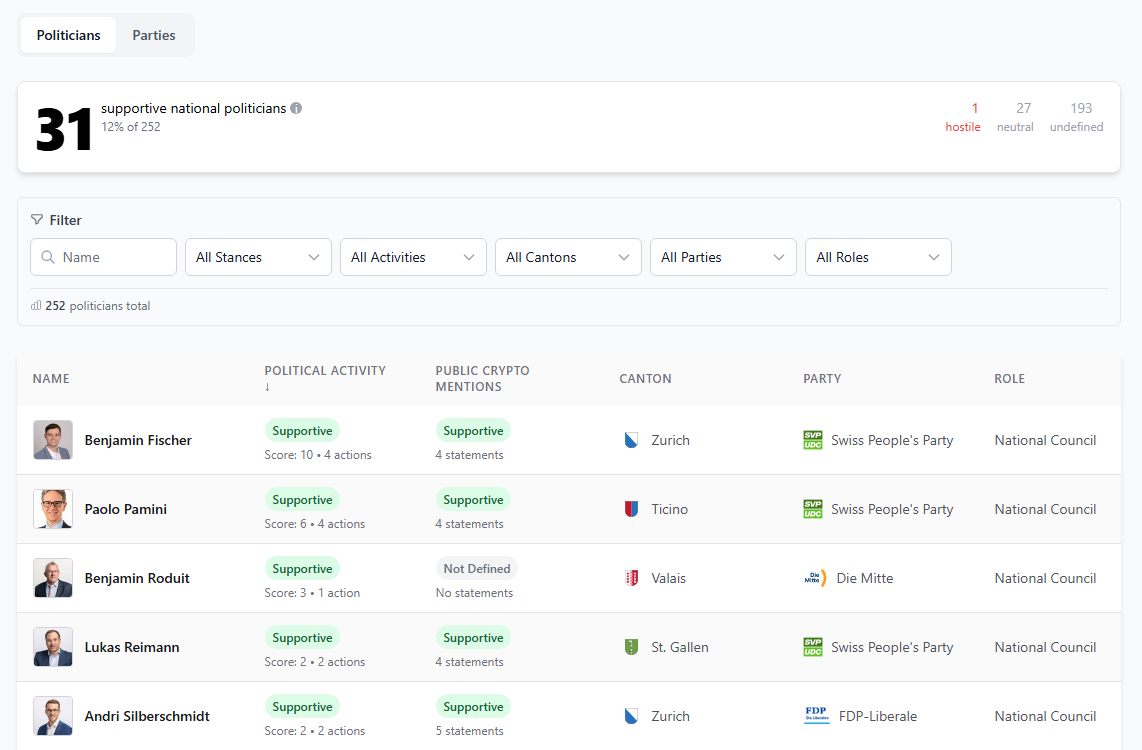
What stands out: only 12% of members of the National Council and Council of States are clearly “pro-crypto.” This confirms the assessment of the Swiss Blockchain Federation (SBF), which states that other topics currently take priority. Politics and society are facing numerous challenges – from geopolitical tensions to energy issues to location competition, an SBF spokesperson told CVJ.CH. Against this backdrop, it is understandable that blockchain is not at the top of the agenda. At the same time, the topic is complex and difficult to understand. Still, the long-term competitiveness of the location must be ensured. Specifically, the association, together with the Crypto Valley Association and Bitcoin Association Switzerland, has identified twelve points to strengthen Switzerland as a financial hub. These are summarized in an eight-page manifesto.
“Other countries have already recognized the potential of blockchain, digital assets, and stablecoins and have aligned their policies accordingly. To ensure we don’t fall behind, Switzerland also needs stronger political action and more attention to the topic.” - Statement by the Swiss Blockchain Federation
Beware of party politics
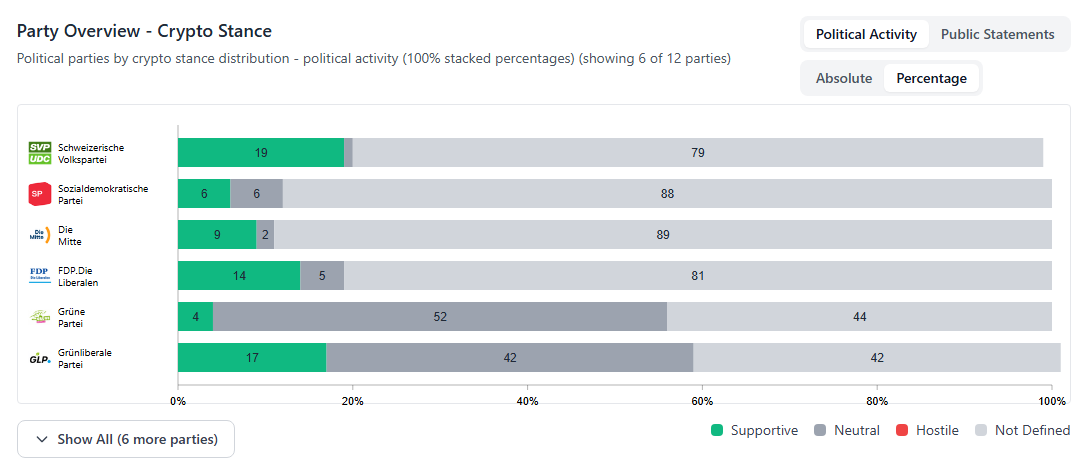
The overview also highlights party positions: representatives from conservative parties appear significantly more enthusiastic, while social democrats and the Greens tend to remain neutral. In principle, however, blockchain regulation should be a cross-party issue, emphasizes the Swiss Blockchain Federation (SBF). The core principles – decentralization, transparency, and immutability – provide added value for many areas of society and could build bridges across party lines. In practice, however, parties place emphasis on different aspects: some highlight economic benefits, others focus more strongly on consumer protection and sustainability.
Speaking to CVJ.CH, entrepreneur and former parliamentarian Pascale Bruderer warns against categorizing politicians solely based on their crypto stance. Like Ethereum founder Vitalik Buterin, she responds with the same counter-questions: What does a “pro-crypto” stance mean? Are there values behind it – and if so, which ones? Does it reflect a vision regarding technology, politics, and the economy in the 21st century? Does it reflect an understanding of cryptography and its applications? Or simply an interest – perhaps even self-interest – in a small subaspect?
Bruderer also stresses the importance of raising awareness of the benefits and diverse applications of DLT technology. Buzzwords without clear definition do not do the issue justice. On the contrary, it is necessary to demonstrate where this technology will gain even more relevance in the future – especially in the regulated world. As this development unfolds, political attention will certainly increase, something Bruderer expressly welcomes and actively supports. The former National Councillor, President of the National Council, and Council of States member founded Swiss Stablecoin AG in 2022, which is developing an openly accessible, broadly supported, and fully regulated digital counterpart to the Swiss franc.
“Blockchain is, as we know, neither a product nor a political stance, but a technology. Interest in this technology and in promoting research and applications cannot, in my experience, be assigned to any one political party. Otherwise, one would also have to consider, for example, support for the FRI proposal on education, research, and innovation.
In my view, demands for regulation should not automatically be equated with a critical stance toward digital assets. As we have repeatedly seen, and especially in recent months, market developments are quite different: regulation not only addresses risks but also increases legal certainty, trust, and therefore reach.” - Pascale Bruderer, founder and Chairwoman of Swiss Stablecoin AG (SSC)