
Bitcoin overtakes gold as the preferred store of value among Americans for the first time. According to a report from the financial services firm River, 49.6 million Americans, or 18.6% of the population, own Bitcoin. That compares with 28.8 million, or 10.8%, who hold gold.
River is a US financial services firm specialized in Bitcoin, and it compiled the figures. While gold has served as a classic store of value for thousands of years, Bitcoin is far younger. The network launched only in January 2009. In early July 2026, the company published the report, titled "America is the global Bitcoin superpower." The timing coincides with the 250th anniversary of US independence. Meanwhile, the Bitcoin ownership rate among US adults climbed from 14.3% in early 2026 to 18.6% by mid-2026. In addition, Americans hold roughly 42% of the world's circulating Bitcoin supply, according to River. This underscores how concentrated adoption is in the United States.
Bitcoin overtakes gold in US ownership within six months
Bitcoin's lead over gold is not a static snapshot. The ownership rate among US adults climbed from 14.3% to 18.6% in roughly six months. River attributes this acceleration to two factors. First, access is low-barrier, because exchanges and mobile apps have lowered the entry hurdles. Furthermore, the provider points to a cultural inclination among Americans toward individual investing, which favors the purchase of single assets. Together, both drivers explain why the curve has run comparatively steeper since the start of the year. That climb outpaces the trajectory for the precious metal.
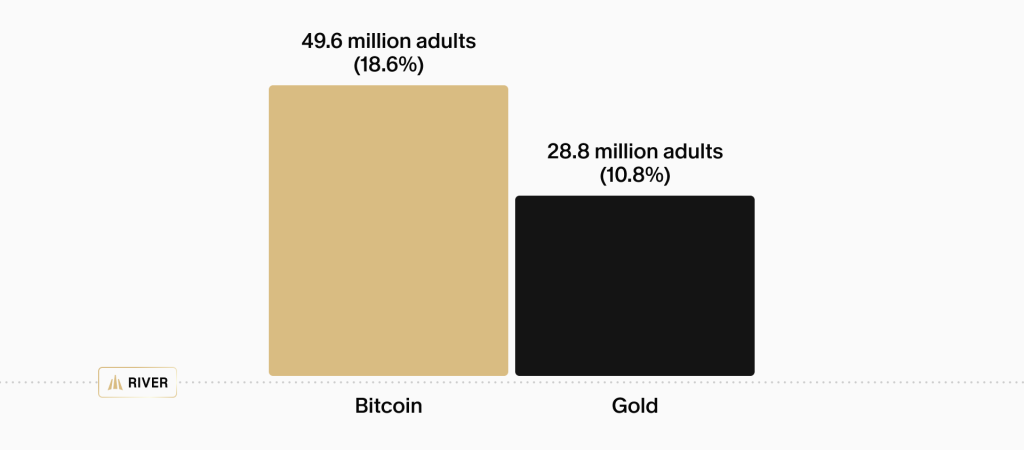
The contrast in time horizons is considerable. Gold has served as a store of value for roughly 5,000 years, whereas Bitcoin has existed for just over 16 years. Nevertheless, the digital asset has now pulled ahead in private ownership. An earlier River report from May 2025 initially put gold ownership at 36.7 million Americans. The current figure of 28.8 million, however, does not reflect a real decline. Instead, it stems from a methodological recalculation of the underlying data basis.
For Bitcoin ownership, by contrast, the order of magnitude remained stable. The 2025 report cited roughly 50 million holders, while the new survey shows 49.6 million. Consequently, the ratio shifts mainly because Bitcoin continues to gain while the gold estimate was revised downward. For River, this point marks Bitcoin's transition into a broad asset class that no longer appeals only to a niche audience.
US companies hold nearly the entire corporate Bitcoin reserve
US dominance is not limited to retail investors. US-listed companies together hold 1.24 million BTC. That corresponds to 92.7% of all Bitcoin that listed firms worldwide carry on their balance sheets. Overall, this concentration underscores how strongly corporate adoption is bundled in the United States. As a result, US corporations have become the defining marginal buyer in the Bitcoin market.
The pace of buying is remarkable. Over the past twelve months, US firms additionally acquired 510,000 BTC. That amount exceeds three times the Bitcoin newly mined in the same period. The market therefore absorbs considerably more supply than the network produces at all. This demand overhang intensifies the structural scarcity already written into the protocol.
Compared with the prior year, the picture has shifted slightly. The earlier River report showed a US share of 94.8% across a combined 733,000 BTC. The absolute amount has risen since then, whereas the relative US share has fallen slightly. This decline therefore points to growing international corporate demand. Strategy, the former MicroStrategy, remains the largest known holder with roughly 569,000 BTC. Behind it, according to earlier River data, follow US mining companies with roughly 96,000 BTC. Other firms hold roughly 68,000 BTC.



US government sits on the largest state-held Bitcoin holdings
The state itself also ranks among the large holders. The US government manages 328,372 BTC, mostly from seizures. However, the state did not acquire this Bitcoin on the market, but rather confiscated it. River originally put the value at over USD 23 billion, while the holdings now correspond to roughly USD 21.6 billion. Washington thus holds nearly three times as much Bitcoin as all other governments worldwide combined.
Politically, the question of a formal reserve is therefore already on the table. Legislative proposals for a strategic Bitcoin reserve are before the US Congress. These aim at an accumulation of up to 1 million BTC, but have not been passed so far. Passage would move the existing holdings from a chance position into a strategic instrument. According to the think tank "Stand with Crypto," a cross-party majority of politicians in Washington is favorably disposed toward Bitcoin.
Among the public, the idea likewise resonates. In an earlier survey, four out of five Americans favored a partial conversion of US gold reserves into Bitcoin. Younger respondents favored a conversion of up to 30%. Consequently, the shift from gold to Bitcoin is unfolding not only in private ownership. It increasingly shapes the political debate over state reserves as well.
Mining hashrate and company density solidify US dominance
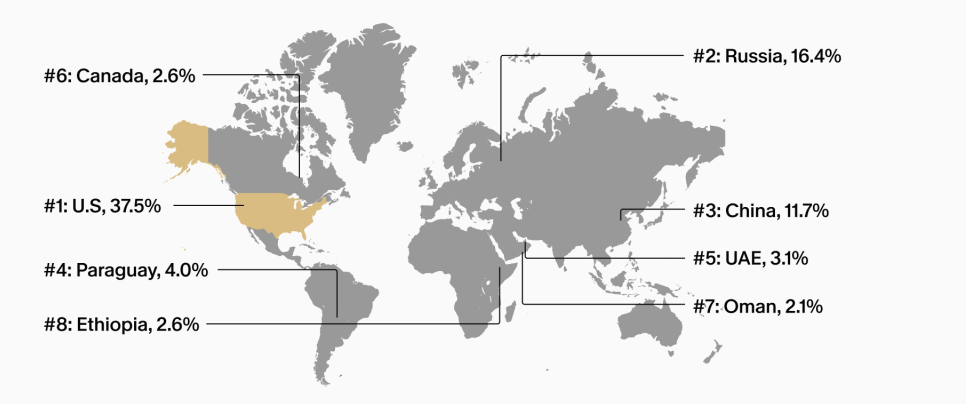
Furthermore, the leadership role of the US rests on physical infrastructure. 37.5% of the global Bitcoin hashrate runs in the United States. That is more than the next five countries combined. Such a high share therefore means that a large part of transaction validation takes place on US soil. For competing countries, catching up ultimately becomes harder with every new data center.
Company density is likewise pronounced. More than 150 Bitcoin firms are headquartered in the United States. Among them are more than 50 mining sites with over 10 megawatts of power draw each. These sites bundle a substantial part of the world's computing capacity in a few US states. This structural anchoring makes adoption harder to reverse than pure ownership rates, which can change with the market cycle.
River itself interprets the development in cultural terms. "It is no coincidence that the country founded on individual rights and free markets is also where Bitcoin adoption is strongest," the report states. Overall, the data paints the picture of an asset class that has taken hold across the US. It now spans the private portfolio, the corporate balance sheet, and the state treasury.