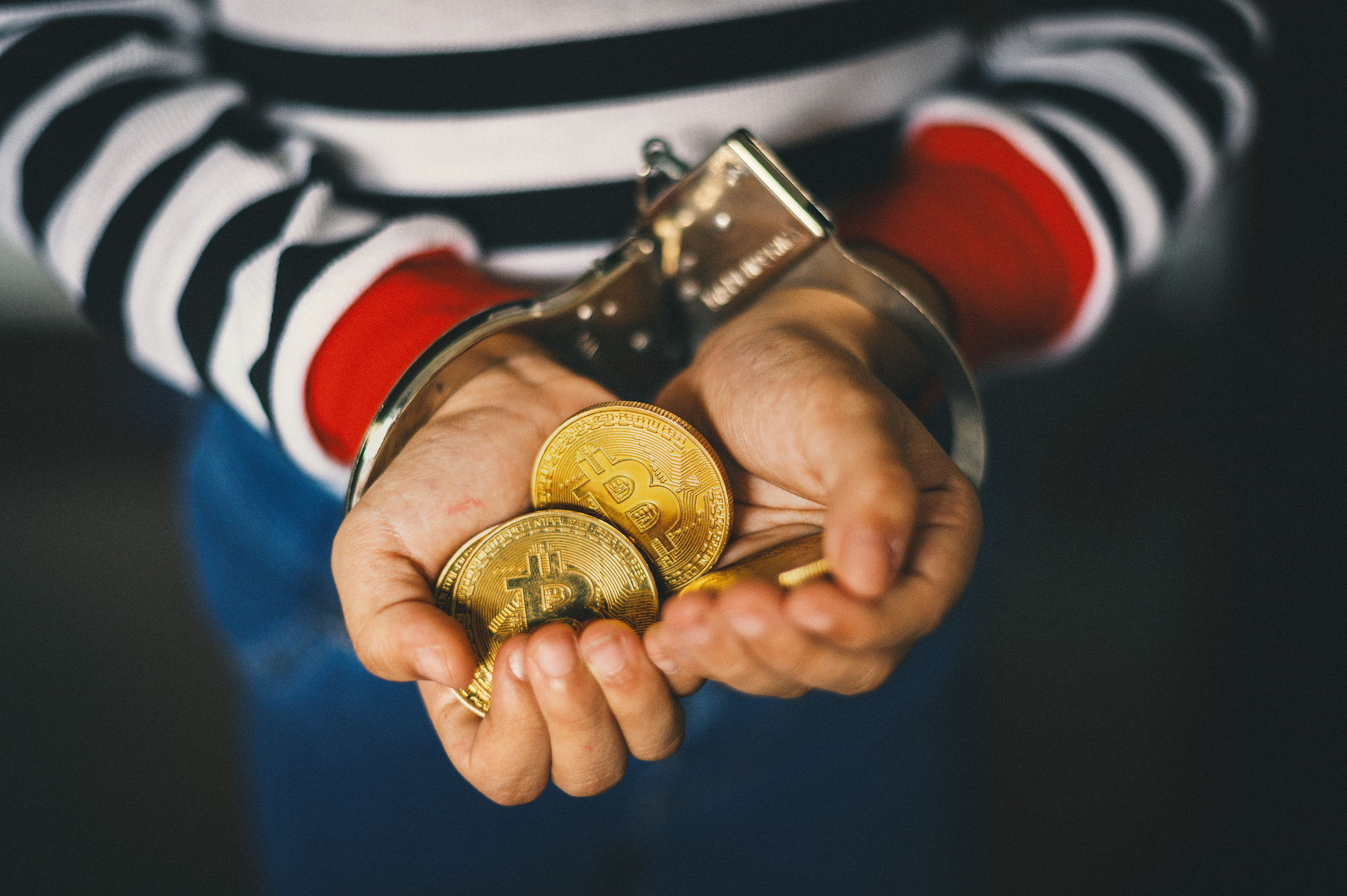
Many critics still regard Bitcoin as a payment method that primarily serves criminals. The Chainalysis Crypto Crime Report 2026 paints a different picture. Illicit crypto transaction volume did hit a record in 2025: USD 154 billion. Yet its share of total on-chain volume stays below 1%.
The myth of the criminal currency originally traces back to the darknet marketplace Silk Road. Those early years ran between 2011 and 2013. Despite differing data between analytics companies, this image still shapes the public debate today. TRM Labs independently puts illicit volume for 2025 at USD 158 billion, or 1.2% of total volume. That marks the same order of magnitude. Chainalysis also revised prior-year figures upward several times, lifting the 2024 value from USD 40.9 to USD 57.2 billion.
USD 154 billion record remains a fringe phenomenon
The absolute record sum and the sub-1% share do not contradict each other. Both statements are true at the same time. Illicit volume grows in dollar terms, but legitimate on-chain volume grows faster. As a result, the percentage share falls over the years while the absolute amounts rise.
Two independent providers back the same order of magnitude. Chainalysis arrives at USD 154 billion for 2025, and TRM Labs likewise at USD 158 billion. Both measure growth of roughly 145% to 162% year over year. The share of attributed transaction volume remains below 1% at Chainalysis and 1.2% at TRM Labs. Even though the denominators and methods differ, the result matches in scale.
The estimates are lower bounds by nature. Besides the 2024 figure, Chainalysis also revised the 2023 value upward, to USD 46.1 billion or 0.61% of total volume. The analysts keep identifying new illicit addresses, so the published values tend to rise. For institutional observers, the finding therefore stays stable. In proportional terms, crypto is a fringe phenomenon of global crime.
Sanctioned actors drive volume to USD 104 billion
The rise to USD 154 billion does not stem from ordinary crime or retail fraud. Instead, sanctioned actors received around USD 104 billion in 2025, up 694% from the prior year. Consequently, state-linked sanctions evasion is by far the largest driver of the overall increase.
Russia delivers the biggest single contribution. The ruble-backed stablecoin A7A5 launched in February 2025 and processed USD 93.3 billion in less than ten months. A single vehicle thus bundles a substantial part of sanctions-related volume.
Iran's crypto sector also reached a notable total of USD 7.78 billion in 2025. Addresses linked to the Revolutionary Guard IRGC alone moved over USD 3 billion. In the fourth quarter of 2025, they moreover accounted for over 50% of all recorded Iranian entity value. The shift toward state actors changes the threat picture. Still, it does not confirm the image of the anonymous lone offender.




Stablecoins displace Bitcoin as the criminal asset
The finding strikes at the core of the old myth. Stablecoins now made up around 84% of total illicit transaction volume in 2025. Bitcoin, long labeled the criminal currency, by contrast plays only a minor role.
The shift follows practical considerations, not a desire for anonymity. Stablecoins suit fast cross-border payments and moreover hold a stable value. Yet this preferred asset is the easiest to seize. Issuers such as Tether and Circle can freeze balances, whereas Bitcoin transactions stay immutable once confirmed.
How industrially this activity is organized shows in the Chinese-language money laundering networks. These so-called CMLNs processed around USD 16.1 billion in 2025 across roughly 1,799 active wallets. That amounts to about USD 44 million per day and around 20% of globally identified money laundering activity. Bitcoin, however, offers no anonymity anyway, since every transaction stays visible on the public ledger.
Public ledger makes crypto assets traceable for investigators
Traceability reverses the crime narrative. Every crypto transaction stays permanently recorded on a public ledger, and every wallet address leaves a traceable trail. Cash offers investigators no such advantage.
Law enforcement therefore uses this fact increasingly. US authorities seized over USD 15 billion in fraud proceeds in 2025, most of it in a single case. The US Justice Department's civil forfeiture from October 2025 targets around 127,271 Bitcoin. Those coins were worth about USD 15 billion at the time, tied to the Prince Group around Chen Zhi. It is the largest asset seizure in the department's history.
The approach is not new. The 2016 Bitfinex hack stole 119,756 Bitcoin, then worth around USD 72 million. Thanks to blockchain forensics, investigators cracked the case in 2022. They then secured around USD 10 billion in assets in the proceedings against Lichtenstein and Morgan. The scale relativizes the figures further. According to the UNODC, money laundered annually through traditional financial channels reaches USD 800 billion to USD 2 trillion. The entire illicit crypto volume of USD 154 billion remains a fraction of what the financial system processes each year.