
Close Menu
Crypto Valley Journal
    Facebook X (Twitter) Instagram
    Crypto Valley Journal
    • Hot Topics
      • News
      • Minds
    • Focus
      • Background
      • Blockchain
      • Legal & Compliance
      • Non-Fungible Token (NFTs)
    • Investing
      • Markets
      • Financial Products
      • Decentralized Finance (DeFi)
      • Exchange overview
    • Education
      • Basics
      • Glossary
      • Politicians on crypto
    • Statistics
      • Bitcoin-ETF-Flows
      • Ethereum-ETF-Flows
      • Crypto market data
      • On-chain data
    • Academy
      • Overview
      • Part 1: Blockchain
      • Part 2: Money
      • Part 3: Bitcoin
      • Part 4: Cryptocurrencies
      • Part 5: Decentralized Finance
      • Part 6: Investing
    • English
      • Deutsch
    Crypto Valley Journal
    You are at:Home » Focus » Background » FBI report 2024: Crypto fraud skyrockets to USD 9.3 billion
    FBI report 2024: Crypto fraud skyrockets to USD 9.3 billion

    FBI report 2024: Crypto fraud skyrockets to USD 9.3 billion

    By Editorial Office CVJ.CH on 22. May 2025 Background

    The latest annual report from the FBI’s Internet Crime Complaint Center (IC3) for 2024 reveals a dramatic surge in cryptocurrency fraud, which accounted for over half of all recorded losses-USD 9.3 billion.

    While the total number of complaints slightly declined to 859’532, financial losses soared to USD 16.6 billion-a 33% increase compared to 2023. The data shows that cryptocurrencies remain a prime target for investment fraudsters.

    Subscribe to our newsletter

    The best articles of the week, directly delivered into your mailbox.

    Crypto investment fraud dominates financial damages

    Losses from cryptocurrency investment fraud alone totaled USD 5.8 billion, surpassing all other categories. Popular schemes such as social engineering scams, fake trading platforms, and romantic crypto scams ("pig butchering") specifically targeted inexperienced investors. Cryptocurrencies were also increasingly used for money laundering in tech support scams and business email compromise (BEC).

    Older individuals were especially affected: people over 60 lost more than USD 4.8 billion-much of it through fraudulent crypto investments. The report highlights a clear trend: cybercriminals are combining traditional fraud tactics with the anonymity and irreversibility of blockchain transactions.
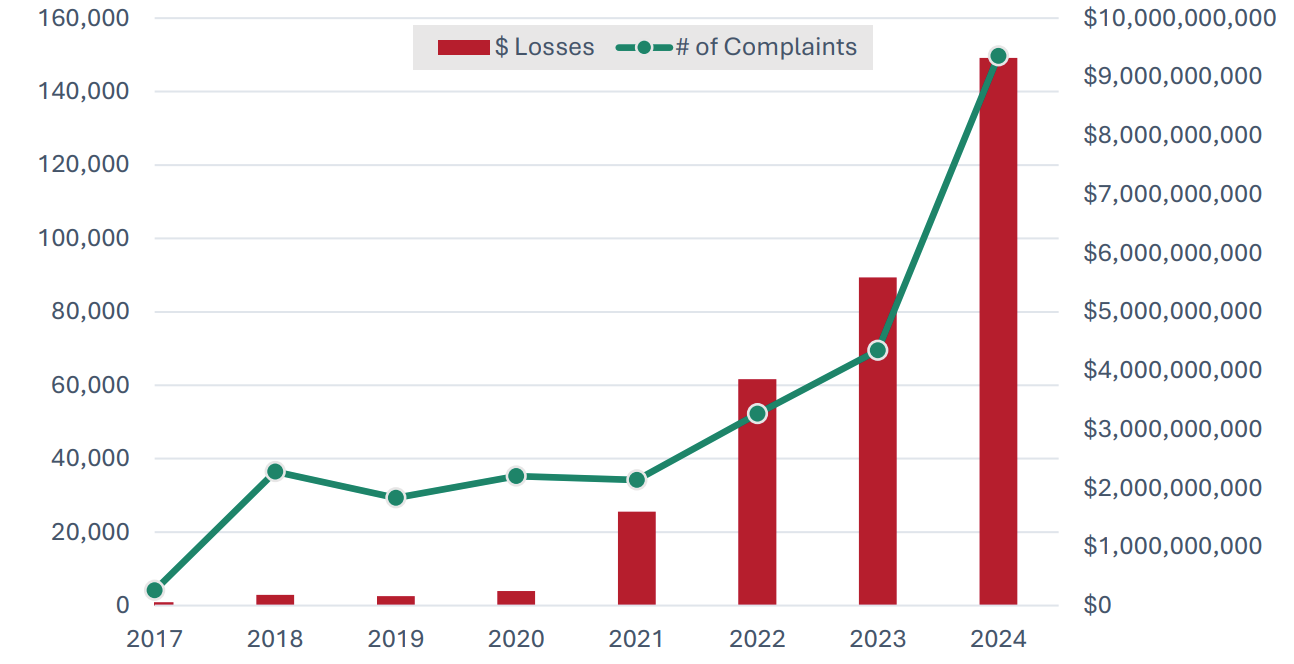

    FBI complaints related to cryptocurrencies / Source: IC3 annual report

    Ray Dalio’s Bridgewater Associates Minds

    Star investor Ray Dalio considers Bitcoin inferior to gold

    Strategy sold 32 Bitcoin in late May and rebought 1,550 a week later. What the move reveals about corporate Bitcoin treasury resilience. Background

    Strategy sells Bitcoin: What it signals for corporate treasuries

    BlackRock files its fourth S-1 amendment for the Bitcoin Premium Income ETF (BITA). A Bloomberg analyst expects a launch ahead of Goldman Sachs. Financial Products

    Launch of BlackRock’s income-generating Bitcoin ETF moves closer

    Digital finance transparency relies on Proof of Reserves, Merkle trees, MPC custody and 24/7 monitoring to verify solvency and user assets. Basics

    Transparency as the foundation of security in digital finance

    Ray Dalio’s Bridgewater Associates Minds

    Star investor Ray Dalio considers Bitcoin inferior to gold

    Strategy sold 32 Bitcoin in late May and rebought 1,550 a week later. What the move reveals about corporate Bitcoin treasury resilience. Background

    Strategy sells Bitcoin: What it signals for corporate treasuries

    FBI initiatives against crypto fraud

    In 2024, the FBI launched several programs aimed at reducing crypto-related losses. Through its “Operation Level Up” initiative, the agency prevented losses of USD 286 million and identified over 4’300 victims. Additionally, cooperation with international authorities led to more than 215 arrests linked to crypto-based call center fraud.
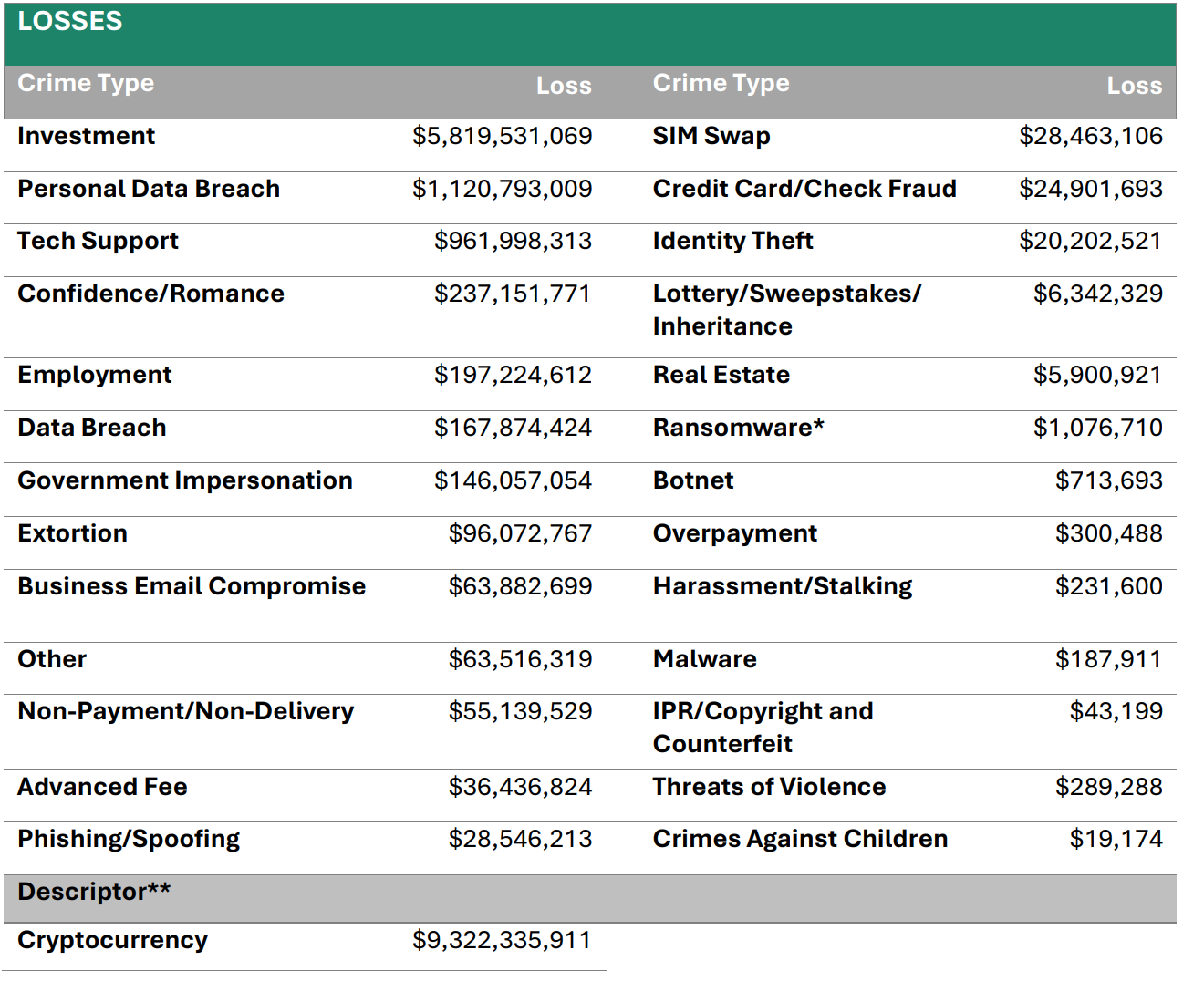
    Breakdown of losses / Source: IC3 annual report

    Ransomware also remains a core issue: nearly all known extortion cases demand payment in cryptocurrencies. Variants such as Akira, LockBit, and RansomHub are increasingly targeting critical infrastructure and SMEs. The number of reported ransomware incidents rose by 9%, with Bitcoin often being the preferred payment method.

    According to the IC3 report, cryptocurrencies lie at the heart of modern cybercrime. A growing market, unclear regulations, and technical complexity make crypto applications vulnerable to fraud. Investors-especially older ones-must be better informed and protected through education, tools, and legal standards. CVJ.CH has outlined the most common crypto scams here.


    Share. Facebook Twitter LinkedIn Email Telegram WhatsApp

    About the author

    Editorial Office CVJ.CH
    • Website
    • Twitter
    • LinkedIn

    Since 2018, the editorial team at Crypto Valley Journal has been reporting from Zug - the heart of Switzerland’s Crypto Valley - on Bitcoin, cryptocurrency, blockchain, and regulatory developments in digital assets. Behind the publication’s collective editorial voice is a team of writers with backgrounds in financial markets, law, and technology.

    Related Articles

    Strategy sold 32 Bitcoin in late May and rebought 1,550 a week later. What the move reveals about corporate Bitcoin treasury resilience.

    Strategy sells Bitcoin: What it signals for corporate treasuries

    More than 50% of the bitcoin supply now sits at a loss. K33 sees parallels to earlier bear market lows that followed within weeks.

    Crypto winter: More than 50% of bitcoin supply at a loss

    A Reuters analysis estimates the Trump family's crypto gains at $2.3 billion, while investors incurred book losses of the same amount.

    Trump family earns $2.3 billion from crypto projects

    CBDC ban in the US: the Senate and House agree on a housing bill that bars the Fed from issuing a digital dollar until the end of 2030.
    17. June 2026

    US Congress agrees on CBDC ban until 2030

    US gaming associations want to ban sports prediction markets in the crypto bill Clarity Act. The CFTC is steering against this with its proposed rule.
    17. June 2026

    Clarity Act: Gaming associations demand ban on sports prediction markets

    Greece's HCMC plans to reject Binance's MiCA licence. Without approval by 1 July 2026, the crypto exchange faces exclusion from the EU market.
    16. June 2026

    Binance ban in the EU: Greece set to deny MiCA licence

    twitter image button instagram image button linkedin image button youtube image button

    About Crypto Valley Journal
    About Crypto Valley Journal

    On the pulse of the movement

    • Academy
    • Contact
    • Advertising
    • About us
    • Partner
    • Imprint
    • Privacy
    • Disclaimer
    Search

    Type above and press Enter to search. Press Esc to cancel.