
Chainalysis (a company specializing in blockchain analysis) helps companies and law enforcement agencies uncover fraud and prevent money laundering. In its recently published Crypto Crime Report, the company recorded the illegal activities that were discovered.
Thanks to the inherent transparency of the blockchain, findings can be made that are not possible when investigating money laundering in the traditional Fiat currency world. According to the report, cryptocurrency fraudsters succeeded in scamming 4.3 billion dollars from their victims last year. Most of the illegal money flows were linked to pyramid schemes, including OneCoin and PlusToken.
Exchanges are a popular money laundering solution – with Binance and Huobi standing out
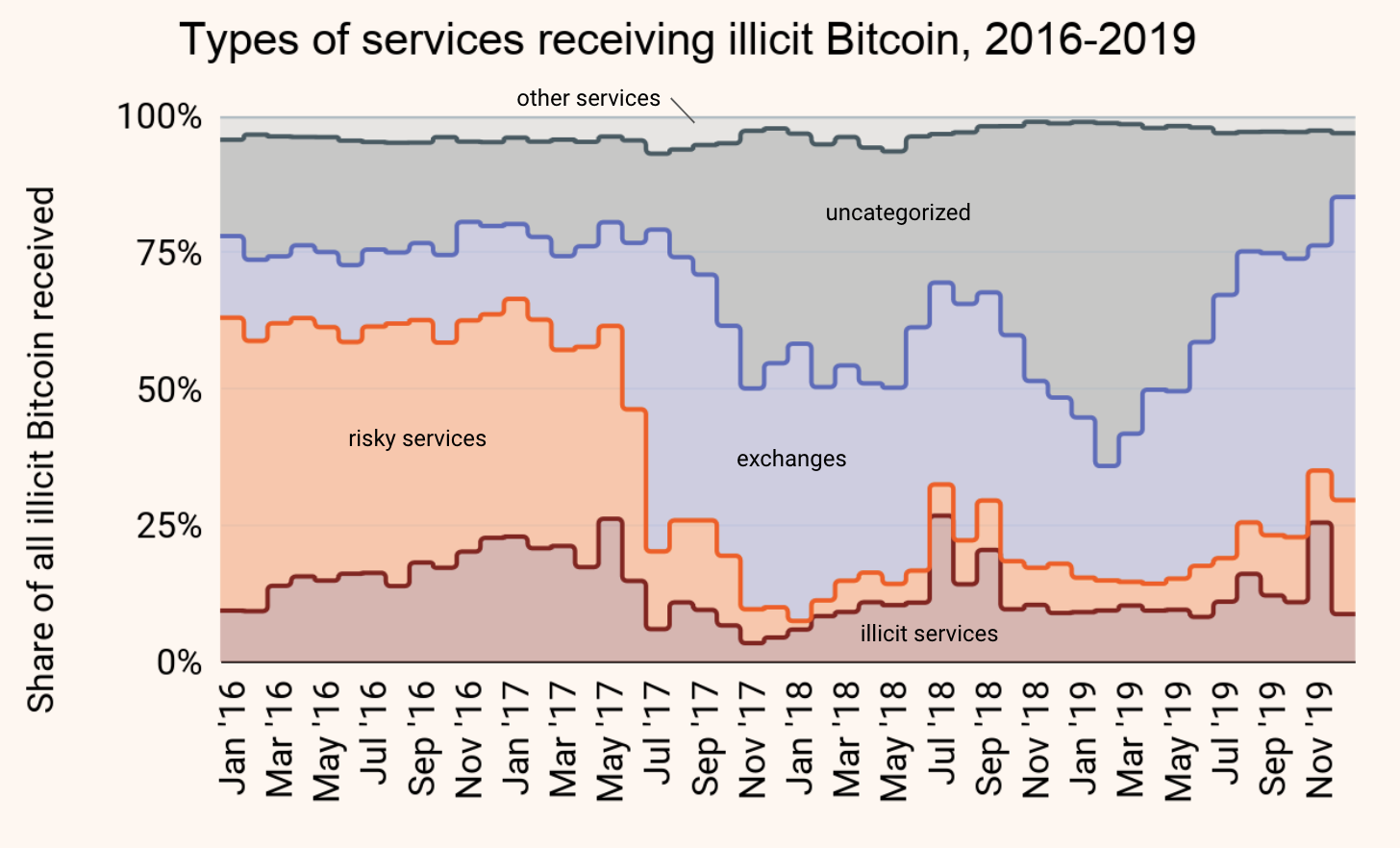
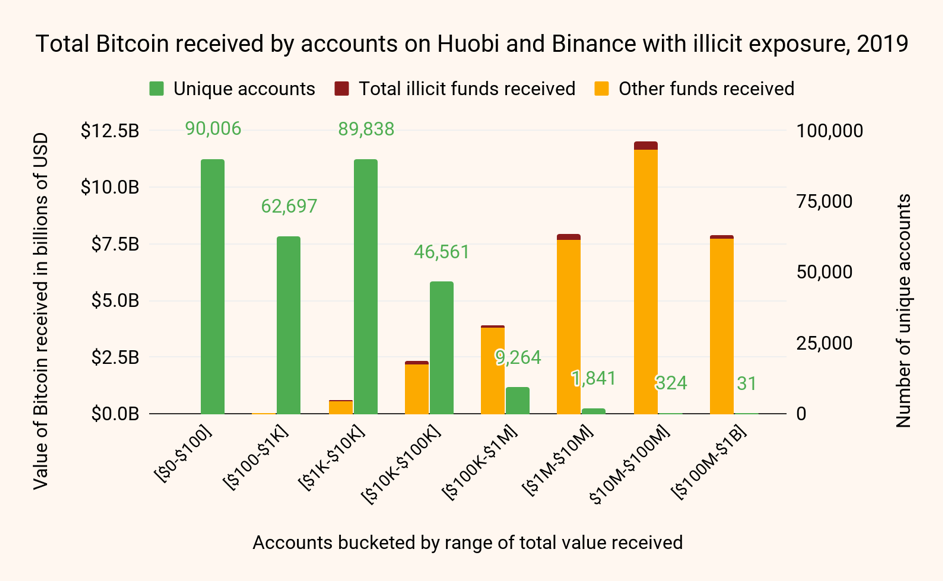
While exchanges have always been a popular way out for illegal crypto-currencies, they have taken a steadily growing share since the beginning of 2019. According to Chainalysis, some $2.8 billion of illegal crypto-currencies have been traced back to crypto exchanges by criminal entities. More than 50% of this amount has flowed through the two platforms Binance and Houbi. In 2019, a total of slightly more than 300,000 individual accounts on Binance and Huobi received Bitcoin from criminal sources.
As can be seen from the following graph, funds from illegal transactions account form only a marginal part of the total amount flowing through Binance and Houbi. However, the total value of illegal funds is a significant amount – 31 peak accounts alone accounted for a cumulative $163 million in Bitcoins.
Bypassed KYC via OTC Broker
The two platforms Binance and Huobi are sometimes the largest exchanges and are subject to KYC regulations. So how is it possible that such large sums of money are laundered via the stock exchanges? The analysis of Chainalysis suggests that a detour via OTC brokers is taking place. OTC brokers trade between individual buyers and sellers who do not want to or cannot trade on an open exchange. Traders often resort to these OTC brokers when they want to liquidate a large amount of crypto-currencies at a fixed, negotiated price. Such brokers are usually linked to an exchange, but operate independently.
From USD Tether to fiat money
However, the problem is that while most OTC brokers operate a legitimate business, some of them specialize in providing money laundering services to criminals. OTC brokers usually have much lower KYC requirements than the exchanges on which they operate. Many of them take advantage of this negligence and help criminals launder and withdraw funds, usually by first exchanging Bitcoin and other crypto-currencies for Tether as a stable intermediate currency before cashing out in fiat funds.
Chainanalysis’s Rogue 100 List
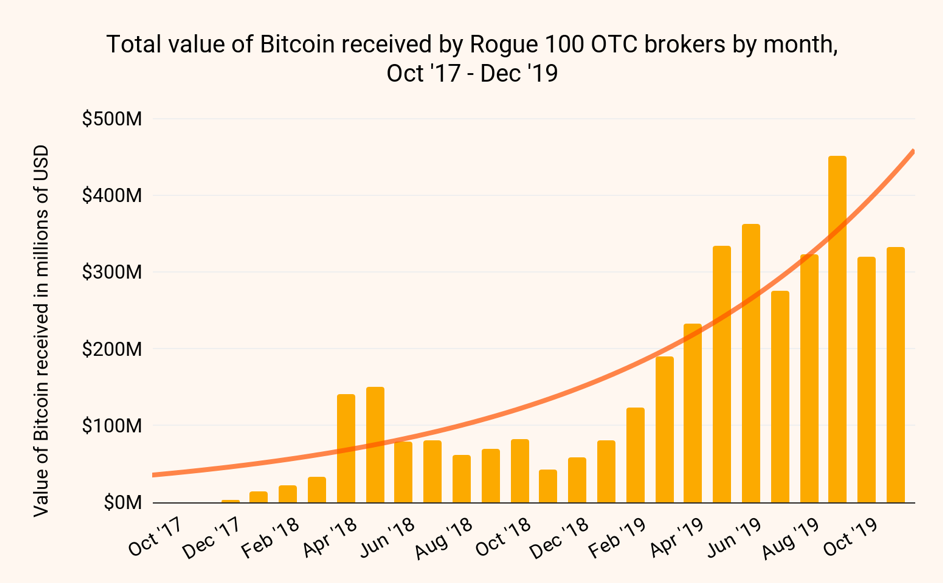
Chainanalysis has compiled a list of 100 major OTC brokers who, according to the company, offer money laundering services, based on an analysis of the transactions of various criminal groups. The Rogue 100 are extremely active traders and have a huge impact on the crypto-money ecosystem. Since the end of 2017, they have been receiving steadily increasing amounts of crypto-currency each month. Their activity has increased significantly in 2019 year. In 2019 alone, OTC brokers received more than $3 billion in Bitcoin, many of which played a significant role in the PlusToken scam. Of the Rogue 100 OTC brokers, 70 belong to the group of Huobi accounts that receive Bitcoin from illegal sources.
What can be done against money laundering in the crypto sector?
According to Chainanalysis, there are steps that law enforcement, regulators and crypto currency companies can take to combat money laundering. For this, transparency is required above all. Through the blockchain and the existing analysis tools, it is possible to get a quicker insight into the way criminals launder their money.
Exchanges should also do their part to minimize this problem through more comprehensive due diligence by OTC brokers and other services.